


Glasp’s Note: Maja Voje has been a friend of Glasp for a while. Last year she joined us on Glasp Talk to talk about where humans still win as AI changes go-to-market, and I wrote a guest post for her newsletter, GTM Strategist about how Glasp grew organically. When she and Kyle Poyar released this year’s report, we decided to collaborate again, because so many of you are founders and product people trying to get your work in front of the right people. This is not a sponsored post: no money changed hands, and the opinions below are our own.
If you want to reread or highlight this newsletter, save it to Glasp.
Every year, Kyle Poyar of Growth Unhinged and Maja Voje of GTM Strategist ask software and AI companies a simple question: what is actually working to find customers? The answer has a name in the industry, GTM (go-to-market): everything a company does to reach people and turn them into customers.
This year they surveyed 300 companies, up from 195 last year. The full report is free at stateofb2bgtm.com.
You might not sell software. Most of our readers do not. But nearly everyone is trying to get something they made in front of the right people: a product, a side project, a research paper, a portfolio, a job application. That is a go-to-market problem too, and the answers in this report travel further than you might expect.
We read all 41 pages. Here are seven findings that stood out to us as a two-person team, each with one thing you could try this week.
How the survey was done
First, who this is for: the survey is about B2B, companies that sell to other businesses. Maja asked us to say this plainly. If you run an e-commerce store or a consumer app, read it as a view into a different market, not a playbook. The 300 respondents answered in September 2026, and the report notes "a large sample of AI-native companies and those with deal sizes of $5-50k per year". [p.4] Answers are self-reported: they show what companies believe is working, not measured results. Read the percentages as signals of where attention is moving, not as proof. Two terms come up often. ARR (annual recurring revenue) is how big a subscription business is. ACV (annual contract value) is what one customer pays per year.
1. Everyone wants more pipeline
The most common answer to “what is your biggest GTM challenge?” was pipeline (a steady flow of potential customers), at 18%, ahead of scaling repeatably (10%) and positioning (9%). [p.9] It shows up in hiring too: growth marketing is the number one priority hire, for 22% of companies under $10M ARR and 16% above it. [p.10]
One respondent put the pipeline problem well: "We can generate content, outreach, product launches, and conversations efficiently, especially with AI, but the hard part is identifying the right buyer signals and channels that consistently convert into paying customers." [p.9]
Try this: write down where your last ten users, readers or clients came from. If you cannot answer, that is your pipeline problem, and it is the first thing to fix.
2. Founders are still the best salespeople
Founder-led sales is the most common primary GTM motion, at 26%. [p.11] Among companies under $1M ARR it is 44%. [p.13] Inbound and outbound only take over after the first million.
Try this: if you are early, do not hand your first conversations to a tool or a hire. Talk to the first ten people yourself. What you hear is the raw material for everything that comes later.
3. The oldest channel is still the best one
Network and introductions is the most widely used channel (62% call it core) and the one rated most likely to have a big impact. [p.16, p.19] It sits at the top right of the report’s scorecard, next to intimate events. In a year full of AI tools, the channel that wins is a warm introduction.
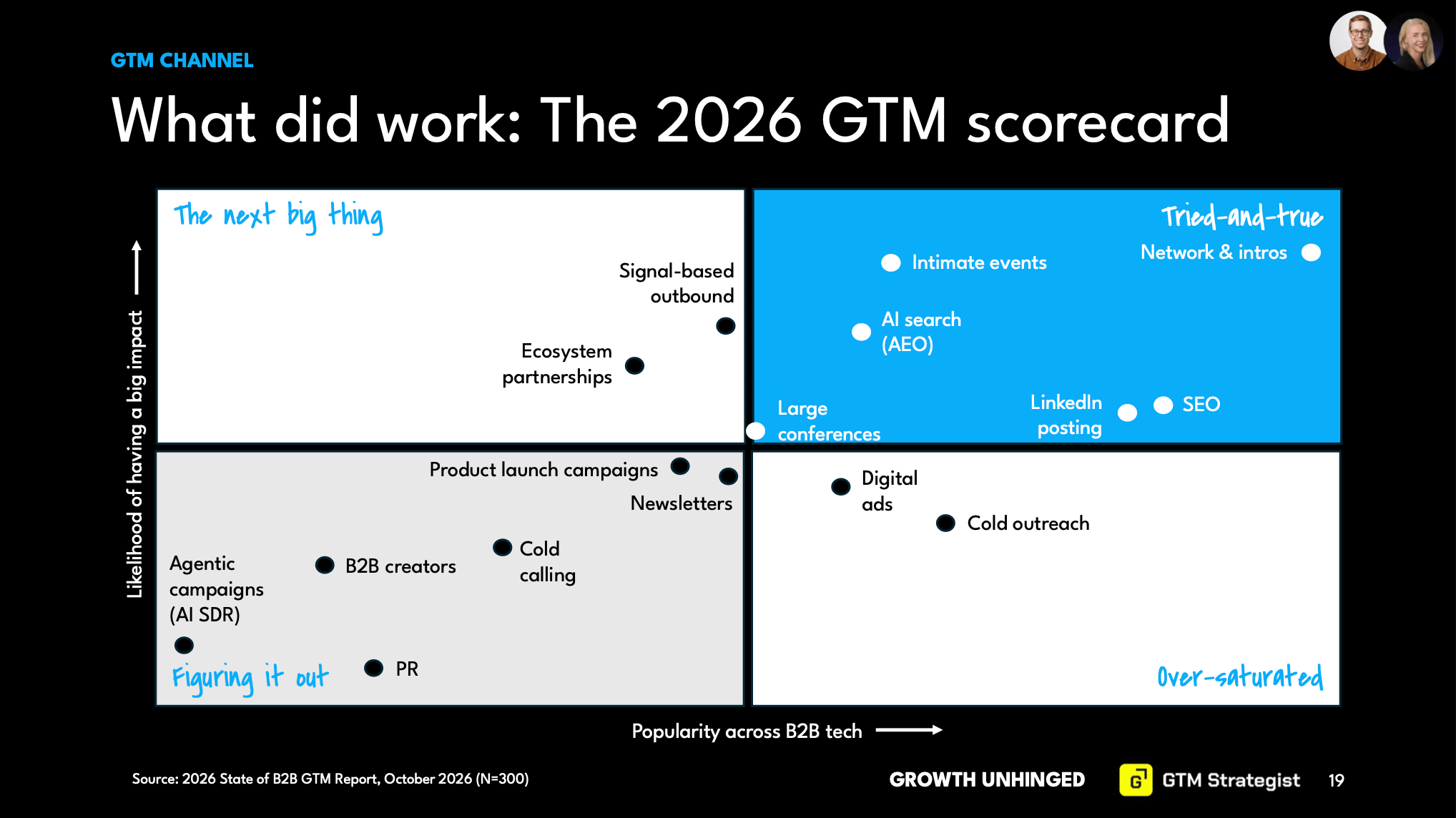
Note where agentic campaigns sit: bottom left, still "figuring it out", rated neither popular nor high-impact yet. That is exactly the finding Maja called her biggest surprise, and why she expects it to move next year. [p.19]
Try this: ask two people who already like your work for one introduction each. Be specific about who, and give them a two-line description they can forward without editing.
4. AI search is now a core channel
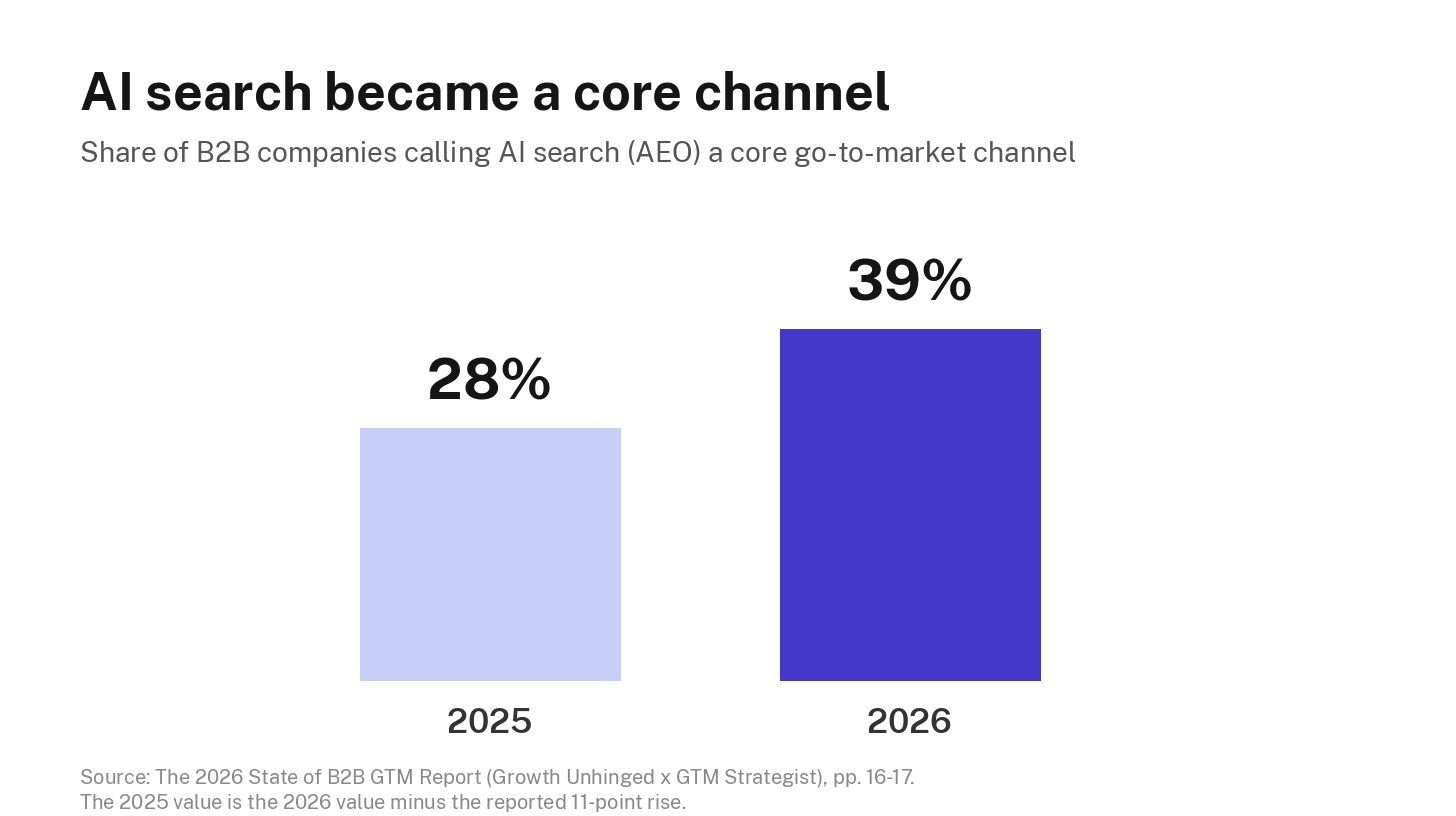
AI search, also called AEO (answer engine optimization: showing up in the answers of ChatGPT, Claude, Perplexity and Google’s AI), rose 11 points to 39% of companies calling it core, the biggest gain of any channel. [p.16, p.17] It moved into the “tried-and-true” quadrant, and it is again the number one place companies plan to increase investment next year, at 50%. [p.19, p.28] Last year it was also number one, at 51%. For companies under $5k ACV it is now tied for the second most popular channel, ahead of SEO, which was number one last year. [p.20]
Right behind AI search is signal-based outbound, at 48%: reaching out when a company shows a sign it might need you, such as a funding round or a new hire. [p.28]
Try this: ask ChatGPT and Claude the question your customer would ask, and see whether you appear and what they say about you. That answer is now part of your first impression.
Maja's take: the change she sees across the companies she works with is how they approach AI search. Some decide it is hot, put money in, and hire an agency to get it running. They do see results, but "whenever you are seeing it as a campaign, it is wrong from the start." It should be an ongoing standard operating procedure, stitched into content engineering or marketing engineering, so it becomes part of how you create, not a one-off "I need to show up in GPT". She has written about how to set that up: the living content graph and building a content system in Claude Code.
5. AI is finally paying off, and Claude leads the tools
43% of GTM teams now say AI has a big impact on their work, up from 24% a year ago. [p.33] Claude moved from fourth to first on the list of most impactful GTM tools, ahead of Clay, HubSpot and ChatGPT. [p.35]
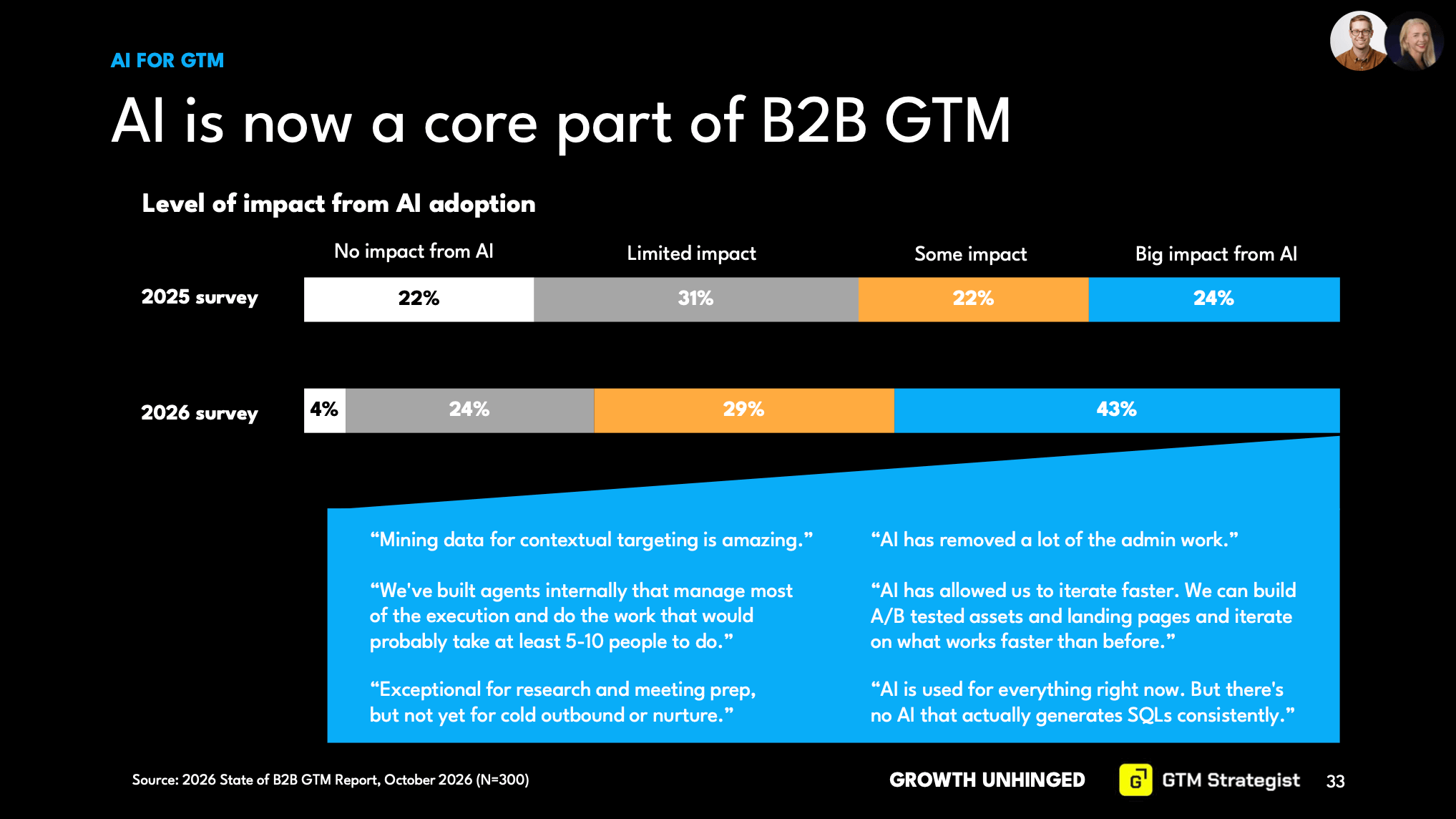
The share seeing no impact at all fell from 22% to 4%. Last year 53% saw no impact or only a limited one; this year it is 28%. [p.33]
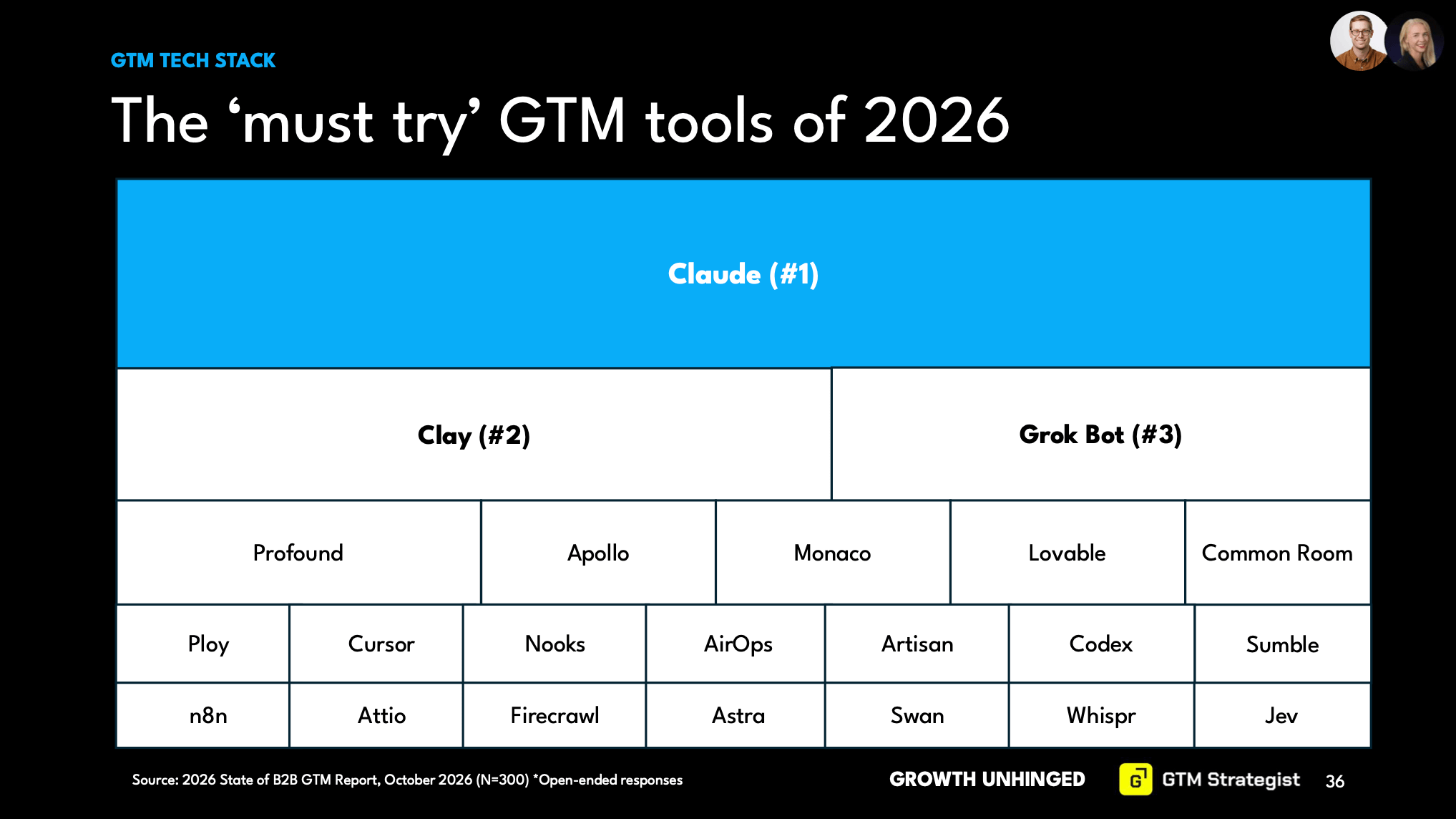
Asked which tools others should try, respondents again put Claude first. These were open-ended answers, and coding agents such as Cursor and Codex now sit on the same list as sales tools. [p.36]
Try this: pick one task you repeat every week, such as research before a call or a first draft of a follow-up, and hand only that to an AI assistant for a month. Keep the judgment for yourself.
6. Newsletters are still an experiment for most
Newsletters and editorial content are core for 34% of companies, which the report files under “still experimental”. [p.16] 18% plan to invest more in them next year, rising to 27% among companies under $1M ARR. [p.28, p.29]
Try this: if you write, publish on a fixed rhythm for eight weeks before you judge it. Experiments that stop at week two never become channels.
7. What did not work
The report’s list of failures is worth reading on its own. Spray-and-pray cold email, AI SDR sequences with “near-zero reply rate”, content generated in bulk by AI, and a $1M launch campaign with “little measurable ROI” all appear on it. [p.18]
Try this: before you automate any outreach, send ten messages by hand and count the replies. If ten personal messages do not work, a thousand automated ones will not either.
What surprised Maja
We asked Maja which finding surprised her most. Her answer: agentic campaigns. The survey assumes almost any motion can involve AI, but fully agentic plays, the dominant play for AI-native companies, were measured as a channel of their own. She expects them to become a serious go-to-market motion next year, “because if you have one or two people working in marketing, how on earth could they not use AI?” She called it an in-your-face finding.
The second was positioning. Pipeline and repeatable scale are “as old as earth”, she said, but how to stand out in the age of AI was “a very big and a very surprising one” for her. And some relief: last year she was “dead afraid” when more than half of respondents saw no tangible impact from AI yet. This year the results are much better.
If you are not selling anything
The hiring data is a career signal. When growth marketing is the most wanted hire at small companies, people who can find an audience, test a channel and explain the result are in demand, whatever their title. [p.10] The same skills help a student get a first job, a researcher get read, or an engineer get a side project noticed. And the top channel is not a skill you buy. It is the people who already trust your work.
The Glasp Take: relationships and machines
Kyle and Maja close with what they call the GTM barbell: “There are two ways to win right now: being exceptional at relationships and being exceptional at AI.” [p.39] That matches our own experience as a two-person team.
On the AI side, AI search has been our fastest-growing channel. We wrote about how we grew ChatGPT traffic 37x using our own server logs, and how we run multiple products with AI agents. It is good to see the survey agree that this is no longer a side bet.
On the relationship side, the report is a reminder that the warmest channel is still a person who vouches for you. Much of what we have learned came the same way: someone shared a link, an article or a highlight, and we followed it. That is also why Glasp exists. When you share what you read and what you learned from it, the people who follow you get the same head start.
The report’s last prediction is the one we will be thinking about most: “the next battleground will be positioning and messaging”, because “every company sounds the same”. [p.39] Tools can help you say more. They cannot tell you what is worth saying.
We also asked Maja what a two- or three-person team should do if it could invest in only one channel in 2027. "Rule number one is go where the audience is." To find out where that is: use AI for research, ask them, or do a little soul searching about where they would naturally find this kind of information. Then run a couple of experiments there, and stitch in agentic campaigns.
A question for you
Which channel is working best for you this year, and is it one the report rates highly or one it calls an experiment? Tell us in the comments.
Want to go deeper? Save Kyle’s full write-up to Glasp and highlight the parts you want to come back to. The full report is free at stateofb2bgtm.com, and Maja’s take is on GTM Strategist.
Would you like to take Glasp on the go?
With the Glasp mobile app, you can highlight and organize your favorite content anytime, anywhere. Stay productive on the move and never miss an insightful quote.
Partner With Glasp
We currently offer newsletter sponsorships. If you have a product, event, or service you’d like to share with our community of learning enthusiasts, sponsor an edition of our newsletter to reach engaged readers.
Kyle and Maja's survey says warm intros are still the most effective B2B channel, while AI search just moved into "tried-and-true." Which channel is actually working for you this year, and is it one the report rates highly or one it calls an experiment? I'd love to hear in the replies.
If a line in this issue stuck with you, highlight it here and it will be saved to your Glasp library:
https://glasp.co/save?u=https://read.glasp.co/p/what-300-b2b-companies-say-works-in-2026
I really like how this bridges “real” B2B GTM with the problems solo builders and tiny teams actually face. The distinction between treating AI search as an ongoing operating system versus a one-off campaign feels especially important, and it pairs nicely with the reminder that warm intros still outperform shiny tools. The GTM barbell of relationships and AI rings true: it is reassuring to see data backing the idea that you cannot outsource trust or positioning, even as AI reshapes everything around them.