


Hi friends,
Here are the 10 Kindle books Glasp readers imported and highlighted the most in April 2026 — along with the single passage that the most readers stopped on in each. Where the same book has also been highlighted by Glasp readers in other languages — Japanese, Spanish, Portuguese, German, French — you’ll find those linked too.
New here? Here’s how to download and import your Kindle highlights to Glasp
If you want to reread or highlight this newsletter, save it to Glasp.
📚 The Top 10
1. Four Thousand Weeks: Time Management for Mortals — Oliver Burkeman · 28 readers
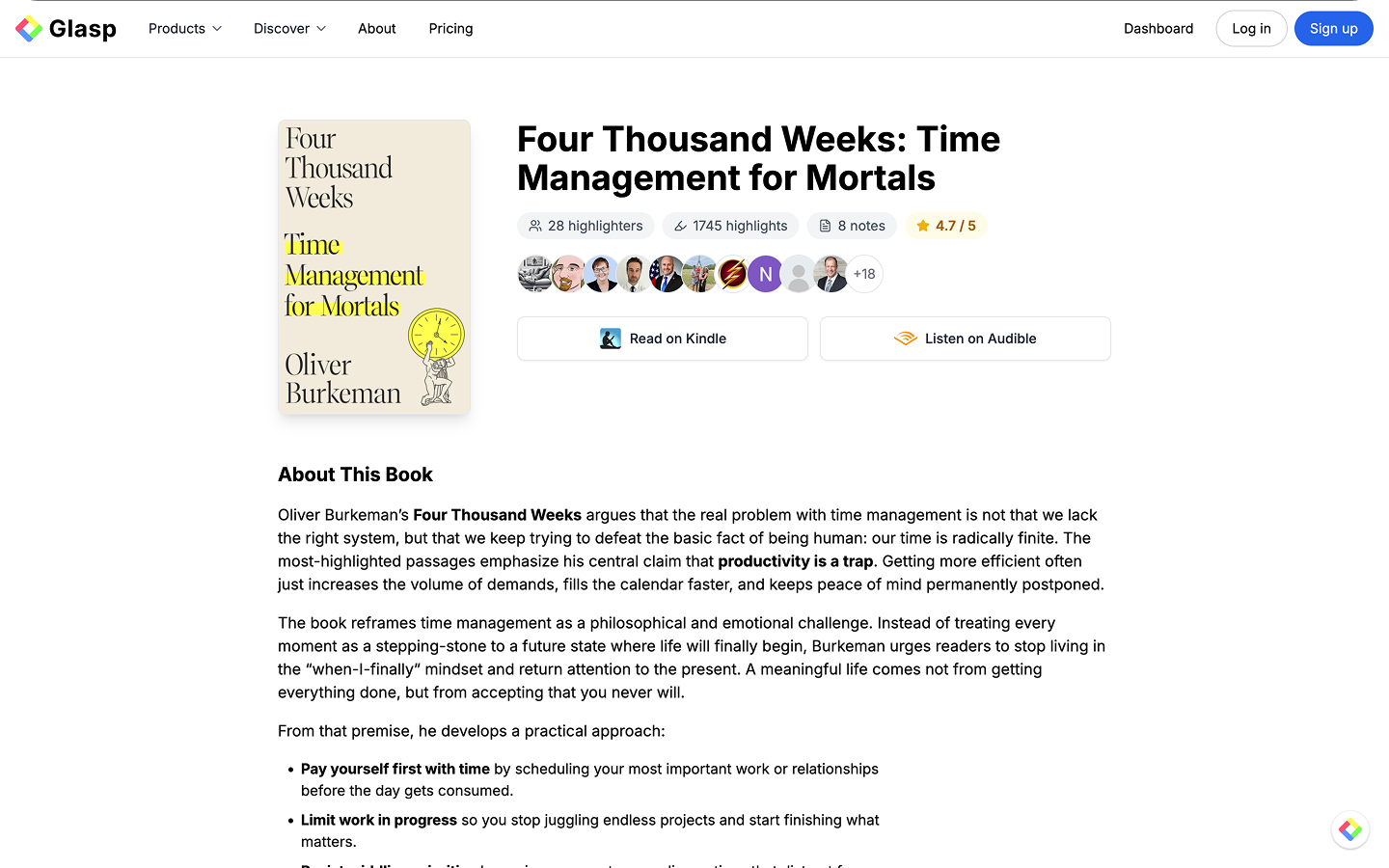
Oliver Burkeman, the former Guardian columnist behind This Column Will Change Your Life, argues that we get about 4,000 weeks alive — and that productivity culture is a doomed attempt to deny that limit. The book reframes time management as the art of choosing what to neglect.
“The fundamental problem is that this attitude toward time sets up a rigged game in which it’s impossible ever to feel as though you’re doing well enough. Instead of simply living our lives as they unfold in time—instead of just being time, you might say—it becomes difficult not to value each moment primarily according to its usefulness for some future goal, or for some future oasis of relaxation you hope to reach once your tasks are finally ‘out of the way.’”
— Top Highlight: 10 of 28 readers · 36%
🌐 Top highlights in other languages: 日本語 (38) · Español (4) · Português (1) · Deutsch (1)
👉 See the 9 other most-highlighted passages
2. The Psychology of Money — Morgan Housel · 48 readers
Morgan Housel, partner at Collaborative Fund, makes the case that doing well with money has more to do with behavior than intelligence. Across 19 short stories, he shows why patience and humility tend to outperform credentials over the long run.
“If expectations rise with results there is no logic in striving for more because you’ll feel the same after putting in extra effort.”
— Top Highlight: 23 of 48 readers · 48%
👉 See the 9 other most-highlighted passages
🌐 Top highlights in other languages: 日本語 (7) · Español (6) · Português (6) · Deutsch (3)
3. The Daily Stoic — Ryan Holiday & Stephen Hanselman · 48 readers
Ryan Holiday and Stephen Hanselman pair 366 passages from Marcus Aurelius, Seneca, and Epictetus with short modern meditations — one for each day of the year. Holiday has done more than anyone to bring Stoicism to a contemporary audience.
“Having an end in mind is no guarantee that you’ll reach it — no Stoic would tolerate that assumption — but not having an end in mind is a guarantee you won’t.”
— Top Highlight: 14 of 48 readers · 29%
🌐 Top highlights in other languages: 日本語 (6) · Português (2) · Deutsch (1)
👉 See the 9 other most-highlighted passages
4. Deep Work — Cal Newport · 35 readers
Cal Newport, computer science professor at Georgetown, argues that the ability to focus without distraction is becoming both rarer and more valuable. The book lays out a set of rules for protecting concentration in an economy designed to fragment it.
“Deep work is necessary to wring every last drop of value out of your current intellectual capacity. We now know from decades of research in both psychology and neuroscience that the state of mental strain that accompanies deep work is also necessary to improve your abilities.”
— Top Highlight: 15 of 35 readers · 43%
🌐 Top highlights in other languages: Español (1) · Português (3) · Français (1)
👉 See the 9 other most-highlighted passages
5. Unlimited Memory — Kevin Horsley · 28 readers
Kevin Horsley, one of fewer than two dozen people in the world to hold the title International Grandmaster of Memory, walks through the techniques memory champions use to learn faster and remember more — including the method he used to memorize the first 10,000 digits of Pi.
“You can have success or excuses, but you can’t have them both. People that learn quickly focus only on the information and skills that matter. Excuses don’t matter — they are ‘thought viruses.’ The only things that keep you from getting what you want are the excuses you make to yourself.”
— Top Highlight: 6 of 28 readers · 21%
👉 See the 9 other most-highlighted passages
6. Excellent Advice for Living — Kevin Kelly · 12 readers
Kevin Kelly, founding executive editor of Wired, spent his 70th birthday distilling decades of observation into 450 short proverbs for his children. The result reads like a personal Whole Earth Catalog for living well.
“Habit is far more dependable than inspiration. Make progress by making habits. Don’t focus on getting into shape. Focus on becoming the kind of person who never misses a workout.”
— Top Highlight: 8 of 12 readers · 67%
👉 See the 9 other most-highlighted passages
7. The Body Keeps the Score — Bessel van der Kolk · 14 readers
Bessel van der Kolk, a psychiatrist who has worked with trauma survivors for over 40 years, shows how trauma reshapes both brain and body — and which kinds of treatment actually help. The book has become a foundational text for understanding modern PTSD.
“The stress hormones of traumatized people, in contrast, take much longer to return to baseline and spike quickly and disproportionately in response to mildly stressful stimuli. The insidious effects of constantly elevated stress hormones include memory and attention problems, irritability, and sleep disorders.”
— Top Highlight: 4 of 14 readers · 29%
🌐 Top highlights in other languages: Español (1)
👉 See the 9 other most-highlighted passages
8. Meditations for Mortals — Oliver Burkeman · 7 readers
Oliver Burkeman returns with a four-week course in giving up the fantasy of getting everything done. Where Four Thousand Weeks made the argument, this one turns it into daily practice.
“The main point – though it took me years to realize it – is to develop the willingness to just do something, here and now, as a one-off, regardless of whether it’s part of any system or habit or routine. If you don’t prioritize the skill of just doing something, you risk falling into an exceedingly sneaky trap, which is that you end up embarking instead on the unnecessary and, worse, counterproductive project of becoming the kind of person who does that sort of thing.”
— Top Highlight: 6 of 7 readers · 86%
👉 See the 9 other most-highlighted passages
9. Thinking, Fast and Slow — Daniel Kahneman · 48 readers
Daniel Kahneman, Nobel laureate in Economics, introduces the two systems that drive human thought: fast, automatic intuition (System 1) and slow, deliberate reasoning (System 2). The book maps the cognitive biases that emerge when intuition gets ahead of itself.
“Systems 1 and 2 are both active whenever we are awake. System 1 runs automatically and System 2 is normally in a comfortable low-effort mode, in which only a fraction of its capacity is engaged. System 1 continuously generates suggestions for System 2: impressions, intuitions, intentions, and feelings. If endorsed by System 2, impressions and intuitions turn into beliefs, and impulses turn into voluntary actions.”
— Top Highlight: 13 of 48 readers · 27%
🌐 Top highlights in other languages: 日本語 (28) · Español (7) · Português (16)
👉 See the 9 other most-highlighted passages
10. Thinking in Systems — Donella H. Meadows · 26 readers
Donella Meadows, environmental scientist and lead author of The Limits to Growth, offers a primer on systems thinking — how to see the world as interconnected feedback loops rather than linear chains of cause and effect.
“The least obvious part of the system, its function or purpose, is often the most crucial determinant of the system’s behavior.”
— Top Highlight: 11 of 26 readers · 42%
🌐 Top highlights in other languages: 日本語 (13) · Português (2)
👉 See the 9 other most-highlighted passages
⭐ The Highlight of the Month
Out of every book on this list, one passage drew the strongest collective pause: 6 of 7 readers who saved Meditations for Mortals highlighted the same paragraph — an 86% consensus, the highest of the month.
Oliver Burkeman, on the trap of becoming-the-kind-of-person-who:
“The main point – though it took me years to realize it – is to develop the willingness to just do something, here and now, as a one-off, regardless of whether it’s part of any system or habit or routine. If you don’t prioritize the skill of just doing something, you risk falling into an exceedingly sneaky trap, which is that you end up embarking instead on the unnecessary and, worse, counterproductive project of becoming the kind of person who does that sort of thing.”
A fitting capstone for a month where Burkeman appeared twice on the list — readers are clearly wrestling with how to actually live inside their finite time, rather than perpetually prepare to.
📅 Want the bigger picture?
If you’d like to see what Glasp readers highlighted across the whole quarter, here’s the Top 20 from Q1 2026 (January–March):
👉 The Top 20 Books Glasp Readers Highlighted in Q1 2026
Bring your Kindle highlights to Glasp
Every reader in this list imported their Kindle highlights to Glasp. Once imported, your highlights become searchable across every book, article, and PDF you’ve saved — and part of the collective data that shapes lists like this one. If you haven’t imported yours yet, here’s how it works:
👉 How to download and import your Kindle highlights to Glasp
Closing
Click any title to read the other highlights Glasp readers left behind. Each book is a window into how the community is thinking — and a shortcut to the ideas that shaped their month.
Every highlight is a breadcrumb for the next reader. That’s how knowledge sharing works on Glasp.
Would you like to take Glasp on the go?
With the Glasp mobile app, you can highlight and organize your favorite content anytime, anywhere. Stay productive on the move and never miss an insightful quote.
Partner With Glasp
We currently offer newsletter sponsorships. If you have a product, event, or service you’d like to share with our community of learning enthusiasts, sponsor an edition of our newsletter to reach engaged readers.