


Every quarter, Glasp readers import thousands of new Kindle highlights into their libraries. Here are the 20 most-imported English-language books between January 1 and March 31, 2026 — a snapshot of what our community has been thinking about.
For each book, we also surfaced the Top Highlight — the single passage that the most readers independently highlighted. When many strangers stop at the same sentence, that sentence matters. This is the knowledge layer Glasp was built on.
New here? Here's how to download and import your Kindle highlights to Glasp
If you want to reread or highlight this newsletter, save it to Glasp.
1. The Subtle Art of Not Giving a F*ck — Mark Manson · 50 readers
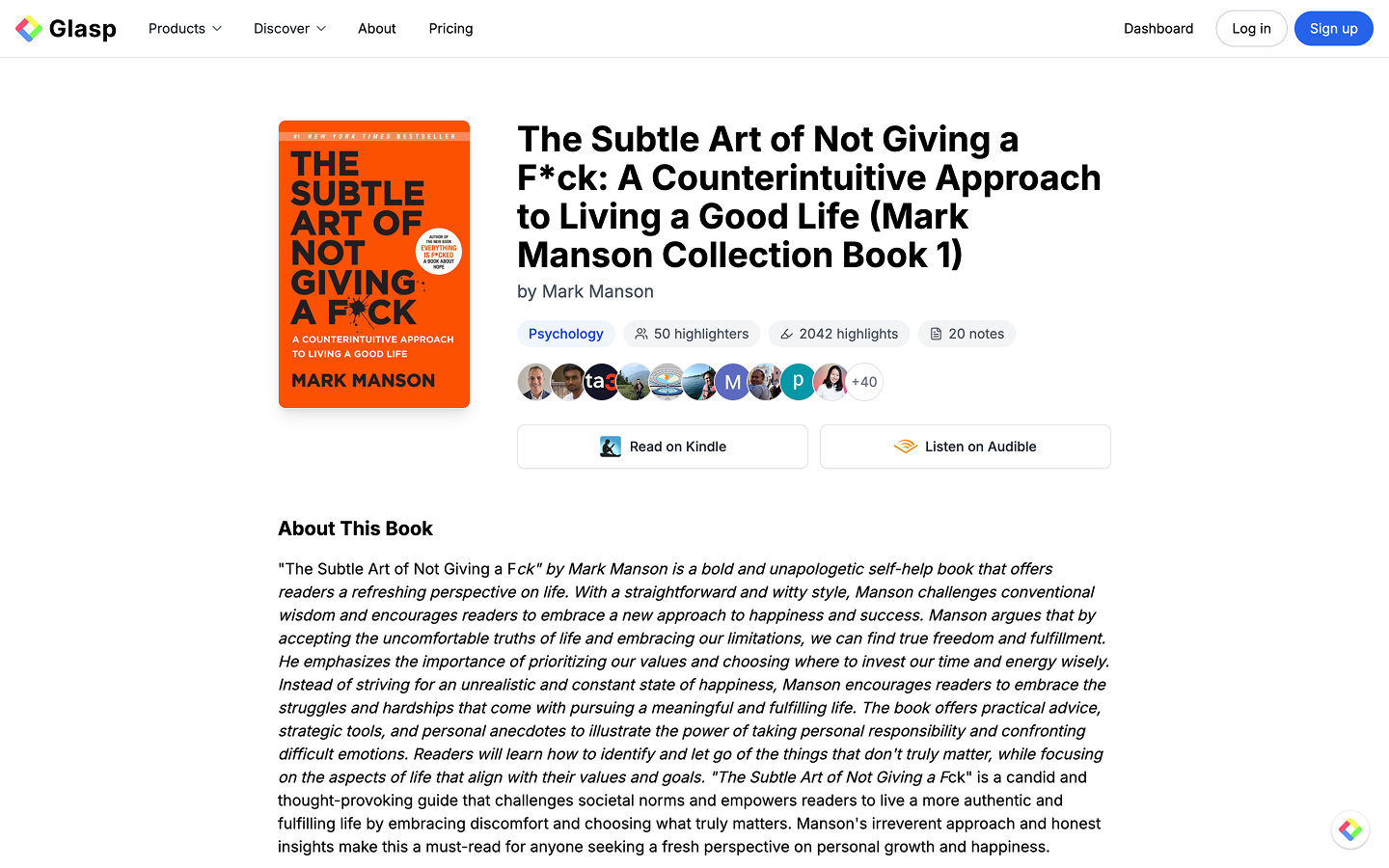
Mark Manson, a blogger-turned-author, argues that the good life isn’t about caring more but about choosing what to care about. His counterintuitive framing has made the book a go-to for readers burned out on conventional self-help. Our #1 most-imported book of Q1.
“The desire for more positive experience is itself a negative experience. And, paradoxically, the acceptance of one’s negative experience is itself a positive experience.”
— Top Highlight: 15 of 50 readers · 30%
👉 See the 9 other most-highlighted passages
2. $100M Offers — Alex Hormozi · 72 readers
Alex Hormozi, founder of Acquisition.com, breaks down how to build offers prospects feel stupid saying no to. Dense with frameworks and examples, it’s become a modern playbook for anyone selling products, services, or ideas.
“The Grand Slam Offer only becomes valuable once the prospect perceives the increase in likelihood of achievement, perceives the decrease in time delay, and perceives the decrease in effort and sacrifice.”
— Top Highlight: 16 of 72 readers · 22%
👉 See the 9 other most-highlighted passages
3. The Almanack of Naval Ravikant — Eric Jorgenson · 60 readers
Eric Jorgenson distilled a decade of Naval Ravikant’s tweets, essays, and podcast appearances into a single volume on wealth, happiness, and how to think. Short chapters, high density — tailor-made for highlighting.
“Learn to sell. Learn to build. If you can do both, you will be unstoppable.”
— Top Highlight: 28 of 60 readers · 47%
👉 See the 9 other most-highlighted passages
4. Thinking, Fast and Slow — Daniel Kahneman · 27 readers
Nobel laureate Daniel Kahneman maps two systems of thought: System 1 (fast, intuitive) and System 2 (slow, deliberate). The foundational text on cognitive biases, and still the most-cited popular psychology book of the past two decades.
“A reliable way to make people believe in falsehoods is frequent repetition, because familiarity is not easily distinguished from truth.”
— Top Highlight: 7 of 27 readers · 26%
👉 See the 9 other most-highlighted passages
5. The Daily Stoic — Ryan Holiday & Stephen Hanselman · 46 readers
Ryan Holiday, who has done more than anyone to bring Stoicism to modern audiences, pairs 366 short meditations from Marcus Aurelius, Seneca, and Epictetus with daily commentary. One page per day, built for a year-long practice.
“Having an end in mind is no guarantee that you’ll reach it — no Stoic would tolerate that assumption — but not having an end in mind is a guarantee you won’t.”
— Top Highlight: 13 of 46 readers · 28%
👉 See the 9 other most-highlighted passages
6. The War of Art — Steven Pressfield · 34 readers
Novelist Steven Pressfield (Gates of Fire, The Legend of Bagger Vance) names the invisible force that stops creative work “Resistance” — and treats fighting it as a lifelong discipline. A cult favorite among writers, founders, and anyone who makes things.
“When I began this book, Resistance almost beat me. This is the form it took. It told me (the voice in my head) that I was a writer of fiction, not nonfiction, and that I shouldn’t be exposing these concepts of Resistance literally and overtly; rather, I should incorporate them metaphorically into a novel.”
— Top Highlight: 11 of 34 readers · 32%
👉 See the 9 other most-highlighted passages
7. Atomic Habits — James Clear · 69 readers
James Clear, whose newsletter reaches millions, lays out how tiny habits compound into remarkable results. His cue-craving-response-reward framework has become the default mental model for behavior change.
“A handful of problems arise when you spend too much time thinking about your goals and not enough time designing your systems.”
— Top Highlight: 24 of 69 readers · 35%
👉 See the 9 other most-highlighted passages
8. The God Delusion — Richard Dawkins · 8 readers
Evolutionary biologist Richard Dawkins makes the case against religious belief and for a scientific worldview — a sharp challenge to faith that has drawn both admirers and critics since its 2006 release.
“Robert M. Pirsig, author of Zen and the Art of Motorcycle Maintenance: ‘When one person suffers from a delusion, it is called insanity. When many people suffer from a delusion it is called Religion.’”
— Top Highlight: 3 of 8 readers · 38%
👉 See the 9 other most-highlighted passages
9. Four Thousand Weeks — Oliver Burkeman · 18 readers
Journalist Oliver Burkeman reframes time management as an existential question: a typical life is only about 4,000 weeks long. The book is an antidote to hustle culture, arguing that the point isn’t to do more but to accept what we can’t do.
“Principle number one is to pay yourself first when it comes to time. If you take a portion of your pay cheque the day you receive it and squirrel it away... you’ll probably never feel the absence of that cash. But if, like most people, you ‘pay yourself last’ instead, you’ll usually find that there isn’t any.”
— Top Highlight: 8 of 18 readers · 44%
👉 See the 9 other most-highlighted passages
10. Unlimited Memory — Kevin Horsley · 27 readers
Kevin Horsley, a Grand Master of Memory, shares the visualization and association techniques competitive memory athletes use. Practical, not mystical — useful for anyone trying to learn faster.
“When your mind is at peace, you can enjoy the moment and your mind becomes like a laser beam. Peace and concentration are the same thing.”
— Top Highlight: 6 of 27 readers · 22%
👉 See the 9 other most-highlighted passages
11. Building a Second Brain — Tiago Forte · 50 readers
Productivity teacher Tiago Forte introduces the PARA method for organizing digital notes into a searchable external memory. Arguably the most on-brand book for Glasp readers on this list — and our Highlight of the Quarter (see below).
“The best way to organize your notes is to organize for action, according to the active projects you are working on right now. Consider new information in terms of its utility, asking, ‘How is this going to help me move forward one of my current projects?’ Surprisingly, when you focus on taking action, the vast amount of information out there gets radically streamlined and simplified.”
— Top Highlight: 30 of 50 readers · 60%
👉 See the 9 other most-highlighted passages
12. The Miracle Morning — Hal Elrod · 22 readers
Hal Elrod lays out a morning routine built around six practices — Silence, Affirmations, Visualization, Exercise, Reading, Scribing — designed to be done before 8 AM. Simple, repeatable, and still one of the most-imported productivity books.
“Always remember that who you’re becoming is far more important than what you’re doing, and yet it is what you’re doing that is determining who you’re becoming.”
— Top Highlight: 7 of 22 readers · 32%
👉 See the 9 other most-highlighted passages
13. Deep Work — Cal Newport · 32 readers
Georgetown computer scientist Cal Newport argues that the ability to focus without distraction is the defining skill of the knowledge economy — and that it’s becoming rare. A manifesto for anyone doing cognitively demanding work.
“In this new economy, three groups will have a particular advantage: those who can work well and creatively with intelligent machines, those who are the best at what they do, and those with access to capital.”
— Top Highlight: 18 of 32 readers · 56%
👉 See the 9 other most-highlighted passages
14. The Psychology of Money — Morgan Housel · 47 readers
Morgan Housel, partner at The Collaborative Fund, tells 19 short stories about how people actually think about money. His thesis: personal finance is less about math than about behavior, psychology, and long time horizons.
“But it’s one of the most important. If expectations rise with results there is no logic in striving for more because you’ll feel the…”
— Top Highlight: 23 of 47 readers · 49%
👉 See the 9 other most-highlighted passages
15. Becoming Supernatural — Dr Joe Dispenza · 9 readers
Joe Dispenza, a former chiropractor turned meditation teacher, blends neuroscience, meditation, and quantum-physics metaphor. A more spiritual pick than most on this list — but clearly finding an audience in the Glasp community.
“Every person, object, thing, place, or situation in our familiar physical reality has a neurological network assigned to it in our brain and an emotional component connected to it because we’ve experienced all these things. This is how our energy becomes bonded to our past-present reality.”
— Top Highlight: 4 of 9 readers · 44%
👉 See the 9 other most-highlighted passages
16. The Millionaire Fastlane — MJ DeMarco · 24 readers
Entrepreneur MJ DeMarco argues that the “save 10% and retire at 65” model is the slow lane — and that real wealth comes from building businesses that scale. A cult classic in the entrepreneurship corner of the internet.
“Priorities: Some want to look rich, and others want to be rich.”
— Top Highlight: 5 of 24 readers · 21%
👉 See the 9 other most-highlighted passages
17. Harry Potter and the Philosopher’s Stone — J.K. Rowling · 14 readers
The only fiction in our top 20. A reminder that Glasp readers don’t just highlight business books — sometimes they highlight the opening chapters of a story they first read as kids.
“Aunt Petunia often said that Dudley looked like a baby angel — Harry often said that Dudley looked like a pig in a wig.”
— Top Highlight: 7 of 14 readers · 50%
👉 See the 9 other most-highlighted passages
18. Sapiens — Yuval Noah Harari · 14 readers
Historian Yuval Noah Harari tells the story of humankind from the cognitive revolution to the present in 400 pages. Sweeping, provocative, and endlessly quotable.
“The human collective knows far more today than did the ancient bands. But at the individual level, ancient foragers were the most knowledgeable and skilful people in history.”
— Top Highlight: 3 of 14 readers · 21%
👉 See the 9 other most-highlighted passages
19. Mindset — Carol Dweck · 22 readers
Stanford psychologist Carol Dweck introduced the terms that now saturate educational and workplace discourse: fixed mindset vs growth mindset. The original source is still worth reading.
“Why waste time proving over and over how great you are, when you could be getting better? Why hide deficiencies instead of overcoming them? Why look for friends or partners who will just shore up your self-esteem instead of ones who will also challenge you to grow? And why seek out the tried and true, instead of experiences that will stretch you?”
— Top Highlight: 10 of 22 readers · 45%
👉 See the 9 other most-highlighted passages
20. Die With Zero — Bill Perkins · 12 readers
Hedge fund manager Bill Perkins makes a counterintuitive case: optimize your life for peak experiences, not for your net worth on your deathbed. Money is a tool for memories, not a scorecard.
“Start actively thinking about the life experiences you’d like to have, and the number of times you’d like to have them. The experiences can be large or small, free or costly, charitable or hedonistic. But think about what you really want out of this life in terms of meaningful and memorable experiences.”
— Top Highlight: 5 of 12 readers · 42%
👉 See the 9 other most-highlighted passages
The Highlight of the Quarter
Across all 20 books, this was the passage with the strongest reader consensus of Q1 2026:
“The best way to organize your notes is to organize for action, according to the active projects you are working on right now. Consider new information in terms of its utility, asking, ‘How is this going to help me move forward one of my current projects?’ Surprisingly, when you focus on taking action, the vast amount of information out there gets radically streamlined and simplified.”
— Tiago Forte, Building a Second Brain
— Top Highlight: 30 of 50 readers · 60%
This passage topped both metrics — the highest absolute number of readers marking the same sentence (30), and the highest consensus rate across the top 20 (60%). Fitting that the quarter’s most agreed-upon highlight came from the book about organizing your highlights.
Closing
Click any title to read the other highlights Glasp readers left behind. Each book is a window into how the community is thinking — and a shortcut to the ideas that shaped their quarter.
Every highlight is a breadcrumb for the next reader. That’s how knowledge sharing works on Glasp.
Bring your Kindle highlights to Glasp
Every reader in this list imported their Kindle highlights to Glasp.
Once imported, your highlights become searchable across every book, article, and PDF you’ve saved — and part of the collective data that shapes lists like this one. If you haven’t imported yours yet, here’s how it works:
👉 How to Download Highlights and Notes from Kindle
Would you like to take Glasp on the go?
With the Glasp mobile app, you can highlight and organize your favorite content anytime, anywhere. Stay productive on the move and never miss an insightful quote.
Partner With Glasp
We currently offer newsletter sponsorships. If you have a product, event, or service you’d like to share with our community of learning enthusiasts, sponsor an edition of our newsletter to reach engaged readers.