


The Glasp Newsletter goes to 550K+ subscribers. Sponsor an issue.
Want to teach what you know? Teachable lets you build and sell your own online course. (We earn a commission.)
Hi friends,
This issue is one of our essays: a question we have been thinking about lately, not a study of our own. If you are a student, a teacher, a parent, or anyone who now learns with an AI, we hope it gives you something to think with.
The short version: nobody has shown why Finland’s test scores fell. Research on teaching suggests that beginners learn more with guidance, and that hard material needs good questions, rather than answers handed over or students left alone. A chatbot that waits for you to ask is about as unguided as learning gets. In the studies we looked at, AI helped weaker students most while they were using it, but few studies test what is left once it is gone. Our guess, and it is only a guess, is that free access to AI could widen the gap between students who take on hard problems and those who do not.
One caution: most of the evidence below is correlational or comes from small experiments, and none of it is a causal study of Finland.
Imagine a tutor that never gets tired, answers any question at any hour, and waits for you to decide what to ask. Who learns the most from it?
The easy answer is everyone. We think the honest answer is harder. A good place to start is a small country in northern Europe, partly because of what its story cannot tell us.
If you want to reread or highlight this newsletter, save it to Glasp.
The fall is real
For years Finland was the country other school systems visited. In the OECD’s PISA tests of 15-year-olds, its mathematics score peaked at 548 points in 2006.
Then the scores went down, and kept going down. The Finnish release on PISA 2022, published by the University of Jyväskylä, said that “mathematical literacy has been on a downward trajectory in Finland since PISA 2006.” In PISA 2025, published on September 8, 2026, Finnish students scored 469 in mathematics, 474 in reading and 504 in science. The mathematics score is 79 points below the 2006 peak.
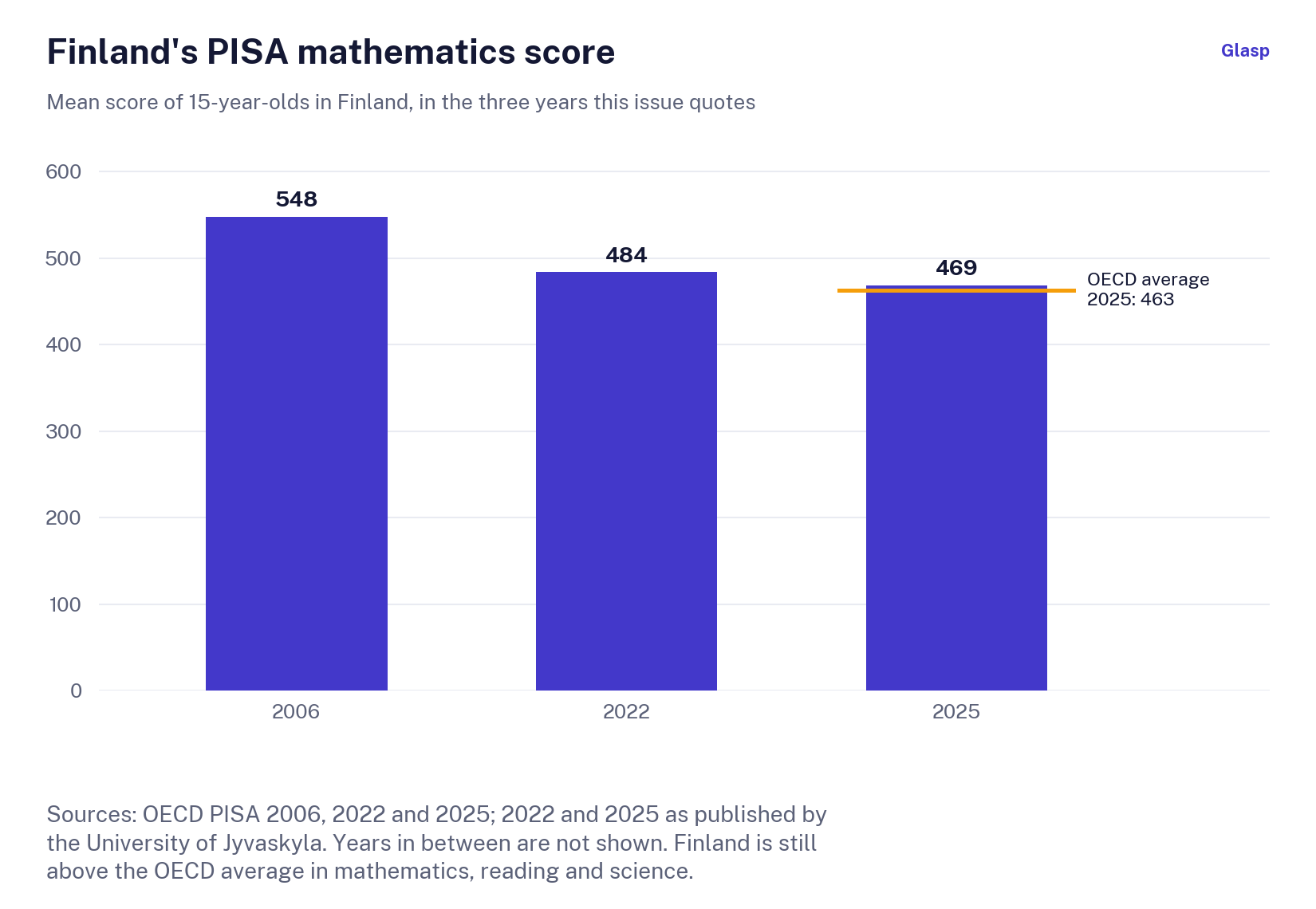
Two things keep this in proportion. Finland is still above the OECD average in all three subjects (463, 461 and 482). And scores are falling in most countries: Finland’s 16-point drop in reading since 2022 matched the average decline across the OECD. In mathematics it fell further than the average. The OECD average fell by 8 points; Finland went from 484 to 469, which is 15 by our subtraction.
One more line from the 2025 release is worth keeping in view. Differences between Finnish schools “remained small compared with the OECD average,” but “performance differences between students within schools increased and were considerably greater than the OECD average.” The release gives no cause.
So the fall is a fact. Why it happened is not.
Nobody has proven the cause
One explanation gets the most attention. In Real Finnish Lessons, a monograph published by the think tank Centre for Policy Studies in April 2015, Gabriel Heller Sahlgren argued that Finland rose while its classrooms were still traditional and teacher-led, and that the decline came as “the traditional and teacher-centred educational culture is being replaced by more pupil-led ways of working.”
He does not hedge on the direction. The move toward less structured methods, he writes, “is likely to have had a causal effect, in and of itself, on the recent Finnish decline.” But he is candid about the limits of his own case. On how much teaching really changed: “it is impossible to conclusively show by how much teacher methods have changed.” And on the whole question: “it is unfortunately impossible to conclusively determine the factors behind changes in Finland’s educational performance.”
Others who know Finnish schools well explain the decline differently. Pasi Sahlberg, the Finnish educator who wrote Finnish Lessons, gave three reasons in a 2016 interview with the Washington Post. The first is a steep fall in boys’ results, which he ties partly to “the diminished role of reading for pleasure among boys,” a trend he says smartphones have probably sped up. The second is screen time that “is often eating the time spent with books.” The third is years of austerity that forced municipalities to “cut spending, merge schools, increase class sizes.”
We are not going to pick a winner. No study we could find isolates the cause, and anyone who tells you the Finnish story has one clean moral is selling something.
One idea with better support: guidance is for beginners
There is a narrower claim with stronger evidence behind it. It is not about Finland. It comes from research on instruction, and its best-known statement is a 2006 paper by Paul Kirschner, John Sweller and Richard Clark with a title that leaves little doubt about their view: “Why Minimal Guidance During Instruction Does Not Work.”
In a 2012 summary of that paper, the three authors describe an earlier review by Clark of about 70 studies: “more-skilled learners tend to learn more with less-guided instruction, but less-skilled learners tend to learn more with more-guided instruction.” Their warning is blunt: “minimally guided instruction can increase the achievement gap.”
They also explain why, citing what Slava Kalyuga and colleagues described in 2003 as the expertise reversal effect: techniques that are “highly effective with inexperienced learners can lose their effectiveness and even have negative consequences when used with more experienced learners.” Guidance is for beginners. Freedom is for people who already know the ground.
This is the part of the argument that says who. The same teaching can suit one learner and fail another, and the difference is what each already knows.
It may also depend on how hard the material is. In a small randomized experiment with 47 sixth graders learning geometry, Ouhao Chen, Slava Kalyuga and John Sweller found that on easy material, pupils did better when they worked out the answers themselves; on harder problems, the advantage went to studying worked examples. Their conclusion is that how much guidance to give depends on the task. It is one small study, and the authors note that the two sets of tasks differed in other ways too.
Is there anything like it in Finnish data? Some, and it needs care. Aino Saarinen and colleagues at the University of Helsinki analyzed the PISA 2012 results of more than 5,000 Finnish pupils. “Frequent student-oriented teaching practices were associated with students’ weaker learning outcomes in mathematics,” they wrote, and inquiry-based teaching with weaker results in science. The pupils who did worst under these methods were those with more of six risk factors the study counted: being a boy, an immigrant background, a single-parent home, low family wealth, a mother with little schooling, and having skipped class or come late at least once. The more of these a pupil had, the larger the gap. The authors are clear that this is a snapshot: no causal conclusion can be drawn. And the data are older than the 2016 curriculum.
The OECD found the same direction across countries for science. In its PISA 2015 report, it wrote that “in no education system do students who reported that they are frequently exposed to enquiry-based instruction” (experiments and hands-on activities) “score higher in science.” The same teaching was linked to students being more likely to expect a science career, so it may not be all loss.
Mathematics is less simple, and it adds something useful. In an analysis of PISA 2012, the OECD found that teacher-directed lessons helped mainly on the easiest problems and advised teachers to “reserve your teacher-directed lessons for simpler mathematical concepts.” What helped most on hard problems was something else: teachers asking questions that make students think, give reasons and try more than one approach. For those practices, “the odds of student success are even greater for more challenging problems.” Hard material seems to need neither answers handed over nor students left alone, but good questions.
Now the limits. PISA results are correlations. They cannot show that a teaching method caused a score, and they describe groups, not any one student. The instruction studies are mostly controlled experiments on specific tasks, and their authors hold one side of an argument that, by their own account, has run for more than half a century. None of this is a causal study of Finland.
And guided does not mean lecturing. In The Learning Gap (1992), Harold Stevenson and James Stigler described teacher-led classrooms in Japan, Taiwan and China where, in the words of a column on the book from that year, lessons were “more like lessons than lectures”: a whole class working through a single problem, with students explaining their reasoning. A teacher can lead and still make students think.
About as student-led as a tool gets
Here we leave the sources above. What follows is mostly our reasoning, not a finding.
A general-purpose AI chatbot, used as a tutor, is about as student-led as a learning tool gets. Unless it has been built to, it brings no syllabus. It does not notice that you skipped the hard chapter. It answers the question you asked, which is not always the question you needed to ask. Asking a good question takes knowledge you may not have yet.
Now picture two students with the same chatbot. One is curious and takes on the hard problem, using the AI to check her reasoning. The other is not very interested, and uses it to get the answer and move on. While the AI is open, both turn in good work. The difference shows when it is closed. The first student has learned something. The second has borrowed it. If that is how it goes, free access to AI could widen the gap between students rather than close it, and the gap would follow interest and willingness to struggle as much as prior knowledge.
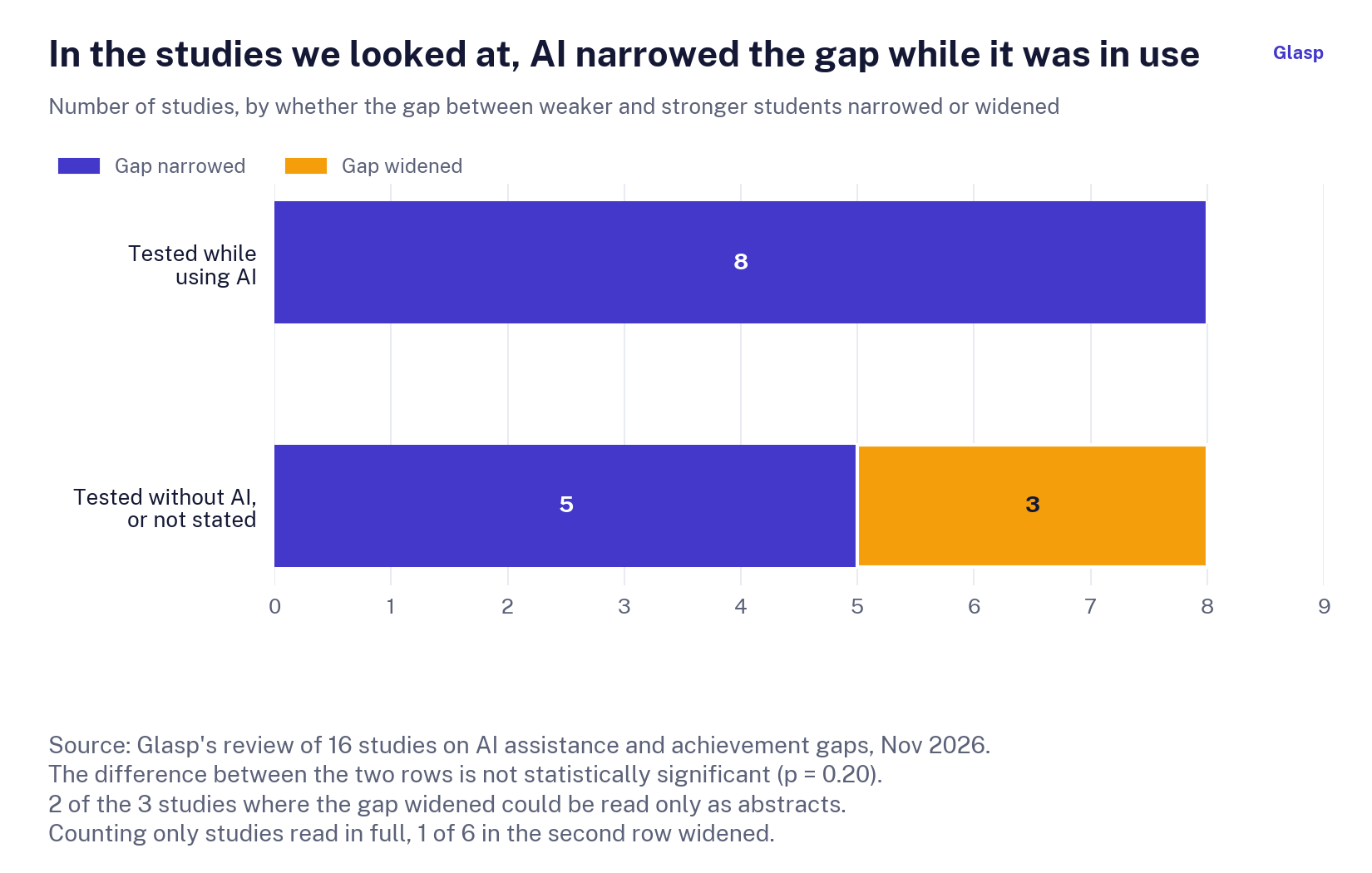
The early research is thin, and it does not all point one way. In most of the recent studies we looked at, AI helped weaker students most while they were using it, so the gap narrows on the work they hand in. Fewer studies take the AI away and test what remains. In a small 2026 experiment on learning a new programming library, posted as a preprint, people who learned with AI scored lower on a quiz afterwards than those who learned without it. None of this settles the question.
Some AI tutors are built differently. They follow a curriculum, ask questions back and set exercises. That design choice is the point. It is close to what the OECD found works on hard math problems: not handing over answers, and not leaving students alone, but asking questions that make them think. An open-ended tool will serve best the people who already direct themselves: who know what they do not know, who check an answer instead of accepting it, who come back tomorrow. Everyone else needs the tool, or someone beside it, to supply the structure and the questions.
That is not an argument against AI tutors. It is an argument about what has to come with them.
The Glasp Take: Self-Direction Is Built From Small Habits
It is tempting to treat self-direction as a trait: some students have it and some do not. We think it is closer to a set of small habits that can be practiced.
The first is noticing. When you highlight a sentence, you make a tiny decision: this matters, and I can say why. The second is keeping. A line you saved can be found again, questioned again, and set next to something you read a year later. Do that often enough and you start to know what you know and what you are missing. That is what a good question is made of.
The third habit is company. A classroom gives structure partly because other people are there: you see what they noticed and where they got stuck. Highlights on Glasp are public by default, so you can read next to other readers. It is a light version of what a good teacher’s room provides, and it is close to what we mean when we say you should learn in public.
We want to be modest here. A highlighter does not replace a teacher, and nothing above shows that it closes any gap. Our claim is smaller: before you ask an AI to teach you, it helps to have a record of your own attention to bring to it.
A question for you
Think of the last thing you learned mostly by yourself. What gave you the structure: a teacher, a book, a friend, a habit? And if you now learn with an AI, what do you do to supply the structure it does not? Tell us in the comments.
Read more from Glasp
We hope you enjoyed reading this newsletter!
See you next week ;)
Best,
Kei and Kazuki
--
Would you like to take Glasp on the go?
With the Glasp mobile app, you can highlight and organize your favorite content anytime, anywhere. Stay productive on the move and never miss an insightful quote.
Partner With Glasp
We currently offer newsletter sponsorships. If you have a product, event, or service you’d like to share with our community of learning enthusiasts, sponsor an edition of our newsletter to reach engaged readers.
Thanks for reading. A question we couldn't settle in the essay: when you learn with an AI, what do you do so that you are still the one doing the thinking? We'd love to hear what works for you.
More essays from Glasp:
https://read.glasp.co/t/essays?utm_source=substack
This raises an important point about AI in education: access to information does not automatically translate into learning. I particularly agree that students who already have curiosity and self-direction may benefit most from open-ended AI tutors, while beginners need more structure, guidance, and thoughtful questions. The real value of an AI tutor should not be measured by how quickly it provides answers, but by how effectively it helps students develop independent thinking. Perhaps the next challenge is designing AI that knows when to answer, when to ask, and when to let learners struggle productively. AI should make us better learners, not just faster answer seekers.