


“Nothing is so fatiguing as the eternal hanging on of an uncompleted task.”
— William James
* Today’s newsletter is brought to you by Clarify.
Founders don't need another tool to manage... they need fewer. Clarify replaces your CRM, enrichment, outbound, and call intelligence stack with one AI-native system that runs itself. One team cut $1000s / yr doing exactly that. This is what "AI-native" really means.
You have been told your brain holds on to what you did not finish. It is why so many products leave things visibly incomplete: the progress bar at 80%, the streak you cannot break, the draft marked unsent. The idea comes from one experiment in 1927, and it has been repeated so often that almost nobody went back to check it.
Someone finally did.
📄 Glasp Deep Dive
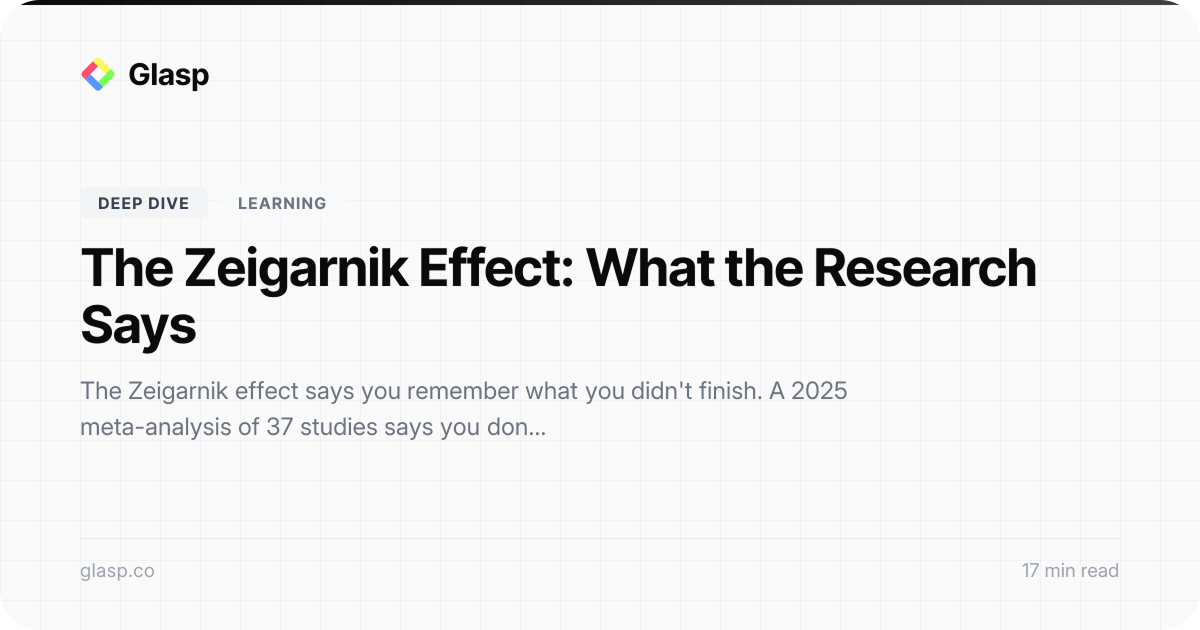
The Zeigarnik Effect: What the Research Says · 17 min read
Why we went looking. We make a tool for saving what you read, so we had a stake in this one. The case for highlighting has always leaned on memory: capture it, and you will remember it. We went through the literature expecting to find support for that. The memory argument did not survive. What replaced it is a better reason to save things, and it is not the one we had been giving.
Here is the short version.
The finding. A 2025 meta-analysis pooled 37 studies and put the weighted ratio of interrupted to completed tasks recalled at 0.99. There is no memory advantage. Zeigarnik’s 1927 original, with 32 adults, reported 1.9. Everything since has scattered between 0.70 and 2.0, and weighting by sample size cancels it out.
What survived instead. Maria Ovsiankina, working in the same lab a year later, measured something different: not what people recalled, but whether they went back. Across 20 studies the pooled resumption rate is 66.79%, against a 50% baseline. The obscure sibling replicates. The famous one does not.
So the pull back toward unfinished work is real. The memory benefit people built products around was never there.
The part that should worry you. Open loops do not help you remember, and they do cost you. Masicampo and Baumeister (2011) found that an unfulfilled goal produced intrusive thoughts during unrelated reading, inflated accessibility of goal-related words, and worse performance on an unrelated anagram task. What degrades is executive function itself: impulse control, logical reasoning, fluid intelligence, all of it leaning on working memory.
No upside, real downside. The worst arrangement available.
The fix is almost insultingly cheap. In the same work, writing a specific plan eliminated the interference. Not finishing the task. Writing down when, where and how you would return to it. The size of the effect tracked how earnest the plan was.
Leroy and Glomb found the same thing in the workplace version. Interrupted work leaves attention residue on whatever you turn to next. Across four studies, people who spent a few seconds noting where they were and what they would do on return carried less residue, and the interrupting task did not suffer.
What this changed for us. We had been telling you to highlight so you would remember. That is not what the research supports. Highlight so you can put the loop down: the sentence you came for, the next step you would take, written where you will find it. You are not saving it to remember it. You are saving it to stop paying for it.
Read the full deep dive, including why the 1927 result probably worked at the time and stopped working since.
What is the one open loop you have been carrying all week without ever writing down where you left it?
📣 Community Updates
🟩 Glasp on mobile passed 100,000 installs:
Across iOS and Android, more than 100,000 of you have now installed the app. Thank you for that. If you have been meaning to try it, this issue is a decent excuse. The phone is where you are most likely to leave a loop open, and the app is where you can put it down.
👉 App Store · Google Play🟦 Kindle Highlights Milestone:
Glasp users have now imported over 83,000 Kindle highlights. Japanese, Spanish, German, French and Portuguese clipping formats work too. Bring your own library in here.
👉 Download Highlights and Notes from Kindle🟥 YouTube Channel Tracking:
Over 4,100 YouTube channels are now being tracked on Glasp, so you never miss a new video worth highlighting. Start tracking here.
❤️ Gratitude
Thank you for sharing and mentioning us on X, LinkedIn, and/or your blogs. 🙂 We appreciate your support! Please don’t hesitate to ask us anything at any time. Also, feel free to join our Reddit Community ;)
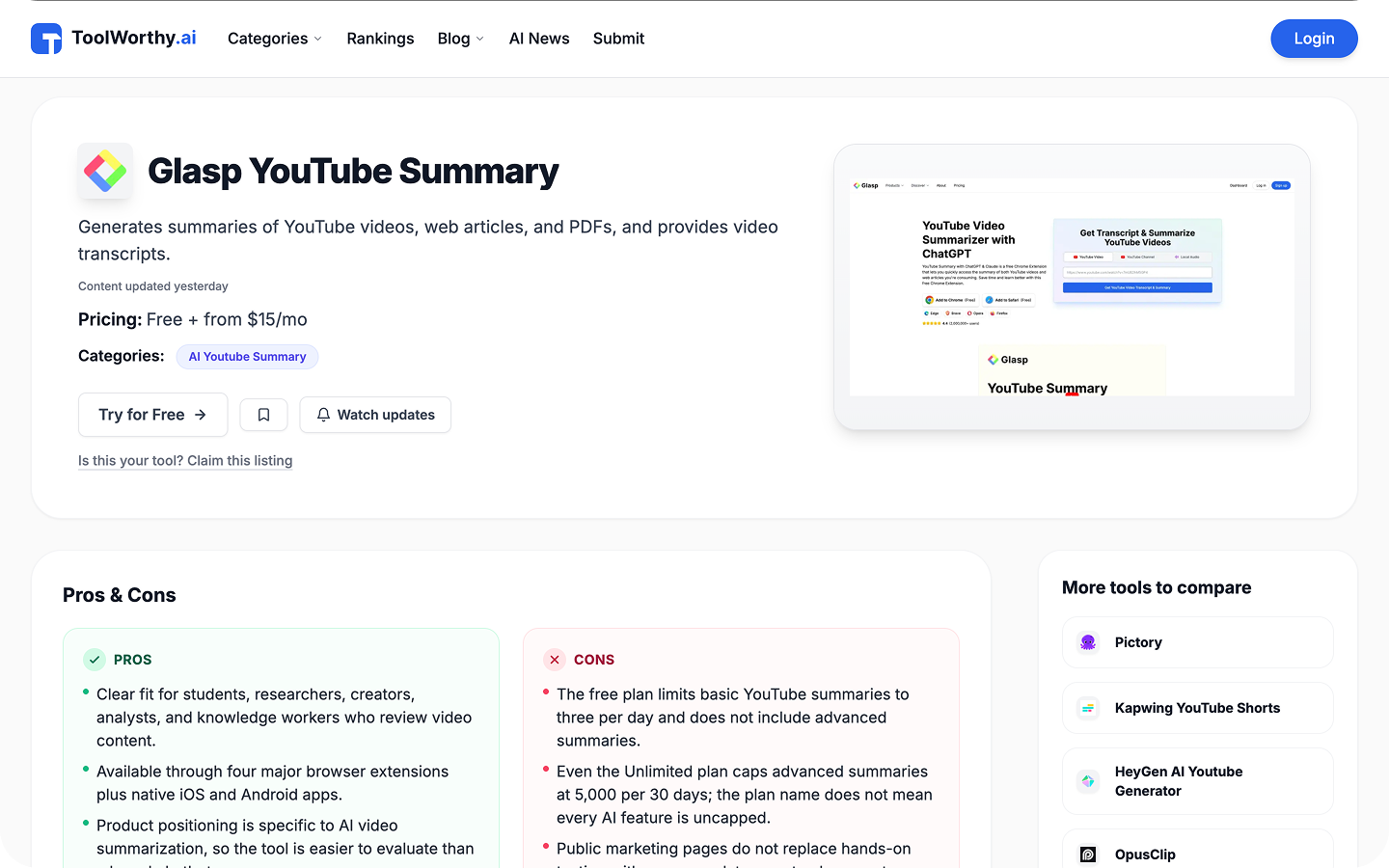
Toolworthy listed Glasp’s YouTube Summary.
PeerPush featured YouTube Summary with ChatGPT and Claude.
Pasquale Pillitteri included us in a roundup of free AI tools beyond ChatGPT.
Paragraph walked through copying the text of a YouTube video without installing anything.
Techreviewer wrote us up as a tool for researchers, students, writers, and lifelong learners.
Aposto described Glasp for readers in Turkey as the extension that collects what you highlight without switching tabs.
INSIDEA recommended Glasp for tracking how AI-assisted readers curate and share knowledge.
Visalytica covered the Glasp MCP connector for searching your highlights from inside an AI assistant.
Acadomi put Glasp in the curriculum of their AI productivity course, in the module on pulling key insights out of articles and documents.
eBool ranked Glasp first among 25 content curation tools.
We hope you enjoyed reading this newsletter!
See you next week ;)
Best,
Kei and Kazuki
--
Would you like to take Glasp on the go?
With the Glasp mobile app, you can highlight and organize your favorite content anytime, anywhere. Stay productive on the move and never miss an insightful quote.
Partner With Glasp
We currently offer newsletter sponsorships. If you have a product, event, or service you’d like to share with our community of learning enthusiasts, sponsor an edition of our newsletter to reach engaged readers.
The article you keep meaning to read, open, and close again is not quietly settling into memory. Leaving it open buys you nothing, and it takes something from whatever you do next.
Mine right now: https://cursor.com/blog/agent-swarm-model-economics. I have opened it four times this week and closed it four times, without once writing down what I was looking for.
Trying the fix from the piece today: one sentence before I close the tab.
What is yours?
This is a fascinating reversal of a productivity idea we’ve taken for granted for decades. The most useful insight isn’t simply that unfinished tasks fail to improve memory, but that our brains keep paying a cognitive tax on them. I especially like how small the solution is: you don’t have to finish everything—you just need to clearly record where you stopped and what comes next. Externalizing that next step may be less about remembering and more about giving your attention permission to move on.