


“I wish to avail myself of all that is already known and then if possible add my mite to help on the future worker who will attain final success.”
— Wilbur Wright
* Today’s newsletter is brought to you by Fiber.

Get paid to make AI training data with a friend (US only)
Fiber is oto's app for recorded video chats that become AI training data.
Talk for 10 minutes with someone you know, each in your own room, or get matched with another participant.
$20 to $30 per eligible recorded hour, per participant. Rate confirmed before you record. Hours not guaranteed.
Face and voice recorded for AI datasets, including commercial use.
US residents 18+, except Washington, Illinois, Texas, Colorado and Connecticut.
In July 1969, when Neil Armstrong stepped onto the Moon, he carried a small piece of history in his personal kit: a scrap of muslin from the wing of a flying machine built in a bicycle shop in Dayton, Ohio, sixty-six years earlier.
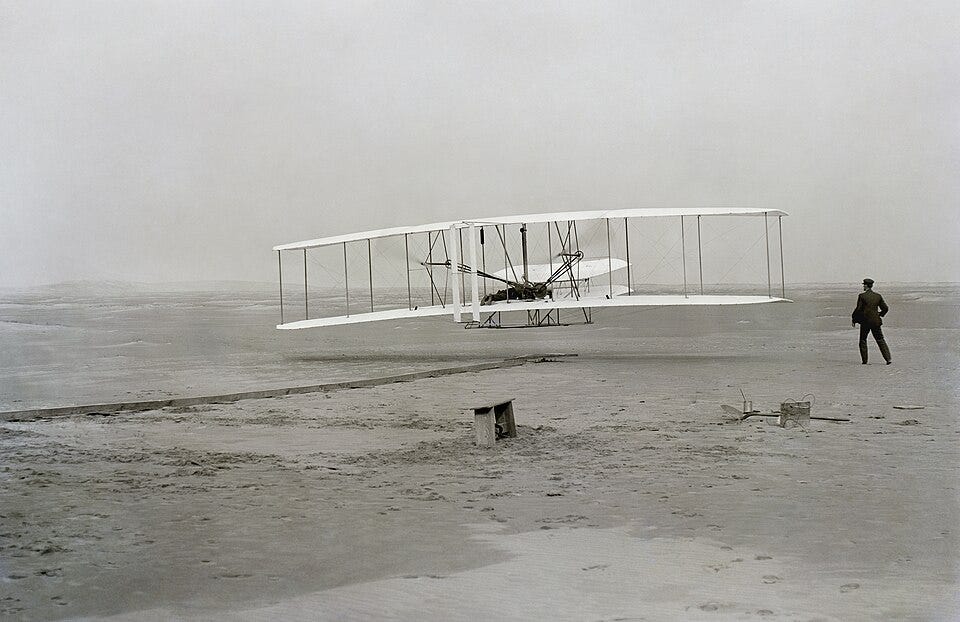
The machine had flown for twelve seconds. It covered 120 feet, less than half a football field. And it changed what humans believed was possible.
We usually tell the Wright brothers’ story as a story about genius, or courage, or two stubborn men who refused to quit. All of that is true. But reading David McCullough’s biography again, something else stood out to us. This is also a story about notes: who wrote them down, who shared them, who hid them, and who was willing to cross them out and start again.
Enjoyed this issue? Subscribe for free to get the next one in your inbox, or become a paid subscriber to support our work.
They started with other people’s notes
Wilbur and Orville Wright had no college degrees, no laboratory and no government grant. What they had was a bicycle business, a habit of reading, and a letter.
In 1899, Wilbur wrote to the Smithsonian Institution and asked for whatever it had published on human flight. The brothers read everything they could find, including the work of Otto Lilienthal, the German engineer who had made thousands of glides from a hill near Berlin before he died in a crash in 1896, and the designs of the American engineer Octave Chanute.
Lilienthal mattered for more than his data. He had shown, in public and on camera, that a person could leave the ground on wings and come back. Before him, flight was a fantasy. After him, it was a problem. Problems can be worked on.
Then they found the notes were wrong
In the summer of 1901, the brothers took a new glider to the dunes at Kitty Hawk. It flew worse than their first one. It dove, stalled and fought the controls. Wilbur wrote in his diary that they “found the machine less manageable than expected.” Something was wrong.
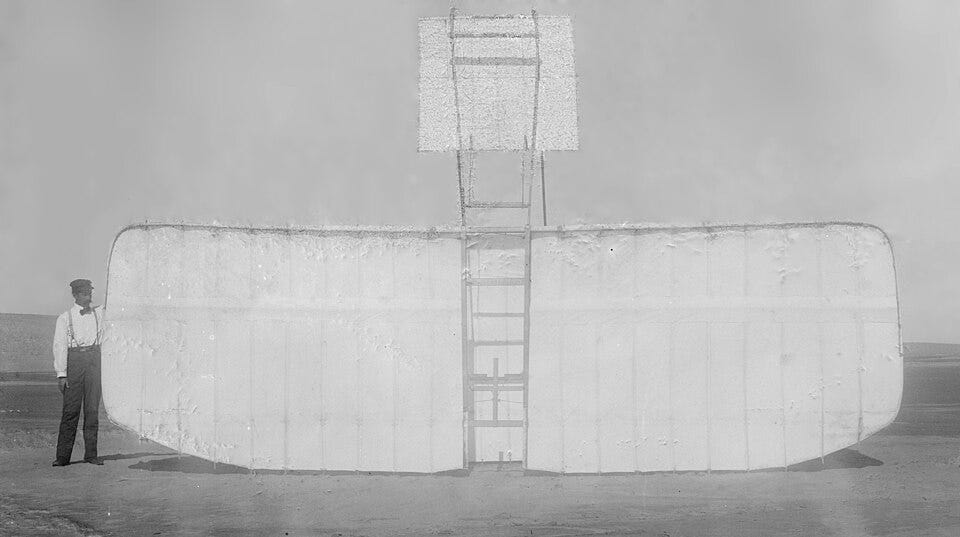
The problem was in the numbers they had trusted. The curve of their wing had been based on Lilienthal’s recommended values, and the lift tables everyone relied on did not match what the air was actually doing.
This is the moment that, for us, defines the brothers. They did not give up, and they did not keep blindly following the experts. That fall they built their own wind tunnel in the bicycle shop and measured lift and drag themselves, on some 200 wing shapes. McCullough treats their decision to work out the science on their own as a turning point.
When they turned to propellers, they found an even stranger gap. There was simply no usable written theory of how an air propeller should be designed. Even for ship propellers, which had been in use for about a century, the library had nothing that explained how they worked. Nobody had written it down. So they worked it out and wrote it down themselves.
They kept careful records
Wilbur filled notebooks with observations of birds. He noted how a buzzard holds its wings in a shallow V and rides the wind without flapping. He noted how hawks hold steady in strong gusts. Distances were measured. Mistakes were recorded. Every season at Kitty Hawk was written down and studied at home over the winter.
Their famous telegram from December 17, 1903 reads like a lab note: success four flights Thursday morning, all against a twenty-one-mile wind, longest fifty-seven seconds, inform press, home Christmas.
Open versus secret
The most striking contrast in the book is between two men who both wanted to fly.
Octave Chanute believed that knowledge and ideas about flight should be exchanged openly. He wrote to the Wrights, visited their camp and shared what he knew. Samuel Langley, the head of the Smithsonian, was the opposite. In McCullough’s telling, he kept his own work close.
Langley also had what the Wrights never had: public money and the backing of the government. His project had cost nearly $70,000, the greater part of it public money. On December 8, 1903, his Aerodrome was launched over the Potomac River and fell straight into the water. The press turned on him, and his government backing ended.
Nine days later, two men flew at Kitty Hawk whose expenses from 1900 to 1903, including materials and every trip to the dunes, came to a little under $1,000, paid out of the modest profits of their bicycle shop. Chanute had offered to help find a wealthy backer, adding that he happened to know Andrew Carnegie. Wilbur declined. “Practically all the expense of our aeronautical experiments lies in the time consumed,” he wrote.
Money did not decide the race. Will did.
Their records became their proof
The brothers wrote everything down: dated diaries, notebooks of bird observations, wind tunnel tables, more than 400 letters exchanged with Chanute, and photographs of their gliders, including the wrecks. McCullough’s point is that few pioneers left so complete a record, step by step, in writing and on film.
That habit turned out to matter far beyond the workshop. Once flight succeeded, others came forward to claim it, and for years the Smithsonian itself promoted Langley’s Aerodrome as the first machine capable of flight. The brothers’ answer was always the same: the record. It took decades, but in 1942 the Smithsonian finally stated that the credit for the first successful powered, piloted flight belongs to the Wright brothers.
Their nephew Milton, who grew up around the shop, remembered the glue pot and the spruce shavings on the floor. Watching his uncles glue strips into ribs for their “flying machine,” he assumed “all bicycle shops did the same thing.” It was, he said, “all very commonplace.” Most important work looks like that while it is happening. The only way it survives is if someone writes it down.
When Chanute died in Chicago in November 1910, Wilbur wrote a long public tribute to the man who had shared what he knew: “His writings were so lucid as to provide an intelligent understanding of the nature of the problems of flight.”
Secrecy did not cause Langley’s failure by itself. But it is worth noticing which way the knowledge flowed. The brothers stood on what Lilienthal and Chanute had made public. They tested it, corrected it, recorded what they learned, and in time showed it to the world. The record of their work traveled all the way to the Moon.
The Glasp Take: Leave Notes Someone Can Fly On
When we read this book in our reading group, one thought kept coming back. Progress happens when knowledge is spread, kept and left in a form other people can use. The Wrights could start because someone else’s work was visible. Their work could last because they wrote it down. And once two people showed that flight was possible, a whole world of builders followed.
Our name carries the same idea. Glasp stands for Greatest Legacy Accumulated as Shared Proof. The Wrights’ notebooks were exactly that: proof, accumulated, that could be shown to anyone who doubted. That is the chain Glasp exists to strengthen. Most of what we learn still goes the way of Langley’s results: kept to ourselves, in notebooks no one else opens, until it is gone. That is the reason we started Glasp, and why we keep arguing that we should learn in public. A highlight you share, a note you leave on something you read, the Kindle highlights you finally take out of your device, a correction you make when the “expert numbers” turn out to be wrong, are small acts in the Lilienthal and Chanute tradition. You may never know who uses them. That is fine. Lilienthal never saw Kitty Hawk. As we wrote in You are reading a book that has already been read, every reader stands in a long line of earlier readers.
There is one more lesson we take from the brothers. They read everything, and then they checked it against the wind. Shared knowledge is a starting point, not a final answer. The best thing you can do with someone else’s notes is test them, improve them and pass them on.
A question for you
Whose notes are you standing on right now? It could be a book, a teacher, a stranger’s blog post or a thread you once highlighted. Tell us in the comments. And if you have ever found that the “expert numbers” were wrong, we would love to hear that story too.
Read more from Glasp
Note-taking Lessons From America’s Greatest Biographer (how biographer Robert Caro researches and takes notes)
The Wright Brothers on Glasp: if you read it on Kindle, your highlights can be the first ones others see
Forwarded this email? Subscribe to Glasp Newsletter.
Would you like to take Glasp on the go?
With the Glasp mobile app, you can highlight and organize your favorite content anytime, anywhere. Stay productive on the move and never miss an insightful quote.
Partner With Glasp
We currently offer newsletter sponsorships. If you have a product, event, or service you’d like to share with our community of learning enthusiasts, sponsor an edition of our newsletter to reach engaged readers.
I really like how this piece shifts the usual Wright brothers story away from raw genius and toward the quieter habits that actually made their breakthrough possible: reading widely, questioning “expert” numbers, running their own experiments, and most of all keeping such careful records that others could later build on their work. The contrast between Chanute’s openness and Langley’s secrecy fits uncomfortably well with how knowledge often works today too, where so much hard earned learning dies in private notebooks, internal docs or closed systems. The idea that progress depends not just on discovery but on what gets written down in a usable form feels both inspiring and a bit convicting because it turns sharing highlights, marginalia and notes into a real contribution rather than a vanity project. I’m also struck by Wilbur’s line about most of the cost being time which hints that the real scarce resource in learning is focused attention and the willingness to stay with a problem longer than comfort would suggest!!
Thank you for reading. Here is the question from the end of the issue: whose notes are you standing on right now?
For me, it is the Wright brothers themselves. What stayed with me from this book is that the real reward of their work was not getting better at it, but wanting to know more. Steve Jobs put the same idea another way near the end of his life: "Everything I do depends on other members of our species and the shoulders that we stand on. And a lot of us want to contribute something back to our species and to add something to the flow." He also said his passion had been "to build an enduring company where people were motivated to make great products."
If you have a book or a line like that, share it below, or highlight it on Glasp so the next reader can find it. And if you have ever found that the "expert numbers" were wrong, I would love to hear that story too.