


Hi friends,
AI models are trained on data, and much of the data made specifically for training and testing them comes from paid human work: doctors grading medical answers, engineers writing code for models to learn from, speakers recording conversations, and workers filming their hands as they fold laundry so that robots can learn. The listed vendors we examined reported combined growth in 2025, and private companies report figures from hundreds of millions to billions of dollars under differing definitions. Nobody measures the market as a whole.
So we measured what we could. We built sourced profiles of 1,297 companies across 64 countries, coded each one against a written codebook, read the annual reports of the listed data vendors that report this business separately, and recorded 117 pay offers that were live on October 15. This report is what we found, including what we could not find.
By the numbers
1,297 AI labs, data vendors and work platforms mapped, in 64 countries
300 demand-side companies with explicit public evidence of obtaining human data
$718M: 2025 AI-data revenue in the filings of four listed vendors, up 32%
$150 vs $20: median advertised hourly ceiling for coding work versus voice work
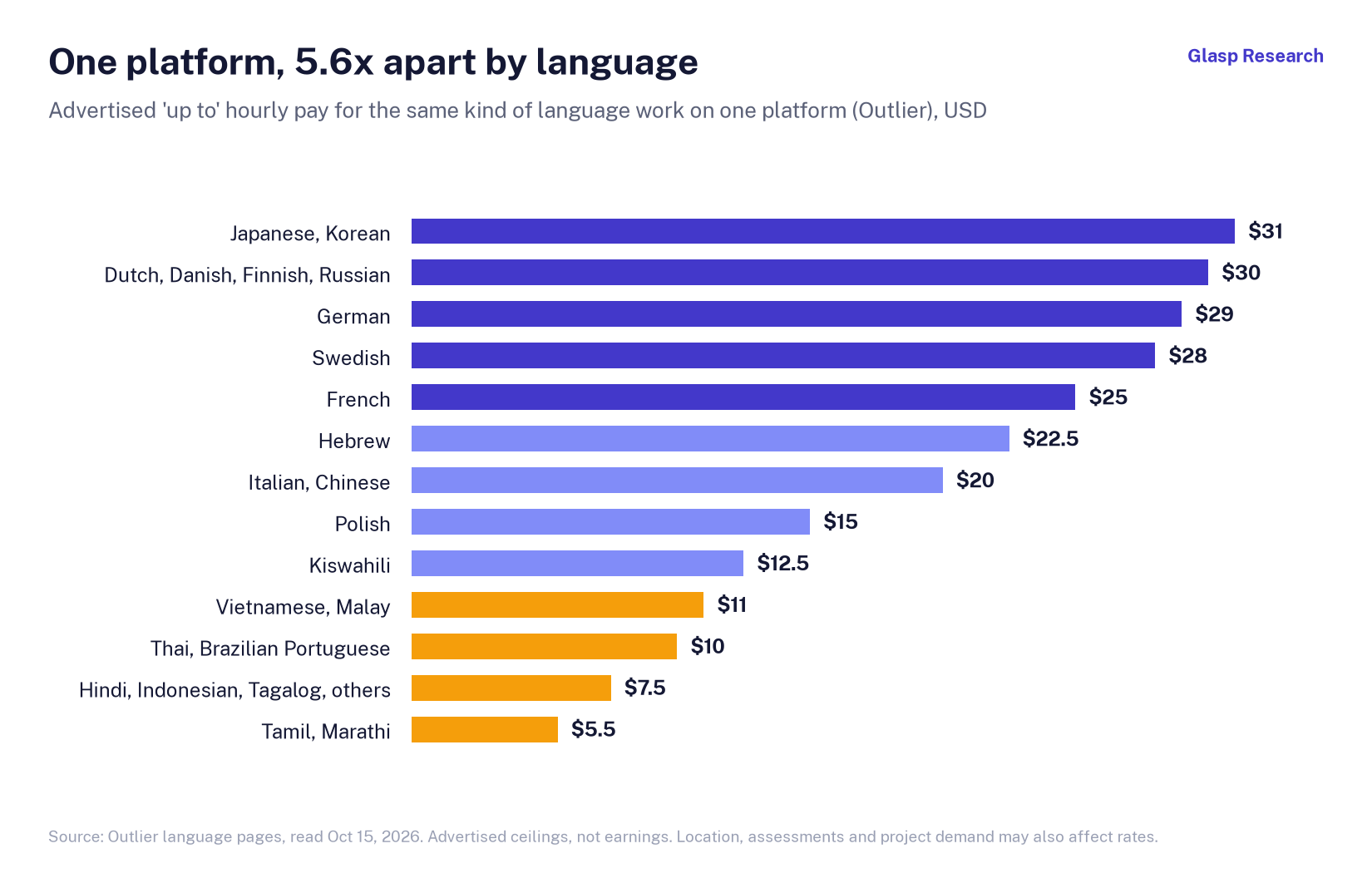
5.6x: the gap between the highest and lowest language rates for the same kind of work on one platform
If you want to reread or highlight this newsletter, save it to Glasp.
Key findings
Demand depends on who is asking. Of 300 demand-side companies with explicit public evidence of obtaining human data, the ten frontier labs all show demand for preference and evaluation data and for code, and six of them for agent or RL-environment data. AI product companies stand out for expert data (68%). Robotics companies want video (90%) and physical demonstrations (100%).
The audited part we could find grew 32% last year, and three of the four vendors disclose heavy customer concentration. The four listed vendors we found whose filings break out AI-data revenue reported $544 million in 2024 and $718 million in 2025. At Innodata, one customer was 58% of revenue; at Appen, the top five were 74%.
The biggest names publish no audited numbers for this business. Scale AI, Surge AI, Mercor, Handshake, micro1 and Turing are private. The figures they or the press report mix revenue, ARR and gross run rate, and range from hundreds of millions to more than $2 billion. They are not comparable with filed revenue or with one another, but they indicate substantial activity outside the four-company audited floor.
In our sample, advertised pay ceilings were highest for credentialed work and varied by language. The median advertised ceiling is $150 an hour for coding work and $20 for voice work. On one platform, the same kind of language work is posted at up to $31 an hour in Japanese and $5.50 in Tamil. What people actually earn is a much thinner record.
Physical AI has two overlapping supply chains. In our sample, robot makers most often disclose teleoperation and simulation (40% each), while data vendors and work platforms most often advertise video of people doing tasks. Of 316 physical-AI companies, 135 are vendors.
How we did this
Sample. Between October 13 and 14, 2026, AI research agents built a company-level profile for each company, with every fact tied to one source URL (more than 42,000 facts in the current version). The sample started from public lists and searches for AI labs, data vendors, AI work platforms, robotics companies and AI product companies whose job posts, papers or press describe human data. It is purposive, not a census. It covers 64 countries; 69 companies are in China or Hong Kong, a smaller share than China’s real weight in this market.
Coding. An LLM coded each profile against a written codebook: one primary role per company, the strength of evidence that it obtains human data, the data types it seeks or sells, seller capabilities, and, for physical AI, collection method and robot type. A second, stricter pass re-judged every buyer: “explicit” means the sources name a concrete act of obtaining data from people outside the company (paying or recruiting contributors, a collection programme, a data or annotation job post, a named vendor or licensing deal, in-house annotators, participant studies). Web crawls, public datasets, a company’s own users’ data and synthetic data do not count.
Checks. We did not rely on one model. A stratified random sample of 130 companies was checked against the live source pages: the first 50 independently by Claude and by Codex, the next 80 by Codex. The first round found 4 of 25 “explicit” labels wrong (the people involved were rating other companies’ models, or were the companies’ own customers), so both models re-judged all 402 “explicit” companies against a stricter rule; they agreed on 326 (263 kept, 63 dropped), Claude settled the other 76 against the written rule, and 300 remain. In the second round, 39 of 40 sampled “explicit” labels held, while 3 of 16 sampled companies coded as not explicit did have explicit evidence. These validation samples are small and do not establish the size or direction of the remaining error. The second round also showed that “frontier lab” had been applied too widely, so Codex re-judged all 76; in this report the term is an editorial grouping limited to the ten companies named in the role table, not a ranking. Other primary roles held for 111 of the 130 sampled companies before that fix; half of the misses were between data vendor and work platform, which the seller analysis treats together. Data types held for 112 of 130 and seller capabilities for 29 of 37. Treat these fields as model-coded estimates, not audited labels. No human reviewed the labels; these are model checks against public pages. One record lost in processing was coded by hand with the same codebook.
Terms. “Obtaining” human data covers buying it from vendors, licensing it, collecting it in-house and running participant studies. A vendor’s “gross run rate” is annualized customer spend passing through its platform, much of it paid on to workers; “revenue” in a filing is what the vendor reports for a fiscal year. The two are not comparable.
Limits. Public silence is coded as unknown, not as absence. Frontier labs mostly buy expert data through vendors, which their own pages rarely show, so expert demand at labs is understated. No individuals appear in this report: everything is at company level. Our sources are mostly English-language, so China is underrepresented (69 of 1,297 companies) even though its annotation industry is large and state-backed. “All companies” figures therefore describe mainly the US and European market; Chinese results are shown separately and should be read as indicative.
Who is in the market
Model companies (including large general models below the frontier, and language, regional, domain, speech, video and image models): 381
Data vendors: 279
AI product companies: 212
Academic and nonprofit (universities, institutes, archives): 182
Robotics and physical AI: 126
AI work platforms (recruit and pay contributors): 102
Frontier labs (Anthropic, Google DeepMind, Meta, Mistral, OpenAI, xAI, DeepSeek, Moonshot, Alibaba, ByteDance): 10
Other: 5
Total coded: 1,297
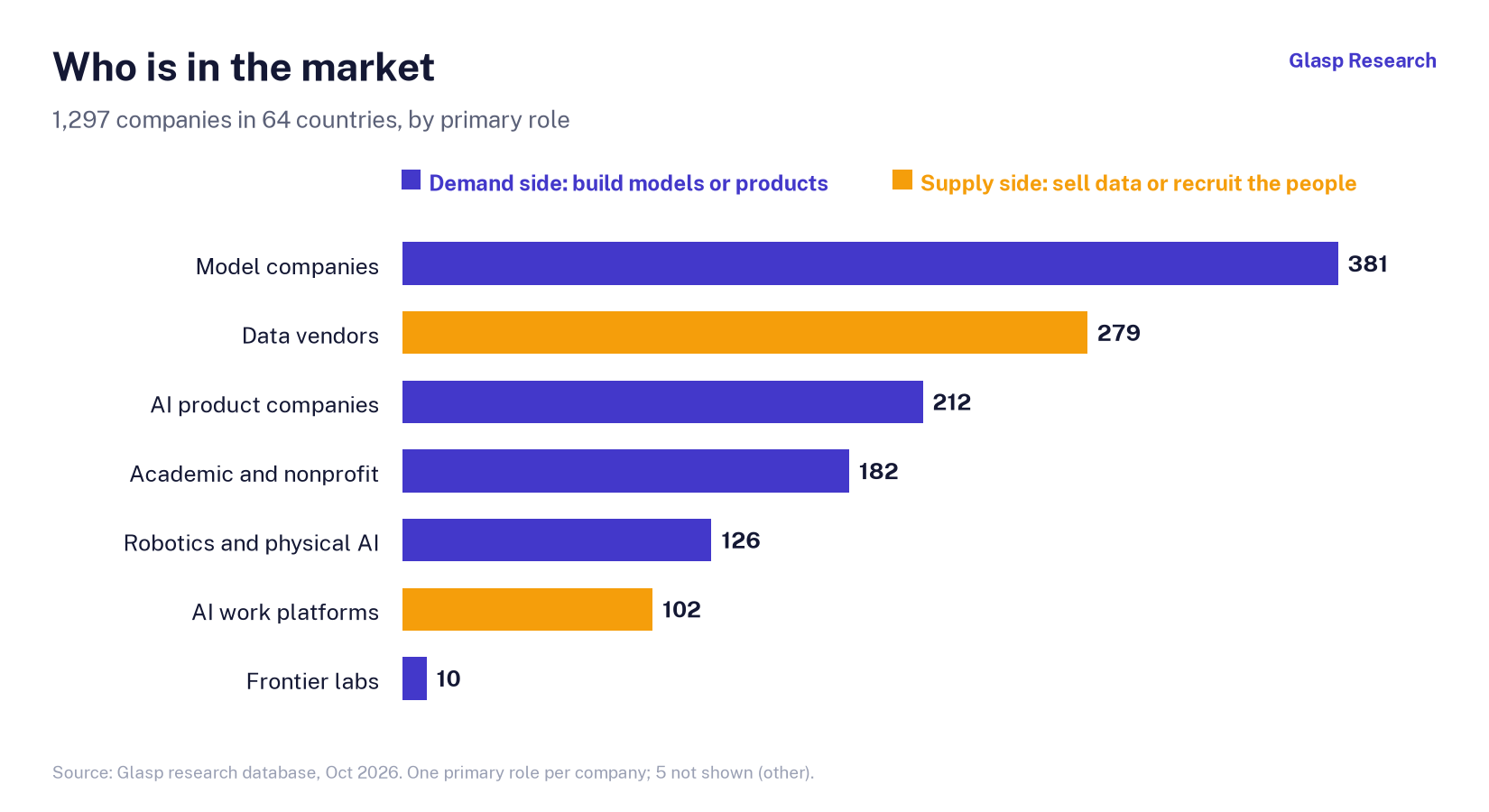
By headquarters: United States 508, Europe 386, China and Hong Kong 69, 236 in other countries (India, Japan, Canada and Korea lead), and 98 that do not publish one.
What buyers ask for
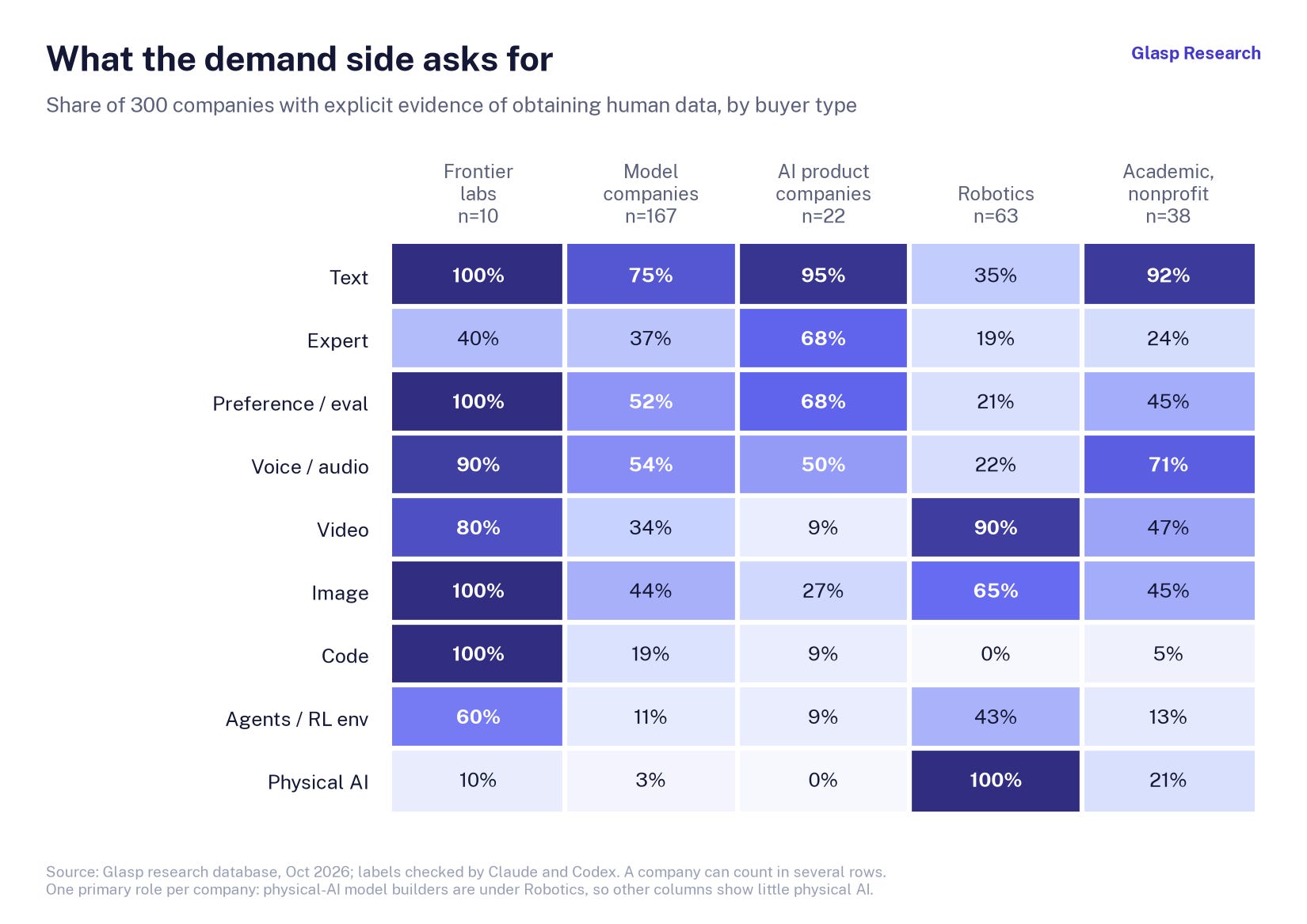
Three patterns stand out.
Frontier labs buy judgment and practice. All ten frontier labs show demand for preference and evaluation data and for code, and six of the ten for agent trajectories or RL environments, against 11% of other model companies. With only ten companies, read these as counts, not shares.
Applications buy experts. Companies building legal, medical and financial products on top of others’ models need specialists to write and grade examples: 68% of AI product companies show expert demand, though only 22 of them have explicit evidence.
Regions differ. US buyers lead in preference and evaluation data (57%, against 37% in Europe) and code (19% against 6%). Chinese buyers in our sample (23) lean toward video (87%), agents and RL environments (52%) and code (48%).
One caution on reading the chart: each company has one primary role, and companies that build physical-AI models are counted under Robotics. That is why the other columns show little physical-AI demand; it does not mean those companies never want such data.
What sellers offer
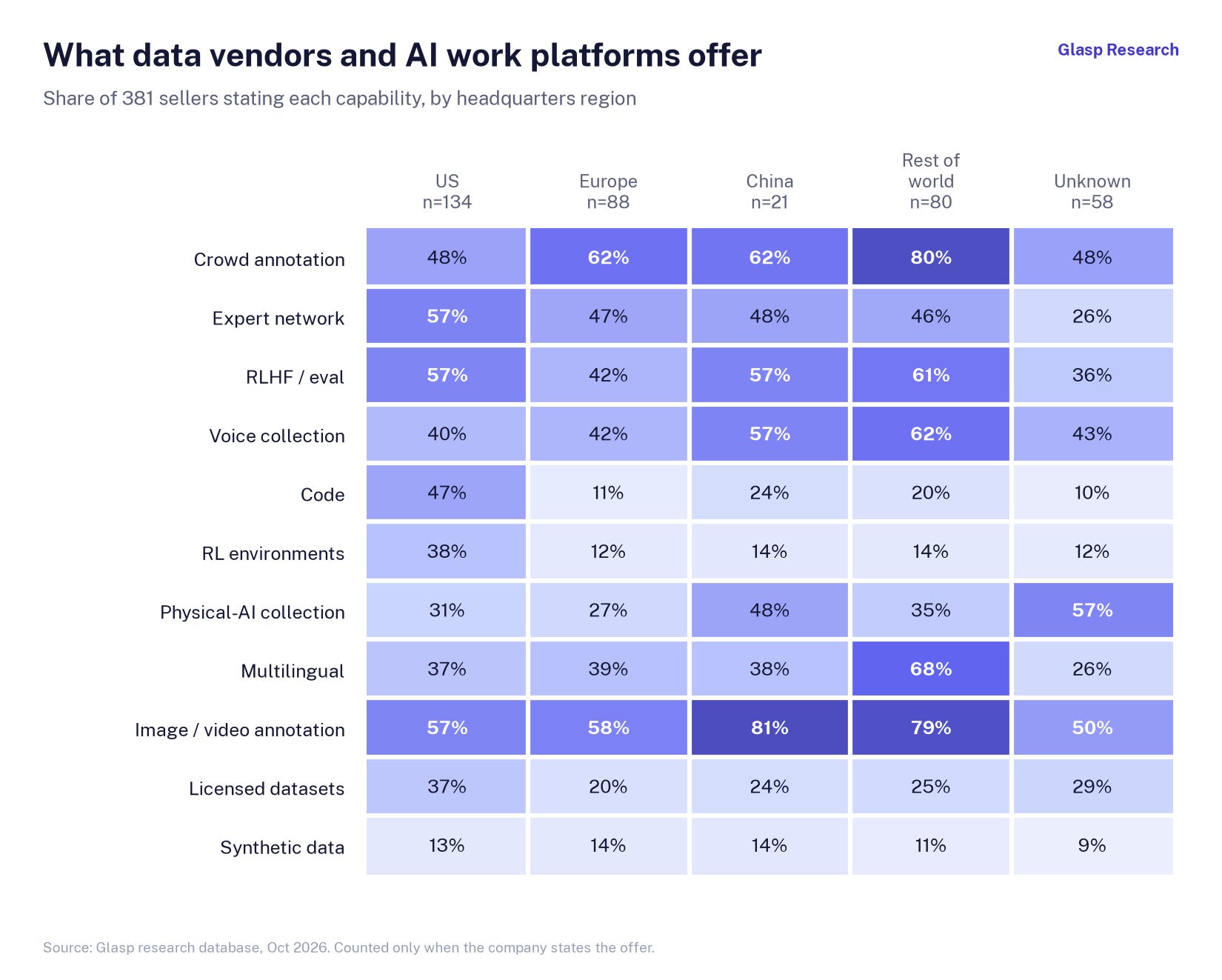
Broad claims are common. 116 of 381 sellers (30%) list six or more capabilities; only 34 list one. Broad lists make it hard for buyers to tell real specialization from a menu.
Code and RL environments are offered mostly from the US. In our sample, US-headquartered sellers state code (47%, against 11% in Europe) and RL environments (38% against 12%) far more often.
The crowd and language layer sits elsewhere. Sellers outside the US and Europe lead in crowd annotation (80%) and multilingual work (68%).
Many sellers already offer physical-AI collection. 136 sellers offer physical-AI data collection, more than offer code (100) or RL environments (83).
How big is the market?
There is no single answer, so we built it up from the parts that can be checked.
The audited floor
Only a few listed companies report revenue for AI-data work separately. Those we found give a floor, not a total; the search was not exhaustive.
Appen (ASX), group revenue, all AI data: $234.3M in 2024, $230.8M in 2025 (-1.5%)
Innodata (Nasdaq), digital Data Solutions segment: $141.1M in 2024, $220.9M in 2025 (+57%)
TaskUs (Nasdaq), aI Services: $135.1M in 2024, $214.2M in 2025 (+59%)
Haitian Ruisheng / SpeechOcean (Shanghai), revenue, all AI data (RMB converted at 7.19): $33.0M in 2024, $52.4M in 2025 (+59%)
Total: $543.5M in 2024, $718.3M in 2025 (+32%)
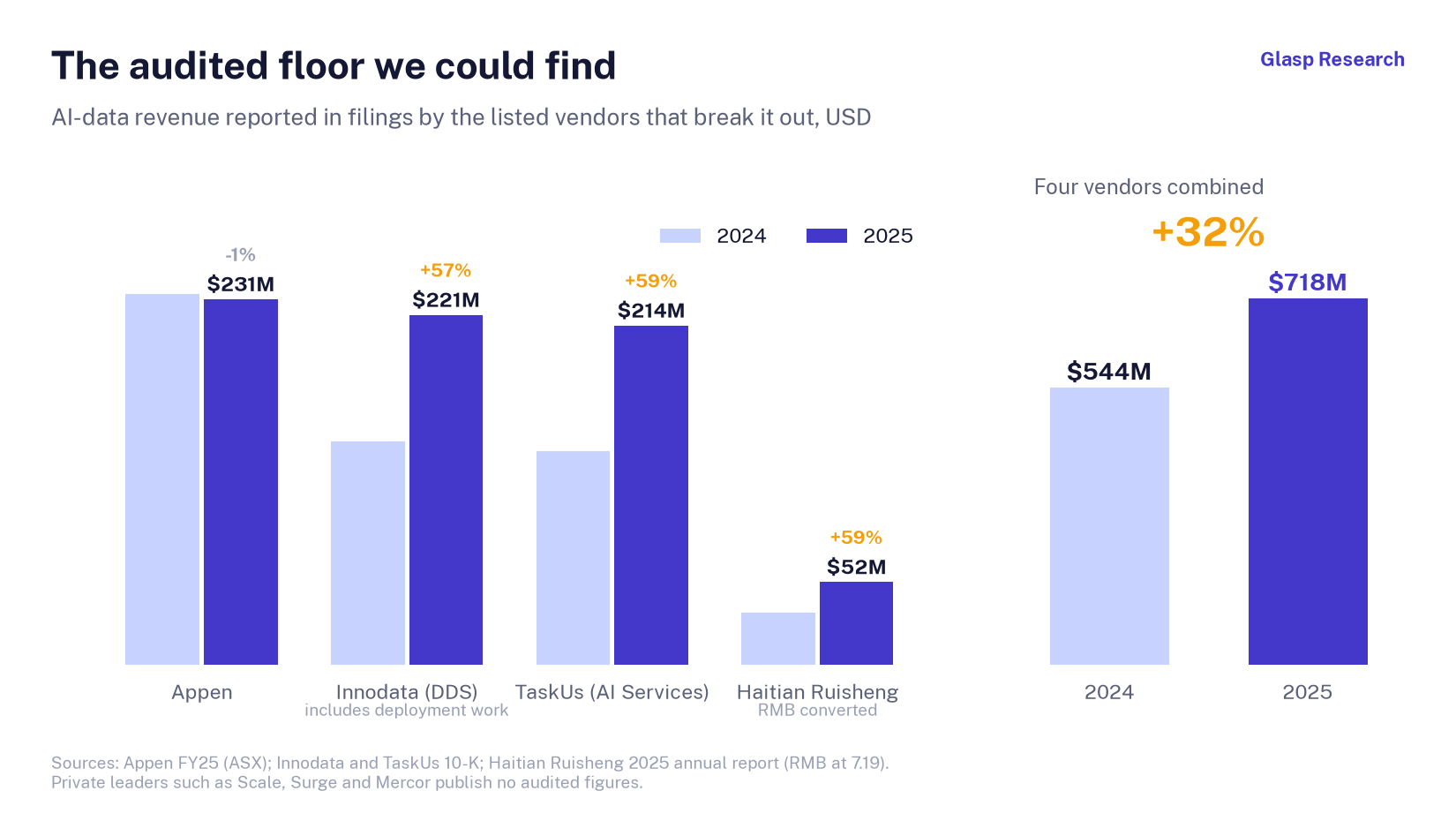
Sources: Appen FY25, Innodata 10-K, TaskUs 10-K, Haitian Ruisheng 2025 annual report. Innodata’s segment also includes model deployment work, so it slightly overstates data work. TELUS Digital does not disclose AI-data revenue and was taken private in 2025.
What the filings show beyond the totals:
Customer concentration is high, and rose at Innodata and Appen. Innodata’s largest customer went from 48% to 58% of revenue. Appen’s top five went from 67% to 74%. Meta was 26% of TaskUs revenue. When Google ended its Appen contract, Appen’s 2024 revenue fell 14%.
Appen’s growth is in its China segment. The segment Appen reports as Appen China grew 75% in 2025, to $102.9 million, and was 64% of Appen’s revenue in the first half of 2026, while Appen Global fell (Appen H1 2026). One company does not make a market shift, but it is the clearest regional signal in the filings.
At one Chinese vendor, vision overtook speech. At Haitian Ruisheng, computer-vision revenue tripled (+218%) while speech fell 9%.
Large private-company indicators
The best-known companies are private and publish no audited numbers. What they or the press report:
Mercor: More than $2B, gross run rate (net estimated $600M to $800M), Jun 2026, annualized (Dealroom, citing The Information)
Surge AI: Over $1B, revenue (reported by press), 2024 (Reuters, syndicated)
micro1: More than $1B, run rate (company claim), Oct 2026, annualized (company announcement)
Handshake (AI training): Nearly $1B, gross run rate (net close to $300M), Apr 2026, annualized (Dealroom, citing The Information)
Scale AI: About $870M, revenue (reported by press), 2024 (Reuters, syndicated)
Snorkel AI: $375M, run rate (company figure; Reuters: above $350M), Sep 2026, annualized (Snorkel)
Turing: About $300M, aRR (company figure), Mar 2025 (TechCrunch)
These mix years, gross and net revenue, and services beyond data, so we do not add them up. Platforms that pay contractors pass a large share of gross revenue on to the people doing the work, so a gross run rate is closer to customer spend than to revenue. Read this table as a sign of scale, not as a second floor.
The research-firm estimates
Market-research firms publish figures under different definitions, which is why they disagree. “AI training datasets” (datasets sold as products) is put at about $3 billion to $3.4 billion in 2025 by Grand View Research, Precedence Research and Global Market Insights. Broader definitions run to $9.8 billion for training data as a segment of AI training in 2025 (Next Move) and $57.6 billion for all data-labeling solutions and services by 2030 (Grand View Research).
The narrow figures are hard to reconcile with the private companies above. The likely reason is definitional: expert feedback, evaluation and RL environments are sold as services and fall outside “datasets”. Our read: the audited floor we found is about $0.7 billion. Individual private-company indicators reach more than $2 billion annualized, but they mix years and metrics and cannot be added. Nobody has measured the total. Anyone building a business case should size it bottom-up from buyers’ budgets, not from a headline number. One widely quoted buyer-side figure, that each leading lab spends around $1 billion a year on human data, comes from a vendor’s chief executive (TIME), so it is an industry view, not a measurement.
Three areas to watch
RL environments
Some labs now buy practice, not just examples: software environments in which a model attempts tasks and an automatic checker scores the result. Scale says “nearly half” of its new data projects involve RL environments (Scale). In interviews with 18 people from environment startups and labs, Epoch AI found most tasks priced at $200 to $2,000 each, with contracts often six to seven figures per quarter and exclusive deals costing roughly four to five times more (Epoch AI). Replicas of websites for agents to practice on cost about $20,000 each (SemiAnalysis). Labs rarely name these vendors publicly, so most of this is reported, not disclosed.
Where an answer cannot be checked by a program, the reporting cited here describes experts writing the rubrics that grade it.
What synthetic data can and cannot replace
Several prominent public model reports show a consistent but limited pattern. In pre-training, the Stanford AI Index 2026 finds “no definitive evidence that synthetic data can fully offset real-data depletion”; mixing real and synthetic data speeds training “by a factor of five to 10 at scale, without surpassing real data in final model performance” (AI Index 2026). Microsoft’s Phi-4 used 40% synthetic data in pre-training, but its synthetic-only models “underperformed on the knowledge-heavy benchmarks and demonstrated increased hallucinations” (Phi-4 report).
In post-training, synthetic data does much of the volume, but people remain in the loop. Meta’s Llama 3 says most of its fine-tuning data is model-generated, yet it ran six rounds of human preference annotation and found that training its largest model on its own outputs without a checker “is not helpful” (Llama 3). DeepSeek-R1 and Qwen3 both used human annotators to refine their cold-start reasoning data (DeepSeek-R1, Qwen3).
What these public cases suggest: synthetic data substitutes for people most where a cheap automatic checker exists (math, code with tests). Where quality needs judgment, the labs in these reports still used people.
Physical AI
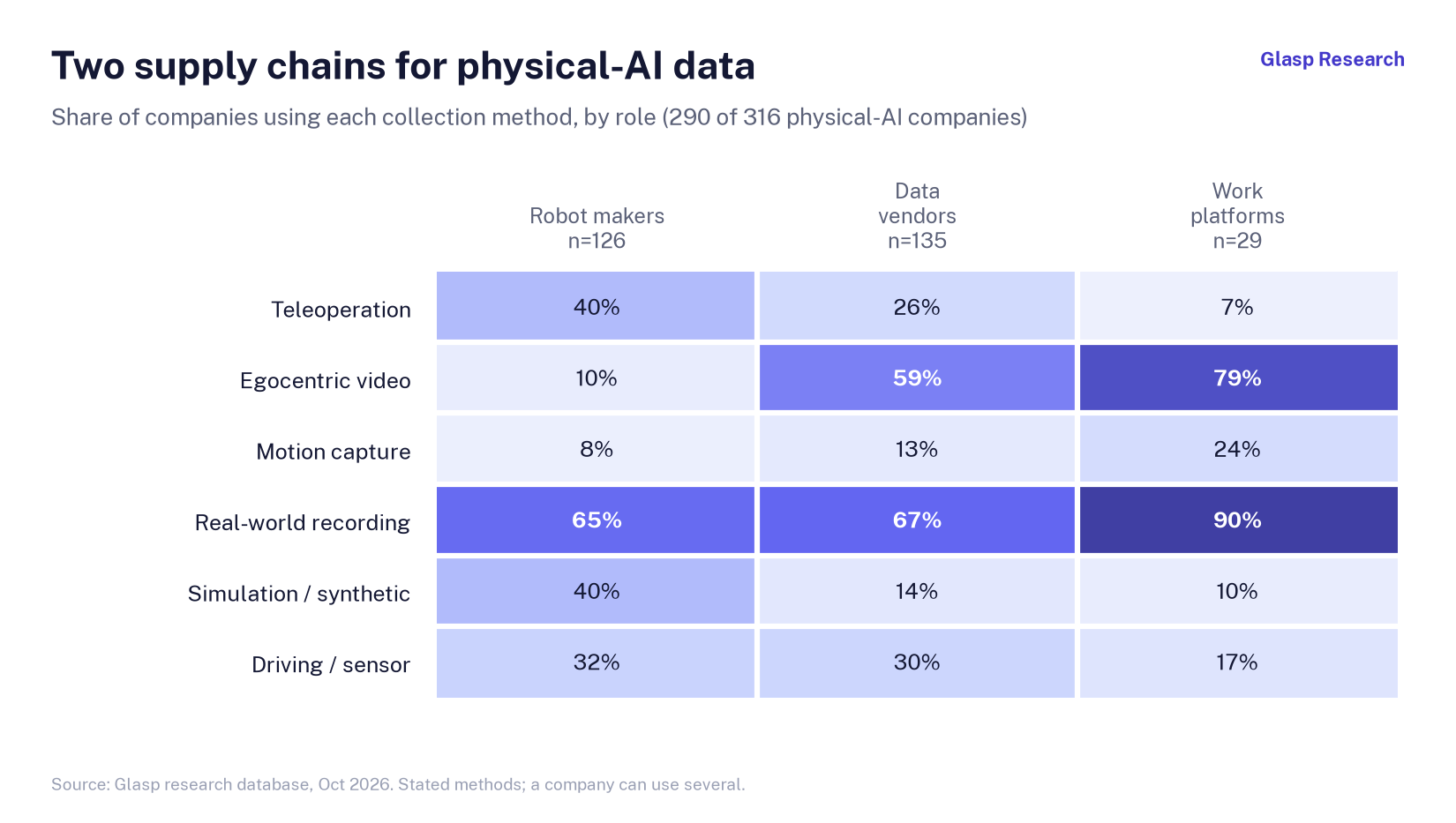
Our sample holds 316 physical-AI companies: 135 data vendors, 126 robotics companies, 29 work platforms and 26 others. Robotics companies lean on teleoperation (40%) and simulation (40%); vendors and platforms lean on first-person video of people (59% and 79%). Robot arms and manipulation are the most common target (52%), ahead of mobile and household robots (37%) and humanoids (16%).
On the buyer side, the clearest disclosure is Generalist AI: its GEN-0 model was trained on about 270,000 hours of real-world manipulation data, growing by more than 10,000 hours a week, collected through its own devices and “multiple data foundry partners” it does not name (Generalist AI). Figure says it has begun “human video capture” in Brookfield environments to build a humanoid pretraining dataset (Figure). On the seller side, Scale says it delivered more than 150,000 hours of physical-AI data and added 10 robotics customers in 2025 (Scale). We found no robotics company that names its data supplier.
Two regional patterns deserve a closer look. Europe has the most physical-AI companies in our sample but the least first-person video collection (19%, against 42% in the US). In China, one analysis citing the state think tank CAICT counts 64 embodied-AI data-collection facilities in at least 27 cities (analysis), consistent with China’s high share of teleoperation (45%) in our sample.
Work and pay
What platforms advertise
On October 15 we recorded 117 pay observations from 19 platforms, 109 of them read on the platforms’ own pages. The medians below use the 103 that were confirmed hourly rates in US dollars; the chart below shows the ten groups that hold 102 of them. These are advertised ceilings, not earnings. Platforms are not weighted equally: Mercor’s listings are counted one by one, while DataAnnotation posts one rate per tier.
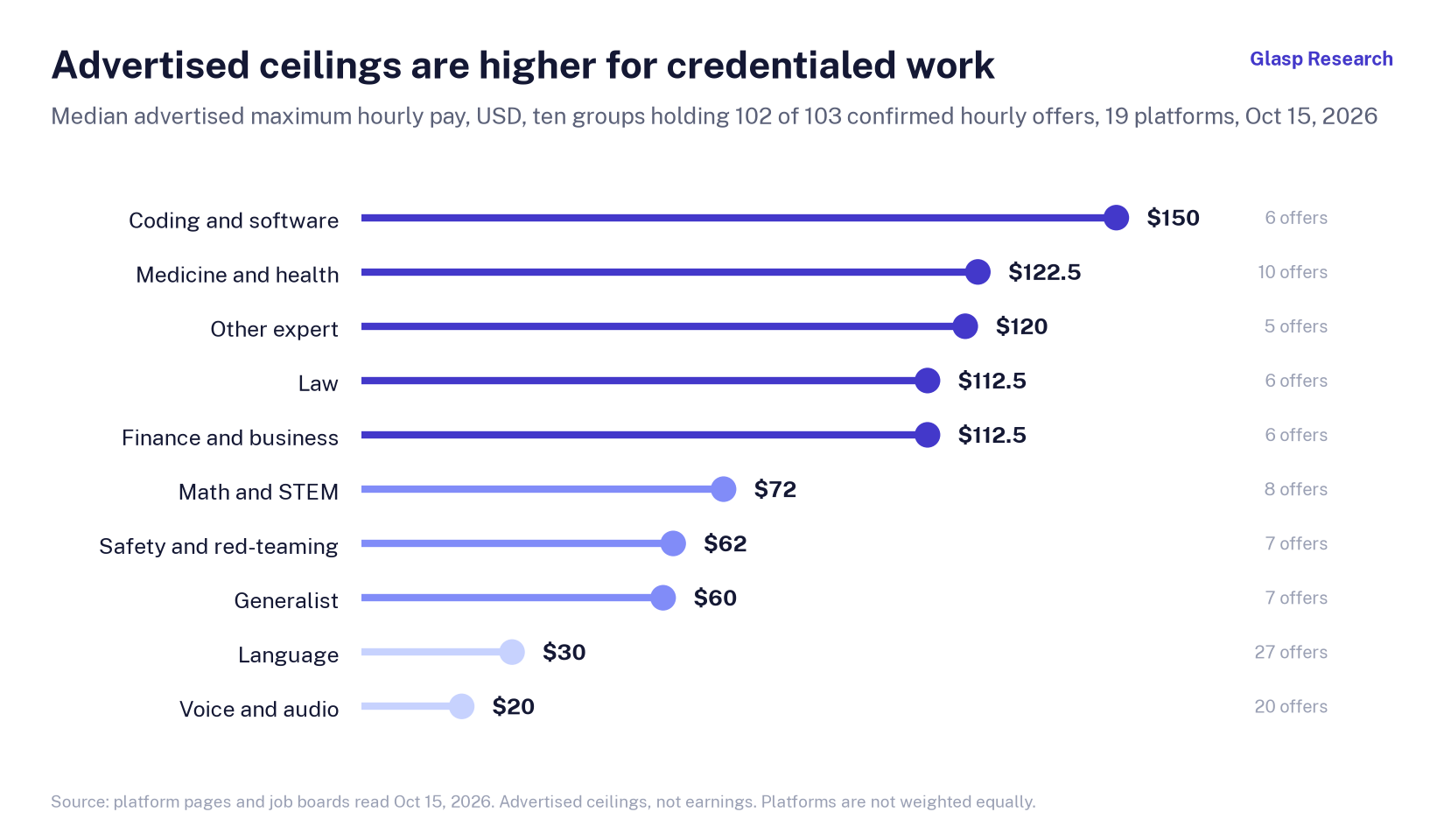
In our October 15 sample, median advertised ceilings were higher in credentialed categories. They also varied by language and location. On Outlier’s own language pages, the same kind of work is posted at up to $31 an hour for Japanese and Korean, $29 for German, $10 for Brazilian Portuguese, $7.50 for Hindi and Indonesian, and $5.50 for Tamil (Outlier).
Separately, across all 194 hourly roles on Mercor’s public listings that day, the median advertised maximum was $90 (Mercor).
What people actually get
The record of real earnings is thinner and older. The 2025 Fairwork ratings found that only 4 of 16 cloudwork platforms could show workers consistently earn at least the local minimum wage after costs, and 31% of 750+ surveyed workers had gone unpaid at least once (Fairwork, via Workplace Insight). The ILO found microtask workers spending about 20 minutes of every hour on unpaid work such as searching for tasks and taking qualification tests (VoxEU). Three gaps recur between the posted rate and the paycheck: unpaid time, projects that end without notice (xAI cut about 500 generalist tutors in one night, TechCrunch), and rates that reset between projects.
We found no study of realized hourly earnings on the expert platforms of 2025 and 2026. That is a gap, not evidence that their pay matches their ads.
Voice data: what it costs and who gets what
Only one vendor we found publishes a full price list for speech data: transcribed, consented two-person conversations at $60 to $95 per audio hour, priced by the speakers’ home economy, $90 for US English and $65 for Hindi or Swahili (SpeechData.ai). Older research corpora cost $7 to $12 an hour (LDC Fisher), and Mozilla Common Voice offers 42,593 hours in 295 languages for free. On the contributor side, in September 2025 the Neon app advertised payments equivalent to $9 to $18 per hour of recorded calls (Malwarebytes); it went offline weeks later after a flaw exposed users’ recordings, transcripts and phone numbers (TechCrunch), a reminder that a recorded call also involves the other person on the line. The buyer price also pays for transcription, quality control, consent and a commercial license, so the two numbers cannot be compared directly.
The rules coming next
Sep 2022, US: FTC policy statement on gig work. A non-binding statement of enforcement priorities: misleading pay claims and opaque algorithmic management.
Aug 2023, China: Generative AI interim measures, Article 8. Providers must set clear annotation rules and train and check annotators.
Jan 2025, China: NDRC opinions on the data annotation industry. Targets over 20% annual growth to 2027, annotation bases and national skill standards; no wage rules.
Aug 2025, EU: AI Act general-purpose AI obligations. Apply from August 2025, including a public summary of training data; the Commission’s enforcement powers start in August 2026.
Dec 2, 2026, EU: Platform Work Directive transposition deadline. A presumption of employment where facts indicate control, applied under each country’s law, plus transparency on algorithmic management; few member states have finished.
Ongoing, US: Worker classification suits. A proposed $12.5 million settlement of a contributor misclassification class action against Scale AI awaits final court approval; the defendants deny liability (settlement notice).
Recording in homes, recording calls and processing voices or images can trigger privacy and consent laws. Biometric data processed to identify a person uniquely is a special category under GDPR Article 9, and Illinois’s BIPA covers identifiers such as voiceprints and scans of hand or face geometry; an ordinary photo or recording is not automatically a biometric identifier. Recording a call may also require consent from everyone on it, depending on where they are.
What this means
For buyers: demand is specific to buyer type, many sellers list broad capabilities, and the labs that buy the most do not name their suppliers. Ask vendors for evidence by capability, not a list of capabilities.
For sellers: the four audited vendors grew 32% combined, and three of them disclose heavy dependence on a few customers, so losing one major contract can move a year of revenue. In the current sample, code and RL environments are offered mostly by US sellers, while physical-AI collection is already offered by more than a third of all sellers.
For people doing the work: the advertised rates for credentialed work are high and public; the realized record is thin, and the gaps are unpaid time, abrupt project ends and rate resets. The rules differ sharply: the US item above is a non-binding FTC statement, China regulates annotation practice, and the EU has separate AI and platform-work rules. EU countries are required to transpose the Platform Work Directive by December 2, 2026.
Before you take an AI-training job: five checks
If you are considering this work, the record above suggests asking five questions before you start.
What do people actually earn, not the ceiling? The advertised rate is an “up to”. Ask how many hours of paid tasks a typical contributor in your field and country gets per week.
Is the qualification test paid? Tests and onboarding may be unpaid. Ask how long they take, whether you are paid if you do not pass, and whether the platform may use your test work.
How and when are you paid? Check the payment method, the minimum payout, how often you are paid, the rejection criteria, whether rejected work can still be used, and how to appeal a rejection.
What happens when the project ends? Projects can stop overnight and rates can reset on the next one. Ask how long the project is expected to run and how you will be told if it ends.
What happens to your data and your work? Check what the platform collects about you (ID documents, voice, biometric data, video from your home), who receives it, how it is secured, how long it is kept, whether you can withdraw consent or ask for deletion, and who owns what you produce. Do not record other people without their consent.
Why Glasp looked at this
More than 3 million people use Glasp to highlight and learn from what they read. This report used public company and platform sources only, not Glasp users’ account data, highlights or reading histories. Much of what AI companies now pay people to do is close to what our users do every day: read carefully, judge what matters, and explain why. We mapped this market to understand that overlap. We are also studying whether, in future, Glasp could help people with the right skills find this kind of work through partners. Nothing has been decided; anything we did would be opt-in, separate from Glasp itself, and run with partners who handle verification and payment. We will keep tracking this market and share what changes.
Talk to us
Researchers, professionals and people doing this work: if you are interested in paid AI-training work in your field, or have done it and are willing to share your experience, reply to this email. We read every reply. This is a research request, not recruitment or an offer of work, and we do not run a contributor pool. Please do not send a CV, a job application, ID documents, client information or other sensitive personal data.
AI labs, companies and data vendors: if you want a cut of this data for your segment, region or data type, or want to compare notes on what you see, reply to this email.
Named companies: if we got a fact about your company wrong, reply with the correction and a source, and we will fix it.
Disclosure. Glasp sells sponsorships in this newsletter, is studying whether it could in future help its users find paid AI-training work through partners, and may contact companies named in this report. No company paid for this report, reviewed it, or saw it before publication.
What would you like us to dig into next: the buyers, the pay, or the physical-AI supply chain? Tell us in the comments.
Sources
Company sample and all database shares: Glasp research database, 1,297 company profiles built October 13 and 14, 2026, coded October 15. Revenue floor: company filings linked above. Private-company figures: self-reported or reported by the press as noted. Pay: platform pages read October 15, 2026. All other figures are linked inline.
Partner With Glasp
We currently offer newsletter sponsorships. If you have a product, event, or service you’d like to share with our community of learning enthusiasts, sponsor an edition of our newsletter to reach engaged readers.
What struck me most here is how uneven and opaque this market still is despite its size and growth. The report makes it clear that human data work now sits at the core of AI progress, yet basic facts like total market size and typical worker earnings remain fuzzy or missing. I found the contrast between the huge run rates at private vendors and the thin evidence on what individual contributors actually take home especially troubling. The language and regional pay gaps, plus the heavy dependence on a few big customers, suggest a fragile ecosystem where both workers and smaller vendors carry most of the risk. It feels like we urgently need better transparency standards on both sides so people can make informed choices about participating in this new kind of labor.