


Glasp’s note: At Glasp, we value the close personal relationships we’ve built with thinkers, creators, and doers who fuel curiosity and growth. This week, we spotlight Bobby Powers —a lifelong learner passionate about leadership development and continuous improvement. With more than a decade of experience leading teams and developing learning and development at startups, Bobby understands the transformative power of curiosity and mentorship. You might remember him from his Glasp Talk appearance, where he shared insights on leadership and personal growth, inspiring thousands. We’re honored to continue learning from Bobby and are thrilled to share his thoughtful reflections with our community.
If you want to reread or highlight this newsletter, save it to Glasp.

Hi, I’m Bobby Powers! I run the Leader & Learner publication, where I share two posts per week that will help you become a more curious leader and learner.
Today, we’re taking a peek into personal values. I’ve been drafting a list of life rules for the past decade or so, and whenever I stumble across a new principle that resonates with me, I add it to my list.
Life rules are a personal thing. Some of mine may resonate with you, but others definitely won’t. I share this list to inspire you to reflect upon which principles guide your own life.
Here are 70 of my linchpins for living:
Completely own who you are. There’s no force more powerful than someone fully embracing their uniqueness. Harness your version of weird. It’s a superpower.
Define your own version of success. Some of the saddest people have fat wallets and big houses. Riches, fame, and power don’t bring happiness. Instead, aim your arrow at fulfilling relationships, passion-fueled hobbies, and meaningful work.
Never lose your childlike sense of wonder. Kids never lose sight of the little things: they gleefully run through sprinklers, pick up rocks to search for creepy crawlies, and view every snowfall as a chance to resurrect last year’s snowman. Most adults could benefit from an extra dose of that mentality in their lives.
Always be a student. School should be the beginning of learning, not the end of it. Make it your goal to learn something new every day.
Drink deeply from good books. They’re a chance to get mentored by dead emperors, business titans, and Olympic athletes. People whom you could never normally ask for advice are as close as your local library or Kindle account. You have wisdom on tap, waiting for you, whenever you’re ready. (HT: John Wooden)
Exhibit confident humility. Have the modesty to understand whether you’re the best person to make a particular decision. Learn from others when they’re the expert. Act with boldness when you’re the expert.
Assess yourself with third-party objectivity. Whenever you find yourself in a conflict, ask yourself what an unbiased journalist would write about the situation. What are the facts? How did you contribute to the mess?
Less certainty, more inquiry. Doubt yourself. As Bertrand Russell says, “The fundamental cause of the trouble is that in the modern world the stupid are cocksure while the intelligent are full of doubt.” (HT: Maria Konnikova)
Operate in permanent beta. Your personal operating system is still an early model. Many more upgrades are on the way, but only if you watch for them. (HT: Reid Hoffman)
Follow your curiosity. Curiosity doesn’t just point to areas of intrigue; it points to areas of potential competitive advantage. The people who succeed are often those who work the hardest, and those who work the hardest are often the ones who love what they’re doing.
Hypothesize and test, then repeat. Thinking is usually the worst way to learn if something works. The best way? Just trying it out. Rather than thinking your way out of problems, experiment your way out of them. (HT: Anne-Laure Le Cunff)
Create your own weather. Choose to never have a bad day. Will Arnett puts it like this: “If you say, ‘Things are gonna be hard for me,’ then guess what? Things are gonna be hard for you…My starting point is: I’m happy no matter what. I create my own weather…How you feel is a direct result of what you think about. The only thing you can control is what you think about.”
Love all seven days. Don’t live for the weekend. If you only enjoy two out of every seven days, you’re sacrificing 71 percent of your life. Figure out how to love Mondays—either by shifting your perspective, finding the right workplace, etc.
Find perfect in the average. Even if you’re not on a beach sipping on a Piña colada, there’s a good chance you can inject a few perfect elements into your average Monday, like enjoying a beautiful sunset, taking a peaceful walk, or catching up with an old friend over the phone.
Be hyper-present. If you’re out to dinner with a friend, be out to dinner with a friend—not answering texts or scrolling social media. Live in the current moment by prioritizing the person in front of you.
Take joy in others’ success. The zero-sum mindset of “I win, you lose” leads to unnecessary competitiveness. Instead, embrace a positive-sum mindset. Cheer on other creators, entrepreneurs, and artists. If they win, we all win.
Focus on the smooth water while paddling. Kayakers are more likely to wipe out if they look at the rocks they’re trying to avoid. Similarly, you’re more likely to botch a presentation or interview if you’re focused on what can go wrong. Instead, focus on the smooth water: how well you’ve prepared, what’s in your immediate control, and what can go right.
No bad beats—focus on the process. Hang around a poker room for five minutes and you’ll hear several players complaining about their “bad beats” (poor luck). Don’t be that guy. Sometimes the odds will fall your way, and sometimes they won’t. Either way, focus on what you can control.
Use setbacks as alternative fuel. Rejections can be constructively molded into a chip on the shoulder. It’s not bad to have something to prove. Use those setbacks as fuel in the tank—to learn, to grow, to overcome. Here’s a perfect example from Jay Yang, who went on to publish the Amazon bestseller You Can Just Do Things:
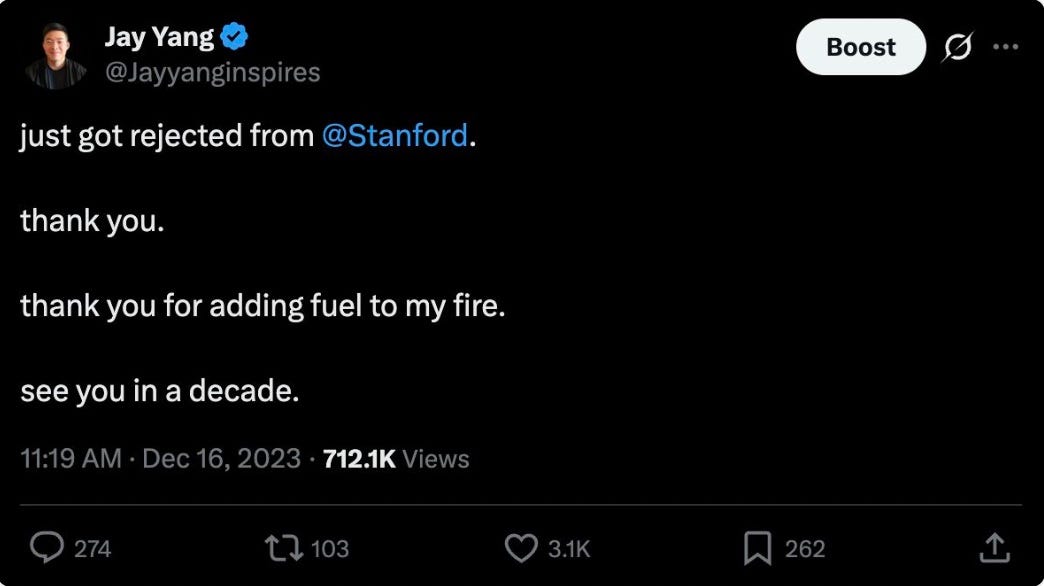
Ask “What can I learn from this?” Every challenge in life is an opportunity to practice a virtue. Treat every event as neutral. It’s not “good” or “bad.” It’s just something that happened, and now you get to decide how to respond.
Widen the space between stimulus and response. When someone pisses you off, it’s easy to lash out. But remember, there’s a difference between a reaction and a response. The former is emotion-driven and instinctive. The latter is a chosen move. Five deep breaths can be the difference between one versus the other.
Use fear as a compass. It’ll show you which option will teach you the most. If a project or challenge looks scary, don’t run from it. Instead, run toward the fire. You’ll learn more than you imagine and become known as someone who can solve any problem.
Choose dreams that scare you. Be willing to pursue goals that are so big, you’d be embarrassed to share them with 90 percent of the people in your life. (HT: Benjamin Hardy, PhD)
Identify the first step. It’s easy to get overwhelmed when thinking about a big project like writing a book, starting a business, or running a marathon. But that overwhelm generally comes from thinking about Step #50, and you don’t need to know Step #50 right now. Just identify Step #1…and do it.
Start with rubbish. The best way to work up the gumption to tackle Step #1 is to lower the bar. Rather than sitting down to “write a bestseller” (a daunting proposition) on the first day of your writing project, tell yourself you’re just going to “jot down some thoughts.” By so doing, you’ll avoid procrastination, get out of your own way, and begin actually making progress.
Practice radical incrementalism. If you want to do something BIG, just bite off a tiny bit each day. Big things get accomplished through small, consistent actions. Follow the Latin adage of festina lente: Make haste slowly. (HT: Oliver Burkeman)
Prepare for a long road. Meaningful accomplishments take longer than you think: finishing your novel, finding the right job, breaking through with your business idea. Because of this, it’s important to do three things:
Set reasonable expectations for yourself.
Start today.
Enjoy the journey.
Fall seven, rise eight. The victors in any arena of life are determined by those still standing at the end, not those who avoided falling along the way. (HT: Japanese proverb)
Be the bull in the china shop. Do you know someone who can be given any project and they’ll figure out a way to succeed? Make it your goal to become that person. Develop the ability to run through walls. It’s the most hireable skill on the planet.
Choose alive time over dead time. In most situations, you can either wait for something to happen or you can take action. I bet you can guess which usually works out better. (HT: Robert Greene)
Close every loop. If you say you’ll do something, follow through. The size of the task doesn’t matter. And as soon as you complete what you promised, close the loop by telling the person it’s done. Simple actions like this build trust.
Die on the treadmill. One of the most inspiring quotes I’ve found:
“The only thing that I see that is distinctly different about me is I’m not afraid to die on a treadmill. I will not be out-worked, period. You might have more talent than me, you might be smarter than me, you might be sexier than me, you might be all of those things you got it on me in nine categories. But if we get on the treadmill together, there’s two things: You’re getting off first, or I’m going to die. It’s really that simple, right?” -Will Smith
Be worthy of remark. “Remarkable” hits differently when you think of it as “something worthy of remark.” How can you embrace that principle in your own life? How can you become so good that others can’t help but notice and share it?
Expand your job beyond its official boundaries. The best way to earn a promotion is to start living into that role today. Want to become a manager? Act like a leader. Want to run a big project? Make yourself helpful by coordinating group tasks.
Be efficient with processes and effective with people. Efficiency is meant for computer programs and job tasks—not interactions with humans. For people, effectiveness is key: doing the right things, not the fast ones. Examples: building early buy-in for a project, hearing everyone’s opinions, etc.
Respect those not in the room. The easiest way to prove you’re trustworthy is to avoid speaking poorly of people who aren’t around. The least trustworthy person is the one who backbites the guy who’s not in the room.
Impatient with actions, patient with results. Big changes often take time. Don’t get worked up if you don’t see instant successes, but do demand instant effort.
Talk about emotions without getting emotional. Emotions aren’t bad, but not being able to control them is. In many situations, the one who keeps their cool will prevail. Examples: negotiations, sports, debates, etc. (HT: Mollie West Duffy and Liz Fosslien)
Be loving, candid, and assertive. It’s possible to be both candid and kind. If you can master those two skills, you’ll have a successful career as a leader and communicator.
Disagree without being disagreeable. This represents the highest bar of communication. Avoid the two extremes of passivity and aggressiveness. Find the middle ground of assertiveness: sharing your perspective in a courageous, respectful way.
Facts > Interpretations. The fastest way to derail a conversation is to label someone with a term like “lazy” or “entitled.” Interpretations are controversial; facts are not. In tense situations, stand on the firm footing of facts.
Assume positive intent. When people do things we don’t understand, it’s easy to jump to conclusions about their intelligence, work ethic, or character. But you’ll never go wrong by first asking yourself, “Why would a reasonable, rational, and decent person do what this person is doing?” (HT: Crucial Conversations)
Find common ground. “Us vs. Them” thinking is a surefire path to lose-lose decisions. Whenever you’re negotiating with someone, look for opportunities to use “we” language (like “We both want…” or “We can probably agree that…”).
Strong opinions, loosely held. Courageously defend the things you care about, but be willing to admit when you’re wrong. Or, in the words of John Maynard Keynes, “When the facts change, I change my mind. What do you do, sir?”
Relentlessly single-task. As Steve Uzzell once said, “Multitasking is merely the opportunity to screw up more than one thing at a time.” Do one thing at a time, and do it spectacularly.
Make time for walks and nature. If you’re cranking away on a big problem and can feel yourself getting tense and stressed, unplug and go outside. A light walk can often jostle big ideas from the brain.
Pre-make your decisions. Roy Disney said, “When values are clear, decisions are easy.” To expedite your future decisions, determine the rules you want to guide your life: “Whenever [this situation] arises, I’m going to [take this action].”
Put in the work to become an overnight success. Inevitably, any time someone’s career skyrockets “out of nowhere,” when you dig into the details, you’ll see they’ve been preparing for that moment for years. What are you doing today to prepare for your moment five years from now?
Write with your pen, not your mouth. It’s way easier to talk about something than it is to do it. But as Ryan Holiday says, “Talk depletes us. Talking and doing fight for the same resources.” Instead of talking about something you haven’t done yet, be the person who works in humble, quiet isolation, then emerges from hibernation having completed something of substance.
Life is about direction, not speed. Don’t get worried about not achieving your dreams fast enough. Instead, focus on whether you’re working on the right things. (HT: Sahil Bloom)
Improve by being boringly predictable. Success is more dependent on consistency than flashiness. It comes from daily singles and doubles, not weekly home runs.
Find your plus/minus/equal. To become great requires finding a mentor to guide you (+), a mentee you can guide (-), and someone at your level who will challenge you and make you better (=). (HT: Frank Shamrock)
Desire less. Contentment is the real path to happiness. Or, as Naval Ravikant says, “Every desire is a chosen unhappiness.”
Use failure as a cue to try harder or differently. Failure can be a powerful teacher, but only if you have the humility, curiosity, and grit to learn from it.
Take ferocious self-accountability. Be willing to hold up a microscope to your own behavior. Doing so can be impossibly difficult but also life-changing. (HT: Elizabeth Gilbert)
“Be a river, not a reservoir.” When you learn something, immediately share it with others. By teaching, your knowledge will only grow, not diminish. (HT: John Maxwell)
In the long term, the slow way is the fast way. Working too quickly leads to mistakes, which cost time and money. Counterintuitively, the best way to move quickly is often to slow down. Effectiveness leads to efficiency, or as the Navy SEALs say, “Slow is smooth, smooth is fast.”
Compare you against you. The most meaningful yardstick in life is who you were yesterday versus who you are today. As Hemingway said, “There is nothing noble in being superior to your fellow man; true nobility is being superior to your former self.”
Believe in Wilson’s Law. If you prioritize knowledge and intelligence, money will inevitably follow. (HT: Giacomo Falcone)
Make a decision, then take imperfect action. There are always a hundred ways to do something. If you try to work out the perfect answer in your head, you’ll find yourself living in a purgatory of analysis paralysis. Instead, choose a path, commit to the path, and take immediate action on that path. (HT: Oliver Burkeman)
Use comparison as teacher, not torture. There are two ways to view a peer’s accomplishments: inspiration or jealousy. Which do you think will make you better? (HT: Mel Robbins)
Compare little things, not big ones. James Clear puts this well: “To improve, compare little things: marketing strategies, exercise technique, writing tactics. To be miserable, compare big things: career path, marriage, net worth. Comparison is the thief of joy when applied broadly, but the teacher of skills when applied narrowly.”
Balance ambition and contentment. You always have a choice between one of two focuses: (1) what you want and (2) what you have. To live a great life, build your house in Camp #2 with occasional glimpses at Camp #1.
Push through the dip. Anything worth doing will have lumpy results. Most creative ventures hit a bone-chilling dip, where you question everything and aren’t sure if anyone cares about your work. This is when most people give up. Don’t be most people. (HT: Seth Godin)
Seek to express, not impress. When talking to others, you have the choice of whether to speak vulnerably or arrogantly (trying to impress them). “Impress” mode is the surest way to torpedo a conversation, whereas “Express” mode forges genuine relationships. (HT: Tristan de Montebello)
Love the questions. Many important topics in life don’t have easy answers: religion, politics, relationships, etc. Instead of seeking black and white answers, fall in love with the questions themselves—and find others who also love pondering those questions. (HT: Rainer Maria Rilke)
Don’t hunt small game just because it’s easier to kill. It sure feels good to cross items off a to-do list, but most tasks don’t move the needle in a meaningful way. Instead of attacking 100 tasks that ultimately don’t matter, target the one that will make a difference.
Exhibit a next-play mentality. Okay, so you struck out this time. So what? Success hinges on what you do next. (HT: Brad Stulberg)
Focus on others. The more you’re paying attention to yourself, the less you’re paying attention to others. That means that the more comfortable you are being yourself, the closer you can get to other people. (HT: Tim Grahl)
Fear being stupid, not looking stupid. The best time to ask a dumb question is today. (Trust me, it will look way dumber tomorrow.)
The most powerful life rules are the ones you choose for yourself. May these serve as inspiration for drafting your own “linchpins for living.”
👉 Want to receive two posts per week with book recs and personal development tips? I’d be honored for you to subscribe to Leader & Learner.
📣 Community Updates by Glasp
🟥 Glasp Talk with Bobby Powers:
Glasp Talk features intimate interviews with luminaries, revealing their emotions, experiences, and stories. The guest, Bobby Powers, is a dedicated learner passionate about leadership and personal development. With over a decade of experience managing teams, leading onboarding, and Learning and Development programs at various startups and SMBs, Bobby is also an avid reader, having read over a thousand books in the last 15 years.
✨ Want a concise summary before diving in? Install the YouTube Summary with ChatGPT extension by Glasp for instant video summaries!

Would you like to take Glasp on the go?
With the Glasp mobile app, you can highlight and organize your favorite content anytime, anywhere. Stay productive on the move and never miss an insightful quote.
Partner With Glasp
We currently offer newsletter sponsorships. If you have a product, event, or service you’d like to share with our community of learning enthusiasts, sponsor an edition of our newsletter to reach engaged readers.