


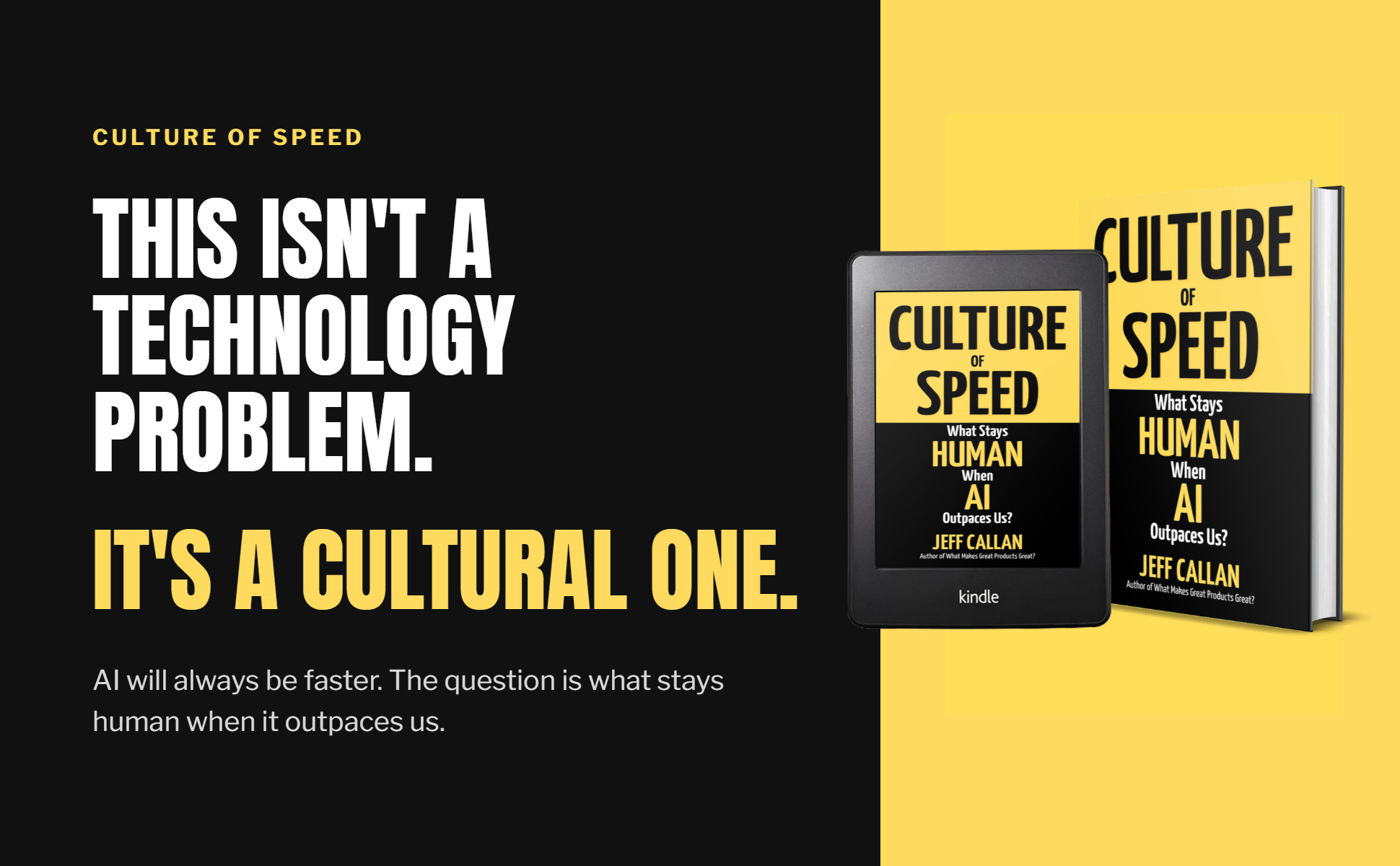
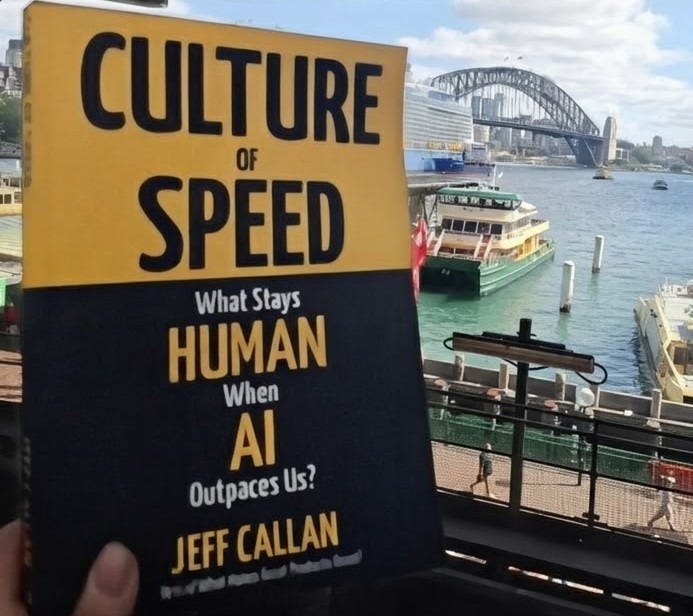
Glasp’s note: At Glasp, we value the relationships we’ve built with thinkers, creators, and doers who fuel curiosity and growth. This week, we spotlight Jeff Callan, author of Culture of Speed: What Stays Human When AI Outpaces Us? Jeff joined Glasp in May 2022, when we were still onboarding early users over video calls, and we met him that same week.
When his new book came out, we opened the acknowledgements and found this:
“Thanks to the team at Glasp, Kazuki Nakayashiki and Kei Watanabe. The reading list at the back of this book grew out of hundreds of highlights I’d saved there over the years. Your tool made it easy to find the thread running through everything I’d been reading.”
That is how this conversation started. Jeff highlighted what stood out as he read, copied those notes into a research file that grew past 600 pages, and linked his Glasp profile in the reading list so readers can see what he pulled from each article.
We asked him about the book, about what didn't make it in, and about what happens to a highlight after you make it.
If you want to reread or highlight this newsletter, save it to Glasp.
Questions
In one or two sentences, what is Culture of Speed about, and who did you write it for?
When ChatGPT and Claude were gaining everyone’s attention, I was thinking a lot about the idea of a human in the loop. I kept thinking the same thought “If people can’t make better decisions faster, organizations will logically hand more and more decisions over to algorithms.” Culture of Speed is about building teams that move fast and stay human, and it’s for leaders who want both.
Your subtitle asks what stays human when AI outpaces us. What is your answer, as far as you’d like to share before readers get to the book?
The simple answer is culture, judgment, trust and context. In the book, I talk about the idea of digital versus analog context. Imagine that you’re sitting in a face-to-face meeting with 10 people in the room. The digital context, what can be datafied, might be things like the agenda, action items, org chart and maybe a transcript from the meeting. Those are the things you’d share with your favorite LLM.
But when you’re actually sitting in the room with those people, there are potentially terabytes of sensory data and knowledge being generated. We filter through these things constantly without even thinking about it. It can be simple stuff like the room is cold or someone’s knowing smirk when a failed project is mentioned and everyone knows what that means. It could be knowing that the junior product manager actually has a better relationship with the CEO than the head of product because their daughters both play on the same girls’ soccer team and they talk for hours every Saturday.
This is the analog context and it’s why our lived experiences are still so valuable and important. Your LLM only gets the digital bits and that’s why culture stays human.
Where do you see speed helping teams, and where does it start to cost them something?
I like to differentiate between what I’d call ‘raw speed’ and what I define as effective or net speed. Let’s say you’re a gamer and you just got your copy of GTA6. You’re not just mashing the gas all the time. A good set of brakes is actually what lets you go hard steering into a curve. So I have this equation in the book:
Effective (Net) Speed = Raw Speed - (Friction + Error Costs)
What does that mean in real life? In Culture of Speed I talk about a category I call balancers. These are things that make teams go faster to a point but if you over-index on them, they’ll start slowing you down. Things like risk, process, quality, control and conflict. Let’s talk about risk. If you take zero risk, you’re not getting out of bed or leaving your driveway. But if you take all the risks, you’re going to be crashing into walls and making unnecessary errors that drive a bunch of restarts and rework. The trick is to find the balance point that allows you to go fast and minimize your errors.
Is there a story behind the book that readers do not know, or something you cut in editing that you still wish were in it?
There’s a ton of research that goes into writing a book, at least as I do it. That’s where Glasp became an essential part of my process. I identified articles using searches like “Impact of Trust on Organizational Speed” and then read those articles with Glasp. My research file grew to over 600 pages. So I started trimming. My first draft of the book was over 350 pages of text and I cut another 100 pages before the final version. A lot of good stuff didn’t survive.
The cut that stung the most was a story about my own analog context. I’m a candy maker. I’ve been making my Christmas specialties for decades. At one point, I was giving away more than 100 pounds of candy a year to family and friends. If I do say so myself, I’m pretty good at it.
There’s one thing that’s different about me from most candy makers. I don’t use any candy thermometers. I use my senses. I make my peanut brittle by smell. There’s a certain aroma that tells me when the peanuts are fully roasted and that’s when they taste the best. And I make my peanut butter fudge by sight. Over the years, I’ve learned what the boil and bubbles look like when the fudge is at just the right level of soft but firm where it can be cut into pieces and still melts in your mouth when you take a bite.
You can’t write that down for an LLM. I could give you my recipe and it still wouldn’t tell you what the peanuts smell like at the perfect moment. That’s analog context. It lives in the human experience but never makes it into the data. It was a great example, but didn’t quite fit the flow of the rest of the chapter so that story ended up not getting told until now.
Which book or author on your reading list shaped Culture of Speed the most, and why?
I’d say it was an article more than a book: Paul Zak’s “The Neuroscience of Trust” in Harvard Business Review. Zak’s research found that people at high-trust companies report 106% more energy at work and 76% more engagement than people at low-trust companies. In his experiments, oxytocin seemed to do one main thing: reduce the fear of trusting someone. And high stress means less oxytocin.
Fear is the first barrier in the book, the one I see slowing teams down most often. Trust is the first driver. Zak’s work provided the connective tissue between the two. When people trust each other, they stop spending energy protecting themselves and start moving. You can’t move fast when you’re afraid. That’s really one of the core ideas of Culture of Speed.
If Zak shaped what the book says, Smart Brevity by the Axios founders shaped how I said it. Keep it crisp and focused. Simplify. It pushed me to cut anything that didn’t earn its place. Nobody wants a 450-page book about speed.
How did your highlights turn into the reading list at the back of the book, and into the ideas in the chapters?
Every highlight is a small judgment call. You ask yourself “Is this part of the story I want to tell?” Tools like Perplexity could help me find interesting articles faster than I ever could on my own, but they couldn’t tell me which sentence in an article mattered. That part was mine. Each time I highlighted something in Glasp, I was deciding what was worth keeping, and those decisions became the ideas and stories I told in the book’s chapters.
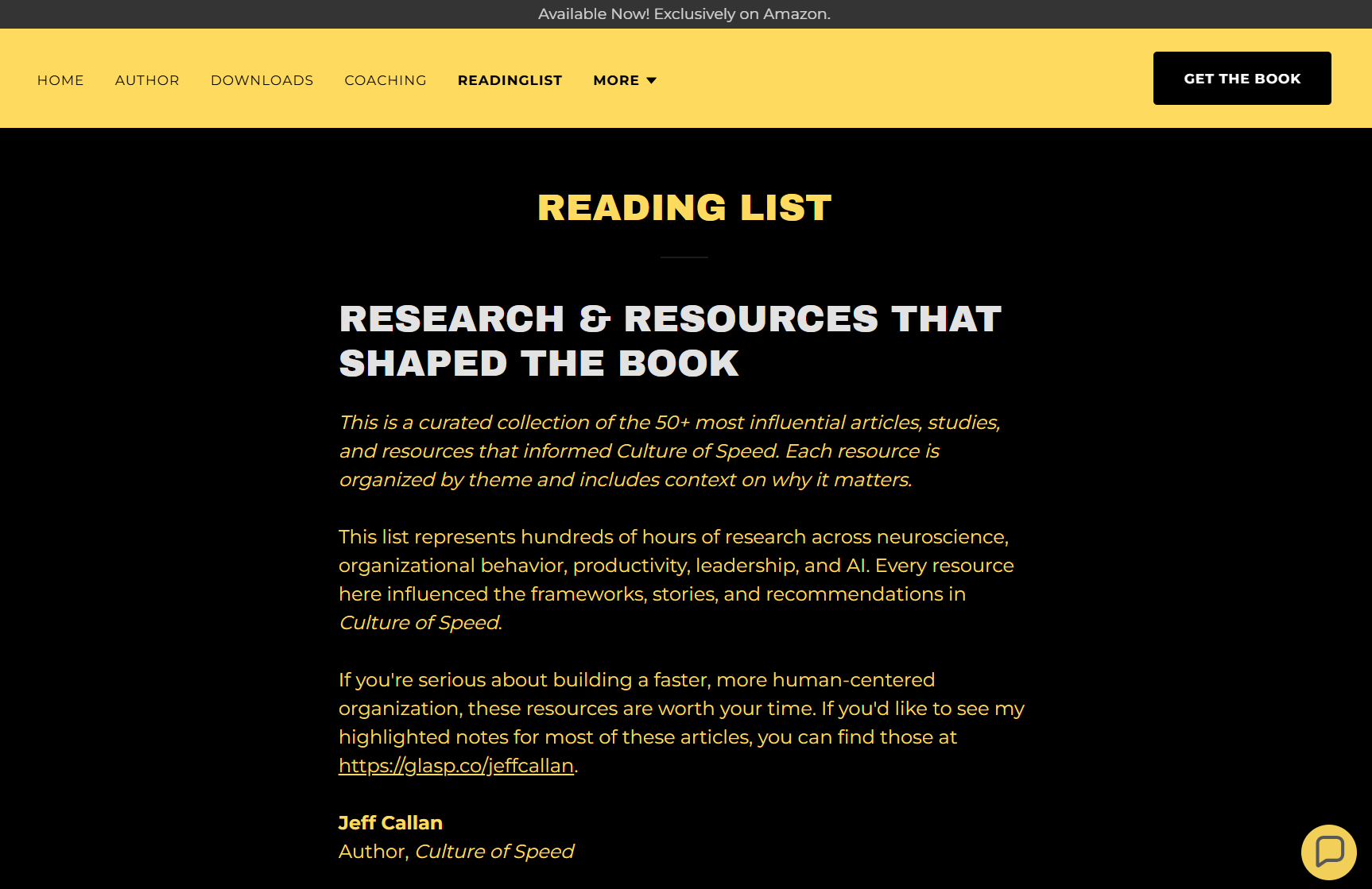
The reading list came from the same place. There are a ton of great articles and hundreds of hours of research across neuroscience, organizational behavior, productivity, leadership, and AI that the book was built on. This list takes the place of traditional footnotes, so readers can follow a thread they find interesting instead of chasing citation numbers. I also linked to my Glasp profile so anyone who wants to can see exactly what I pulled from each one. Together, the reading list and my Glasp notes let readers get into the headspace I was in while I researched and wrote the book.
In a way, it’s the book’s argument in miniature. The tools made the work faster. The thinking stayed mine.
Is there one highlight or note that changed the direction of the book? What was it, and what changed?
Not so much a single note or highlight but a pattern that emerges from looking at several of them. My original framework had two forces: barriers that slow teams down and drivers that speed them up. But as I was doing my research, I kept finding ideas about the same forces that contradicted each other.
Let’s take process as an example. Some of the articles said process speeds teams up. Process brings structure to chaos and helps get people moving forward quickly and consistently. But other articles suggested that process can bury a team in bureaucracy. As I looked at other forces, some of them like control, risk, quality and conflict showed up on both sides of the barriers/drivers line too. Eventually I realized this was pointing to a problem with my framework. These forces weren’t barriers or drivers. They were both, depending on how much of them you had. They speed you up to a point, and then they start pumping the brakes.
So I added a third category called balancers. The framework went from a list of things to remove and things to add to include these forces that were something closer to a set of dials you have to tune. Seeing that pattern emerge in my Glasp notes reshaped the entire book.
How do you go back to your notes now, and what do you look for when you reread them?
I think it’s really interesting to see all the articles and notes the book was built on in one place. When I go back to my notes now, I’m usually looking for the source behind a specific idea. Being able to tie an article back to the section of the book it shaped is like seeing the individual brush strokes in a painting or hearing an early demo of a favorite song. It’s why music artists like Elvis Costello or Bruce Springsteen put out deluxe box sets full of early takes of their songs: the biggest fans want to see how it was made. I figured some readers might want to dig into the source material behind the ideas the same way, so I shared my highlights.
There’s a practical reason too. Some of those articles have since disappeared or gone behind a paywall, but my notes are still there in Glasp.
What would you tell someone starting research for their first book or long project?
Start with an outline or hypothesis for what you want to write about but hold it loosely. You’re going to learn things you might not have expected. Set a deadline for the research phase. The research is the fun part, so it’s easy to just keep going down the rabbit hole.
Use Glasp to highlight as you read. Everything ends up in one place that you can search, review and share. Export everything into a research file.
Make writing a daily habit. When I was struggling with my first book, What Makes Great Products Great?, one of my connections, Eric Burgess, recommended the London Writers’ Salon to me. Several times a day, they have Writers’ Hour, a Zoom call where a couple hundred fellow writers show up and write in silence. I haven’t missed a single weekday in over four years and I’ve probably logged more than 2,000 hours there. Keep showing up. Do the work and eventually you’ll be holding a book in your hands.
From Jeff’s highlights
Jeff's Glasp page holds more than 4,500 highlights from about 350 pages, read since 2022. Two he kept from "The Neuroscience of Trust":
high engagement—defined largely as having a strong connection with one's work and colleagues, feeling like a real contributor, and enjoying ample chances to learn—consistently leads to positive outcomes for both individuals and organizations. The rewards include higher productivity, better-quality products, and increased profitability.
Oxytocin appeared to do just one thing—reduce the fear of trusting a stranger.
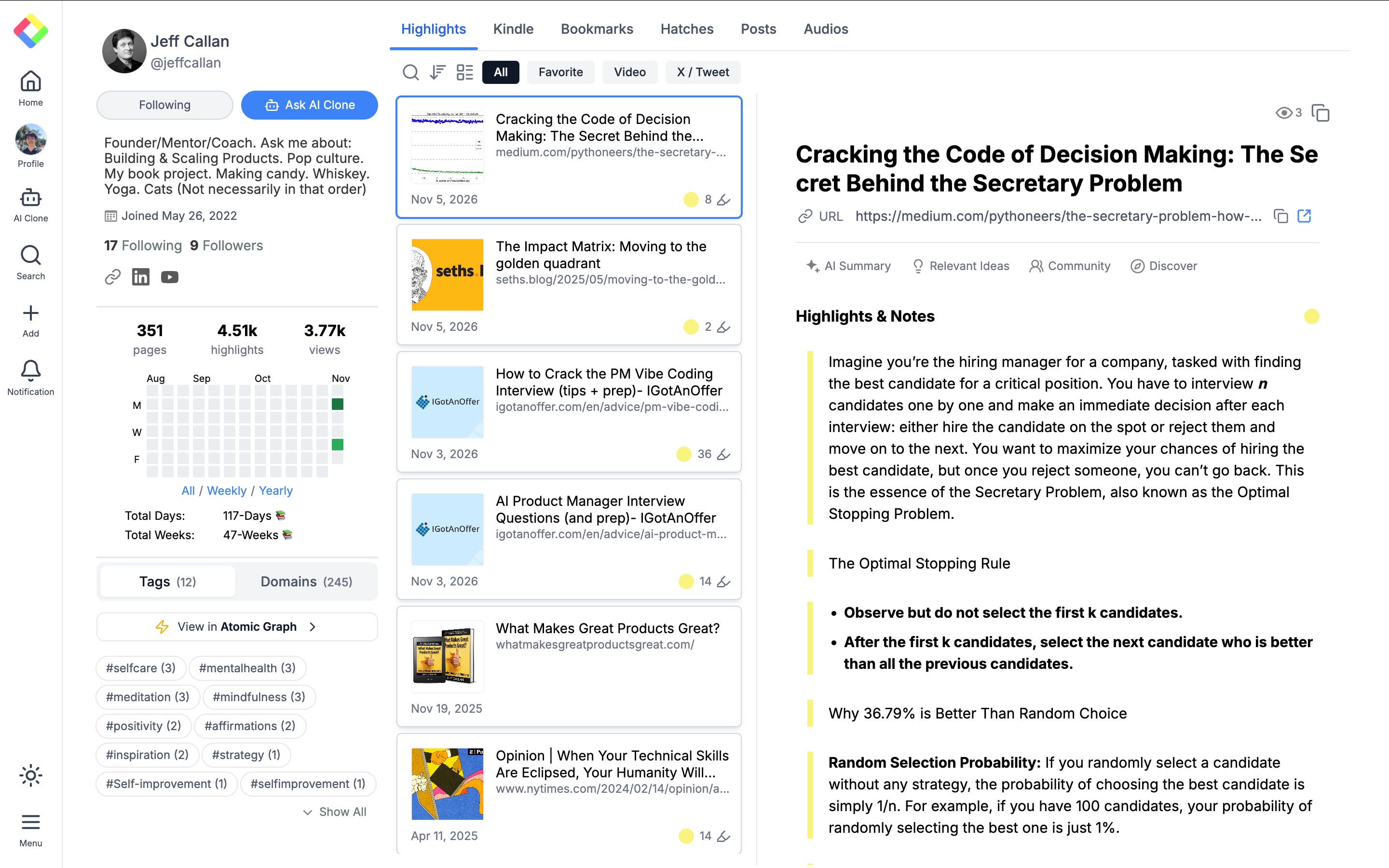
His highlights are public, so you can open any article and see the sentences he kept.
Culture of Speed
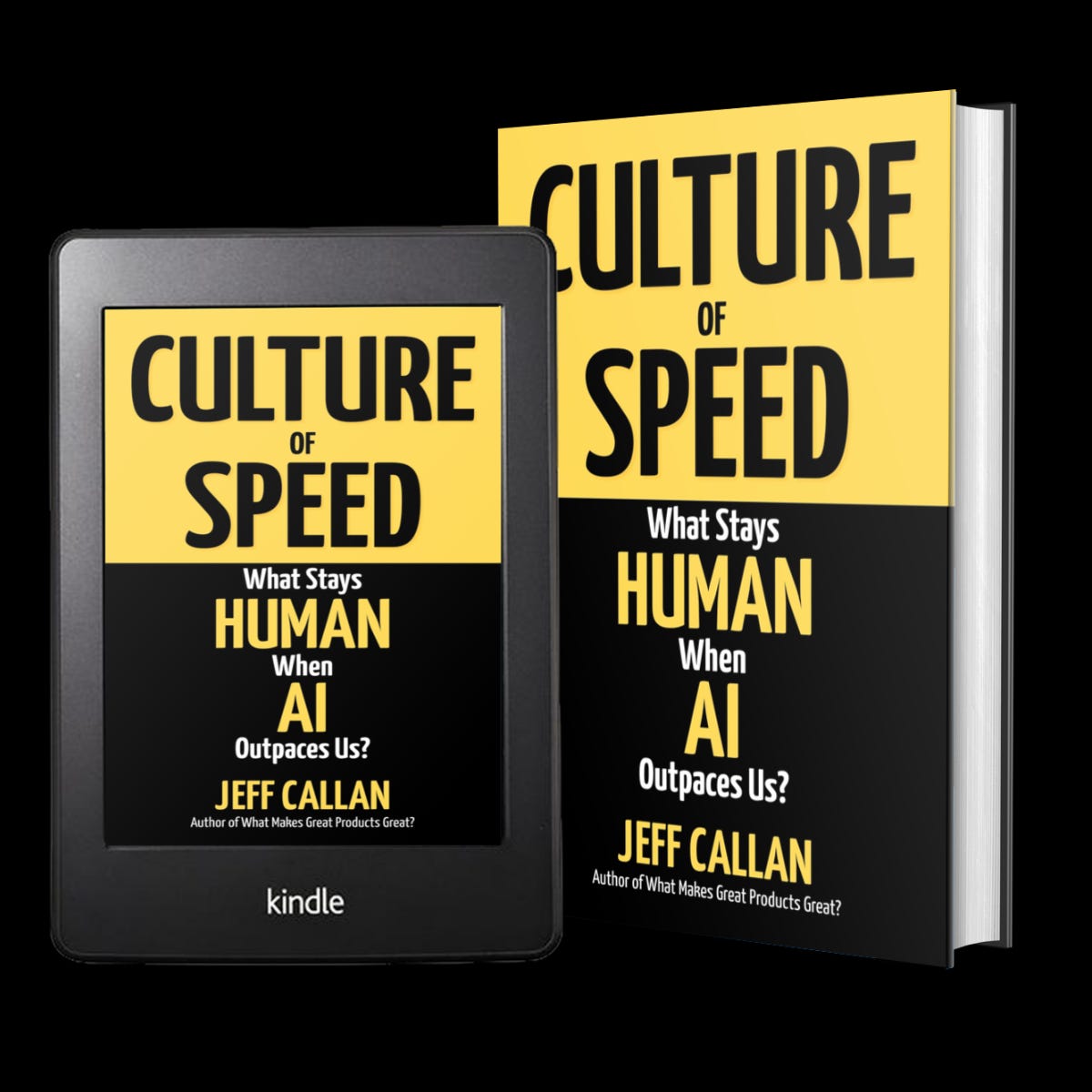
Jeff Callan's book is about building teams that move fast and stay human, for leaders who want both. More at cultureofspeed.com.
Would you like to take Glasp on the go?
With the Glasp mobile app, you can highlight and organize your favorite content anytime, anywhere. Stay productive on the move and never miss an insightful quote.
Partner With Glasp
We currently offer newsletter sponsorships. If you have a product, event, or service you’d like to share with our community of learning enthusiasts, sponsor an edition of our newsletter to reach engaged readers.
Thanks for reading! The highlights behind Culture of Speed are on Jeff's Glasp profile, the same ones his reading list links to:
https://glasp.co/jeffcallan?utm_content=pinned-comment
Which idea stayed with you most: analog context, net speed, or the peanut brittle you can't write down for an LLM? Tell us below.
Really interesting perspective on the relationship between AI, speed, and human judgment. I especially like the idea that effective speed is not simply about moving faster, but about reducing friction and the cost of mistakes. The distinction between digital and analog context is also powerful: AI can process information, but it often misses the subtle human signals, relationships, and lived experiences that shape good decisions. Ultimately, trust and culture are not obstacles to speed; they are what make sustainable speed possible. A great reminder that technology should accelerate human thinking, not replace the human judgment behind it.