The Glasp Newsletter goes to 550K+ subscribers. Sponsor an issue.
Hi friends,
Glasp Newsletter is a reader-supported publication. To receive new posts and support my work, consider becoming a free or paid subscriber.
This issue is a piece of Glasp Research here on Substack: we looked into a topic we have been curious about lately. If you are a founder, thinking about starting a company with AI, or a student weighing that path, we hope it is useful, so we are sharing it with you.
If you are naming an AI company, someone will tell you to get the .ai, and someone else will tell you that serious companies end up on .com. We read the public counts, the documented domain moves, and what Google and the mail providers have said. The short version: across all funded startups, .ai is common among new companies and rare among later-stage ones; among AI companies it holds about three to four in ten even on a late-stage list; the reported moves run toward .com; and we found no measurement we could verify of whether the ending changes traffic or email.
One caution: no source counts “AI companies” in general. Every figure below is for a named list. None of the companies named here sponsored this issue.
If you want to reread or highlight this newsletter, save it to Glasp.
We counted the 2026 Forbes AI 50 (list dated April 16, 2026) by hand on November 23, 2026, taking the names from a third-party copy of the list and checking most of the domains on the companies’ current websites: 24 of the 50 are on .com and 19 on .ai. Seven use other endings, such as Lovable on .dev. With 50 companies the margin is about 13 points either way, so the count cannot say which ending leads.
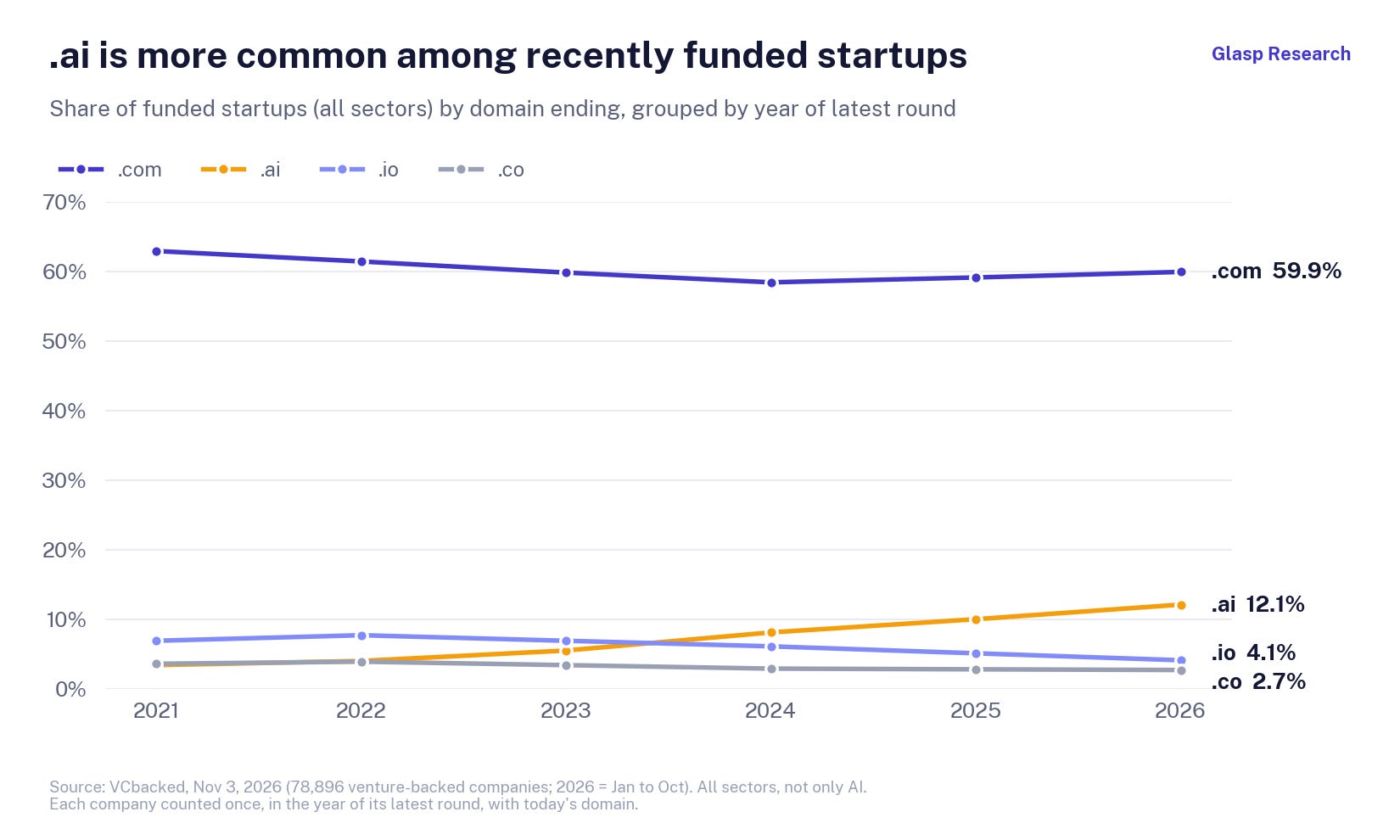
A larger sample points the same way. VCbacked, which sells startup data, looked at 78,896 venture-backed companies (November 3, 2026). Among those it tags as AI that raised since 2025, 31.8% use .ai and 44.0% use .com. Across all funded startups, not only AI, .ai is used by 3.4% of companies whose latest round was in 2021 and by 12.1% of those whose latest round was in 2026 (so far), while .com stays near 60%. Each company is counted once, in the year of its latest round, with today’s domain, so this is a snapshot sorted by year, not a record of what startups picked each year.
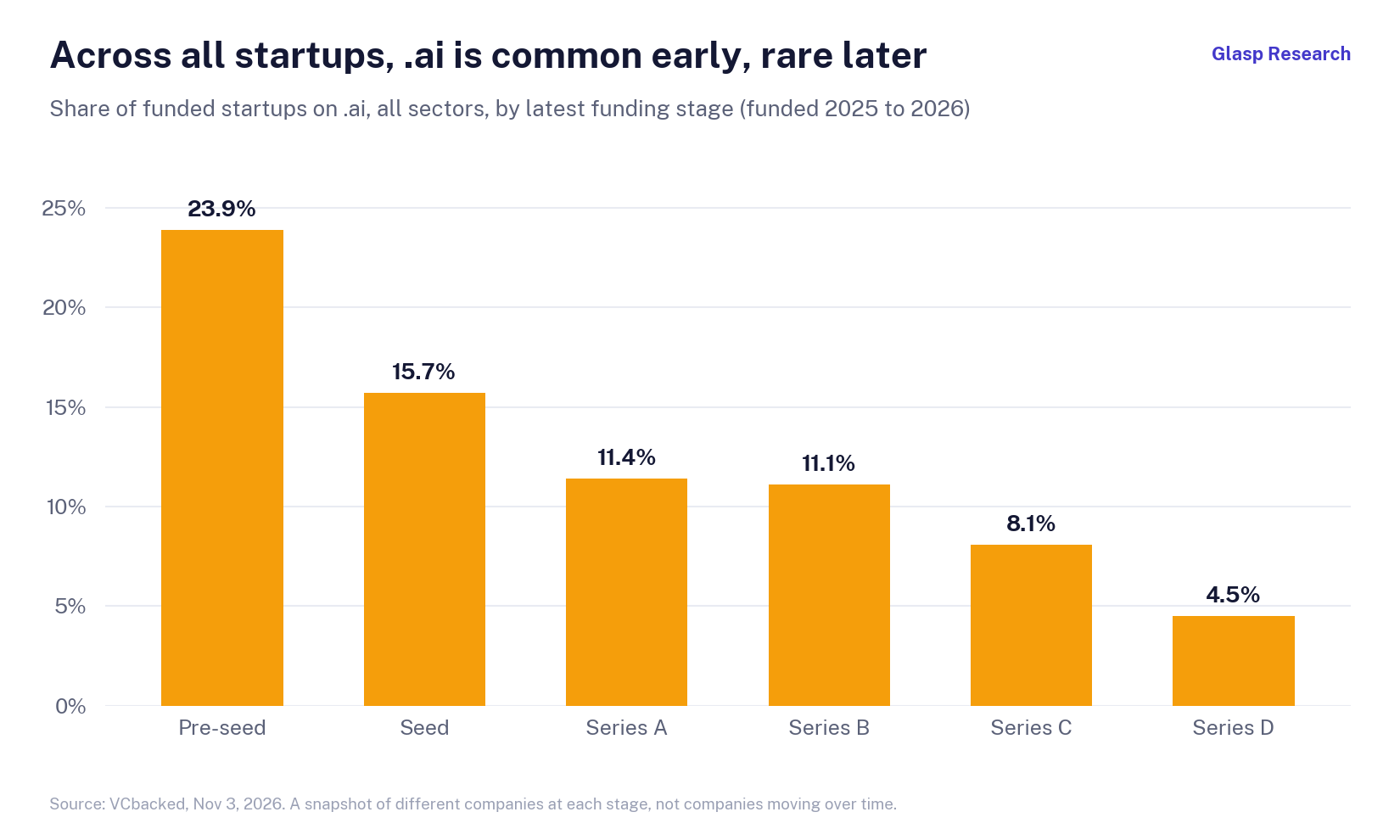
Across the same all-sector sample, the share falls with stage: 23.9% of pre-seed companies funded in 2025 or 2026 use .ai, 11.4% at Series A, 4.5% at Series D. That is a snapshot, not a record of moves: later-stage companies are older, and most of them are not AI companies. Among AI companies the picture differs: the Forbes AI 50, a late-stage list, is 38% on .ai.
Y Combinator shows the steepest rise. Identity Digital reported (August 4, 2026) that the .ai share among YC startups “rose from 8% in 2020 to a peak of 30% in 2025.” Identity Digital runs the technical side of the .ai registry, so it earns from the trend it reports, and a 2025 YC batch is mostly AI companies, which a 2020 batch was not.
Every count uses today’s website, so a company that started on .ai and later moved counts as .com.
Eliza, from a .ai name via eliza.io to eliza.com, 2025. Its founder, Stephen Garden, told Domain Name Wire (November 20, 2025): “I personally believe that .coms carry a lot more credibility.”
Cognition, cognition.ai to cognition.com, domain records changed in late May 2026, price under a non-disclosure agreement (DomainInvesting, July 29, 2026).
Scale, Suno and Bland have also moved from .ai to the matching .com; we found no public date.
These come from the domain press, which reports .com purchases far more than other moves, so the direction is what gets reported, not a measured trend.
The reverse happens as a first step up, not as a step away from a good .com: Cognition reached cognition.ai from cognition-labs.com in March 2024, for a name that reportedly cost US$110,000. We found no company that left its exact-match .com for .ai.
How often? We found no study, registry or broker report with a rate we could verify. These are documented cases, not a measured trend, and no AI company we found has published its traffic before and after such a move.
3. Does .ai bring more traffic from Google or ChatGPT?
We found no measurement we could verify. No ranking or click study comparing .ai with .com turned up, and no controlled test with AI assistants.
Google’s documentation lists .ai among the country codes it treats as generic. When .ai was added, Google’s Gary Illyes wrote (reported May 31, 2023): “What does this mean? In short, nothing.” John Mueller wrote in 2015: “Keywords in a TLD do not give any advantage or disadvantage in search.” These are statements, not measurements.
We found no statement from OpenAI, Anthropic, Perplexity or Google about endings in AI answers. Two sellers of AI-visibility tools published counts: Profound (June 2025) found .ai in 1.13% of ChatGPT citations, and Otterly.AI (updated May 7, 2026) found cited .ai and .com pages each cited 1.7 times on average. Neither divides by how many sites use each ending (W3Techs puts .ai at 0.3% of the sites it surveys, read November 23, 2026), so neither answers the question.
4. Does a .ai address affect email delivery?
We found no inbox placement test we could verify that includes a .ai sender.
The one email figure with a .ai row comes from Cloudflare (March 26, 2024): in January 2024, 21% of the mail its service saw from .ai senders was classed as spam and 0% as malicious. It gives no .com rate to compare against, and it says nothing about what happens to a legitimate company writing from .ai.
Google’s sender guidelines ask for authentication, a low spam complaint rate, and slowly rising volume from a new domain; they do not mention the ending. Mail gateways such as Microsoft Defender let a company’s admin block a whole ending, but we found no default list that names .ai and no count of companies that do it. The one report of trouble is Eliza’s: the reporter wrote that its .ai address “encountered technical issues with some corporate firewalls.”
5. If the .com is taken: the alternatives
The usual options are a prefixed .com (getname.com, tryname.com), .co, .io, .so, .dev, or .ai. Nothing measures which works better, so we do not rank them.
How common they are depends on the stage. In the Forbes AI 50 count, 23 companies are on their exact .com and none uses a get, try or join name. In YC’s Fall 2025 batch, SmartBranding counted 22 of about 155 with a prefix or suffix added to the name. Across funded startups in 2026, VCbacked puts .io at 4.1% and .co at 2.7%.
Moves from these to the exact .com are documented: Buffer from bufferapp.com, in its own account (2015); Loom from useloom.com in 2018, for US$150,000; Discord from discordapp.com in 2020. Lovable, on lovable.dev, bought lovable.com in August 2026; it has not said it will move.
Each alternative has a dated drawback:
Prefixed .com: visitors and customers reach the owner of the exact .com. Dropbox, then on getdropbox.com, had that problem in 2009.
.co: in March 2012 Overstock’s CEO said that of 13 people trying to reach O.co, “eight were typing O.com”.
Finding the owner. Under ICANN’s Registration Data Policy (in force since August 21, 2025), the owner’s name and contact details are usually hidden, but the registrar must publish a relay email or web form. ICANN’s request service is for law enforcement, IP holders and others with a legitimate interest; a wish to buy the name is unlikely to qualify.
Brokers. Where a buyer fee is published, it is about US$99 up front plus 20% of the price (Sedo). Many brokers publish no fee; ask for it in writing. All of them earn more when the price is higher.
Price. Among single English word .com names sold through Escrow.com, the median was US$45,000 in the third quarter of 2026, up from US$35,000 in the second (Escrow.com Domain Investment Index, Q3 2026, page 8). Coined or two-word names, and sales elsewhere, can be far lower or higher. The 20 largest reported .com sales of 2026 start at US$500,000 (DNJournal). Most startup purchases are never priced in public.
Paying. Use an escrow service. Escrow.com, also the source of the price figures here, earns a fee on each sale it handles: its standard fee works out to US$1,200 on a US$50,000 deal and US$12,000 on US$1,000,000. Afternic offers lease-to-own over up to 60 months; you do not own the name until the last payment. Ask whether a 60-day transfer lock will apply after the owner change (ICANN Transfer Policy).
Handles. Take them on day one. GitHub does not release usernames because they look inactive.
7. The same name on .ai and on .com: which costs more?
We found no study that prices the same word on both endings. Two comparisons can be made from public figures, and they give different answers.
A name nobody owns yet. .ai wholesale is US$80 a year, sold in two-year terms, so US$160 on the first bill. .com wholesale is US$10.97 a year from November 2026. That makes .ai about 7 times the yearly price and about 15 times the first payment, or about US$70 a year more in dollars. Registrars add their own margin on top of both.
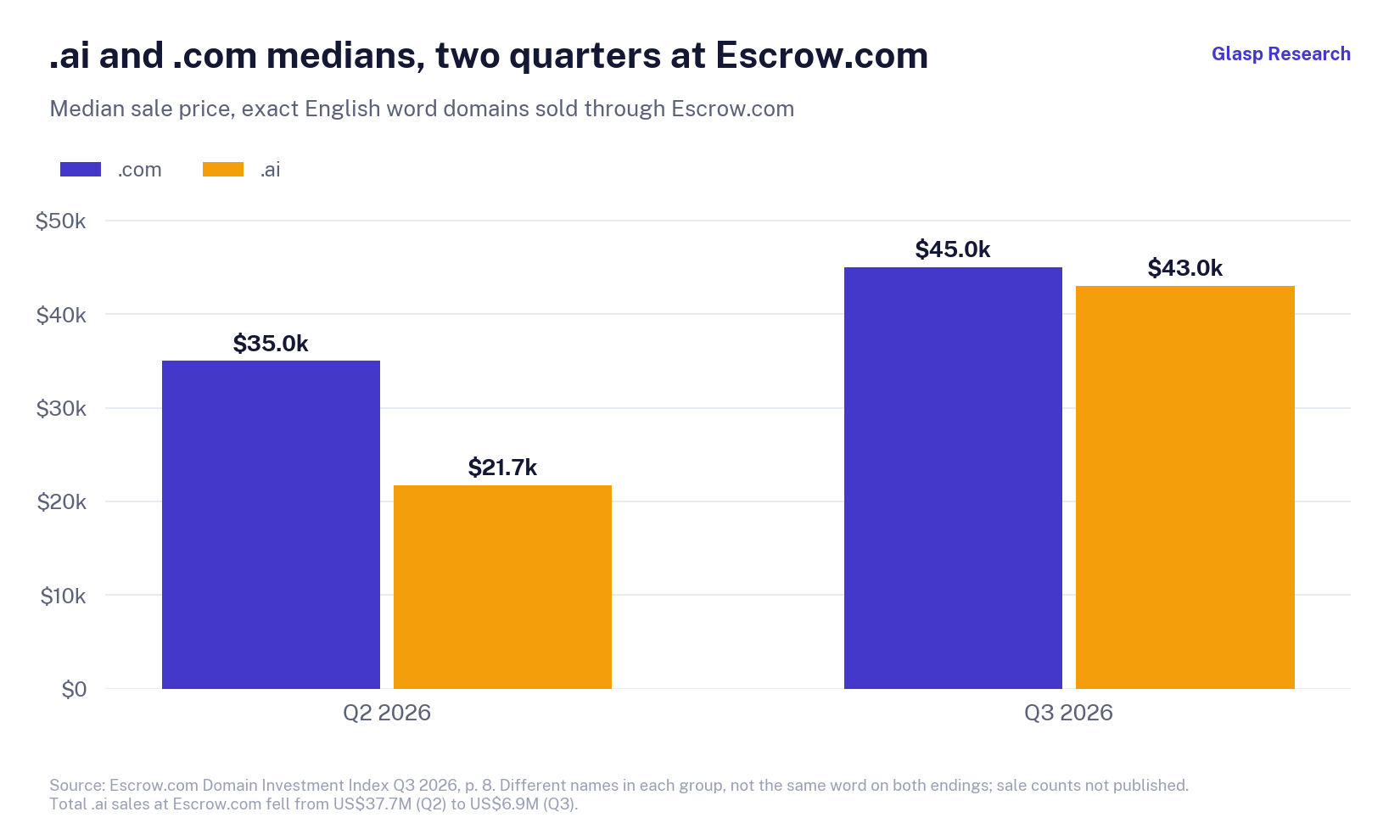
A name someone already owns. Escrow.com’s Domain Investment Index for the third quarter of 2026 splits exact English word sales by ending, with the same definition for each. The median exact-word .ai sold for US$43,000, up from US$21,700 the quarter before; the median exact-word .com sold for US$45,000, up from US$35,000. So in the middle of the market a .ai cost about 60% of a .com in the second quarter and about the same in the third. The same report shows how thin the .ai side is: total .ai sales at Escrow.com fell from US$37.7 million in the second quarter to US$6.9 million in the third, and the number of sales behind each median is not given.
The averages swing far more. The mean exact-word .ai was US$535,800 in the second quarter, just above .com’s US$529,600, then fell to US$121,700 in the third, against US$516,100 for .com. A handful of very large sales moves an average, which is why we lean on the medians.
Three limits: these are different names in each group, not the same word on both endings; only sales that went through Escrow.com count; and the report does not give the number of sales behind each figure.
The short answer: a free .ai costs several times a free .com, but the gap is small in dollars. For a name that is already taken, two quarters of medians are too few to say whether the ending moves the price: .ai was well below .com in one quarter and close to it in the next.
8. What this means for founders
Starting on .ai is normal. About three to four in ten companies on the AI lists above use it, and about a quarter of pre-seed startups in all sectors.
Do not pick .ai for traffic. There is no evidence it helps in Google or AI assistants, and Google says the ending is neutral. Pick it because the name is free.
If you plan to grow, look at the .com on day one. The reported moves go toward .com (Modular, Pickle, Eliza, Cognition), and buying a taken .com later is rarely cheap (part 6). A name whose .com is a live business in your field is the one to avoid.
If the .com is taken, every alternative has a documented cost. Pick knowing which one you are accepting; nothing shows one leads to better results than another.
Budget the real price. .ai is sold in two-year terms at US$80 a year wholesale since March 5, 2026, against US$10.97 for .com from November 2026. Buying a taken name later is a different scale: a single English word .com sold through Escrow.com had a median of US$45,000 in the third quarter of 2026, plus fees, and coined names or other venues can be far lower or higher (parts 6 and 7).
If you move, move once and by the book. Redirect every old address, keep the redirects at least a year as Google advises, and use Google’s Change of Address tool.
Measure your own case, for free. Set up SPF, DKIM and DMARC and watch your bounces and Google Postmaster Tools. In Search Console, check who ranks for your company name. Track visits from chatgpt.com, perplexity.ai and claude.ai month by month. If you hold the other ending, forward it and count stray visits and email for 30 days.
.io carries a question .ai does not. The code belongs to the Chagos Islands, whose transfer of sovereignty is not settled. If the code were ever withdrawn, ICANN’s rule starts a five-year phase-out window. No such decision has been made.
Lines 3 and 6 are our judgment from the documented cases, not from a measured rate.
Side note: who earns from .ai
.ai is the country code of Anguilla, a British territory in the Caribbean of about 15,000 people. Fees go to its government, and Identity Digital, which runs the technical side, takes 10% (Domain Name Wire, January 28, 2026).
Before 2023: 144,000 .ai registrations in 2022; .ai brought in around 5% of government revenue.
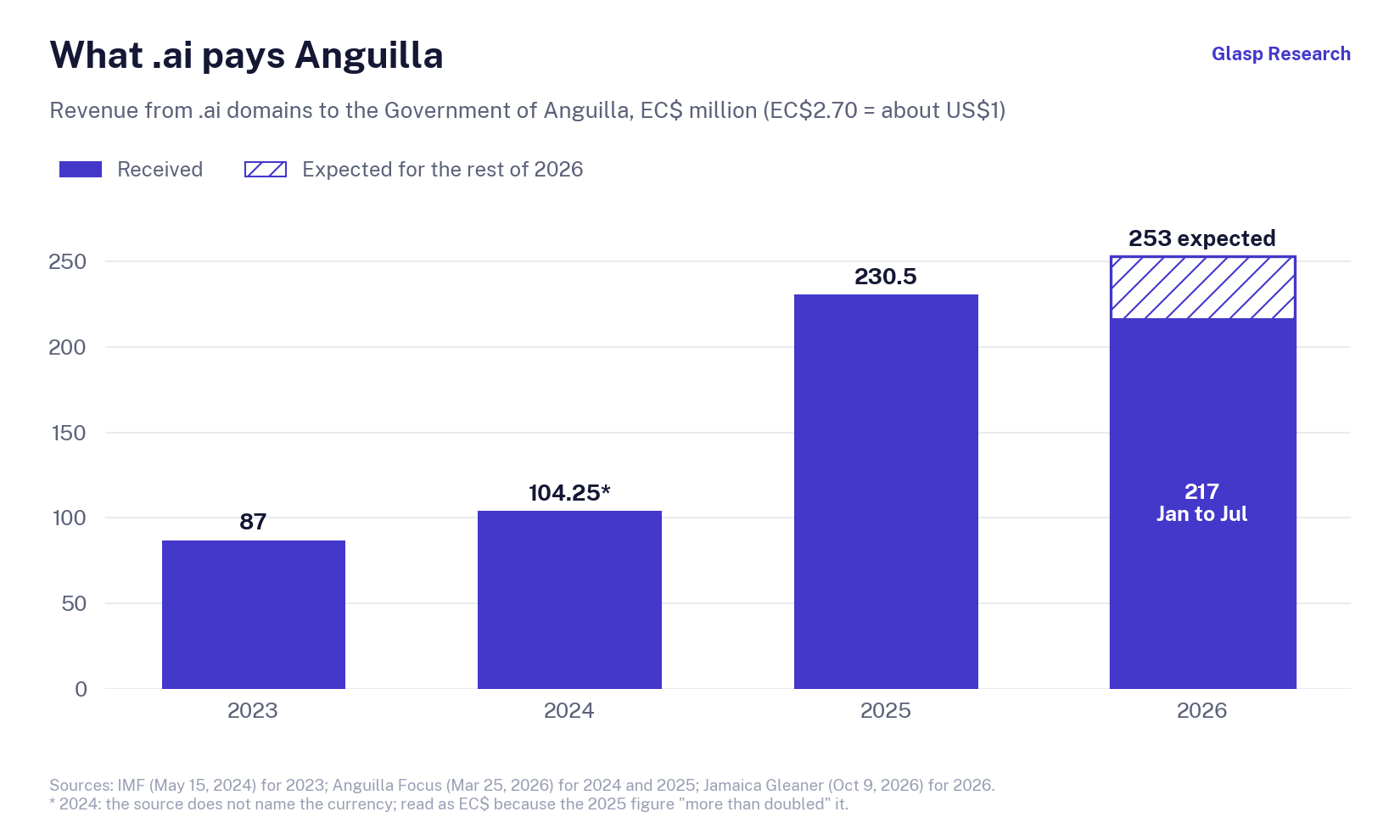
2023: 354,000 registrations; EC$87 million, just over 20% of government revenue.
2024: 598,007 registrations on January 2, 2025; 104.25 million (the source does not name the currency; we read it as EC$, since the 2025 figure “more than doubled” it).
2025: over 1 million registrations in January 2026; EC$230.5 million (about US$85 million).
2026: EC$217 million in January to July; EC$253 million expected for the year.
The turn came in 2023. The IMF credits “AI technologies like ChatGPT (launched in November 2022)” for the surge in demand. It also expected the share to settle near 15% of government revenue “as the initial rush slows”. The money is still rising (EC$230.5 million in 2025, EC$253 million expected for 2026), but the growth has slowed from more than doubling in 2025 to about 10% expected in 2026; we found no current share of government revenue to compare with the IMF’s 15%.
Why two years at a time? We could not find a reason published by the registry or the Government of Anguilla. The IMF and the domain press mention the two-year term without explaining it. What it does mean in practice is that every new .ai name pays Anguilla for two years up front, and the IMF reports that about 90% are renewed after those two years.
📣 Community Updates
🟦 New from Glasp Research: Our latest papers ask whether a small model trained on what readers highlight can beat frontier models at predicting crowd highlights, and whether a lesson an AI agent writes after one unlucky failure carries that bad luck into its next decision. Each paper comes with a plain-language explainer. 👉 Glasp Research
🟩 Did you know? Glasp can do more with YouTube transcripts than show them next to the video. You can copy a video’s full transcript to paste into your notes or an AI chat, and you can download the transcripts of many videos at once. 👉 How to Bulk Download YouTube Transcripts
We hope you enjoyed reading this newsletter!
See you next week ;)
Best, Kei and Kazuki
--
Would you like to take Glasp on the go?
With the Glasp mobile app, you can highlight and organize your favorite content anytime, anywhere. Stay productive on the move and never miss an insightful quote.
We currently offer newsletter sponsorships. If you have a product, event, or service you’d like to share with our community of learning enthusiasts, sponsor an edition of our newsletter to reach engaged readers.
This is a really insightful analysis of how domain choices reflect an AI company's positioning and long-term ambitions. I especially appreciate that it challenges the assumption that a .ai domain automatically improves SEO or visibility in AI-powered search. Ultimately, a domain should be a strategic branding decision rather than simply following a trend. While .ai communicates an immediate connection to artificial intelligence, .com still carries familiarity, credibility, and long-term flexibility. I also found the Anguilla revenue angle fascinating. It’s remarkable how the AI boom has created an unexpected economic opportunity for a small island. Great research!


Founders: did you start on .ai, .com, or something else, and would you pick the same ending today? We'd love to hear what made the call for you.
More from Glasp Research:
https://read.glasp.co/t/glasp-research
This is a really insightful analysis of how domain choices reflect an AI company's positioning and long-term ambitions. I especially appreciate that it challenges the assumption that a .ai domain automatically improves SEO or visibility in AI-powered search. Ultimately, a domain should be a strategic branding decision rather than simply following a trend. While .ai communicates an immediate connection to artificial intelligence, .com still carries familiarity, credibility, and long-term flexibility. I also found the Anguilla revenue angle fascinating. It’s remarkable how the AI boom has created an unexpected economic opportunity for a small island. Great research!