


Hi friends,
At Glasp, we are always doing research, and we write papers too. The further that work goes, the more it leads to the same place: models are built from data, and someone has to gather it, whether for a foundation model or for fine-tuning. Sooner or later you start asking what data should go in. So we got curious and looked into this market. We are still exploring whether there is something useful we can do here. This issue shares what we found along the way, so you can see this market too.
A note first: Glasp does not sell your highlights to AI companies. This issue is about how other companies get their data.
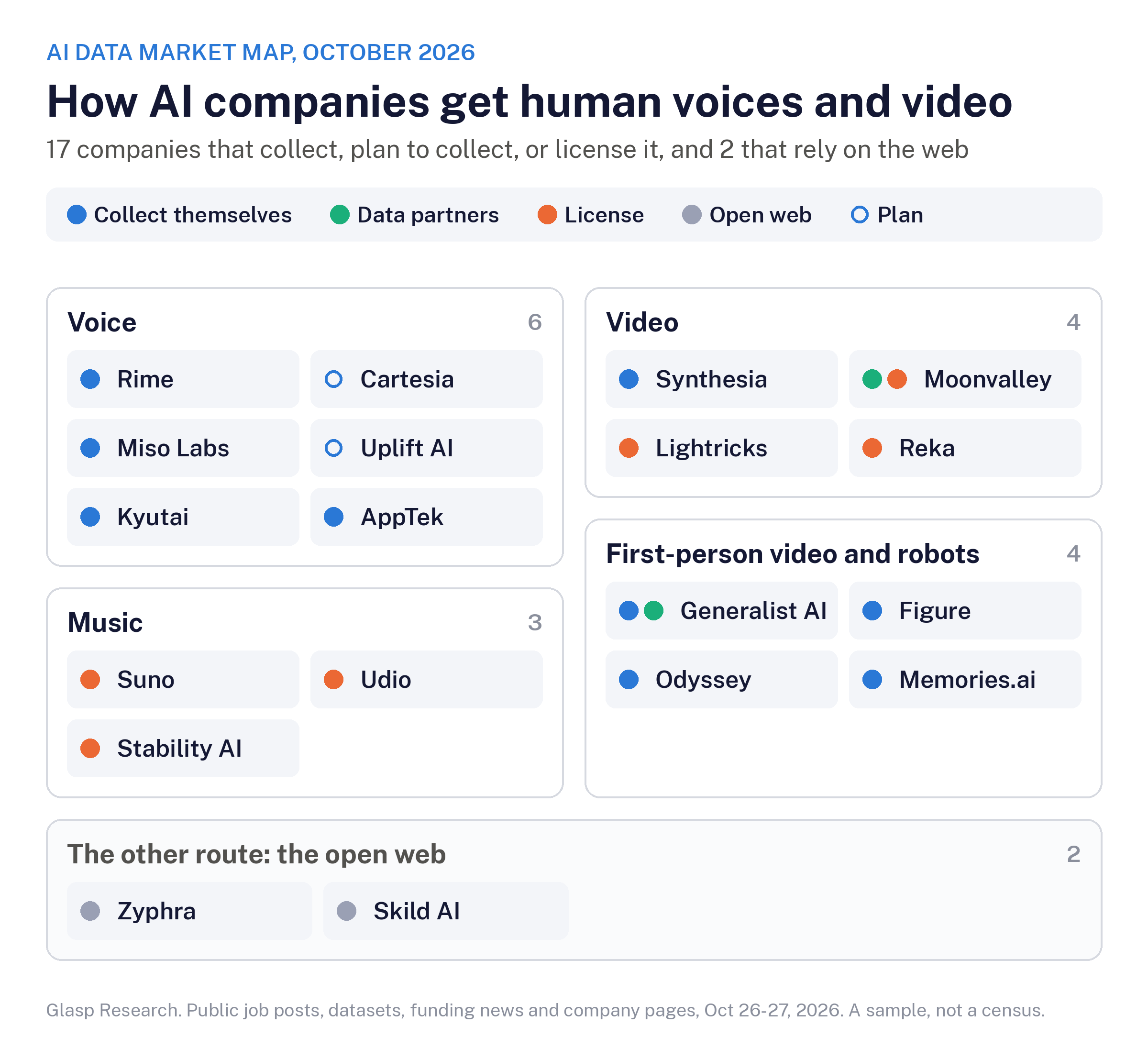
Voice, video, robot and music models now need data the open web does not supply well: two people talking on separate channels, a face reacting in real time, a task filmed the same way many times, music with clear rights. We reviewed 79 AI companies and mapped 17 that publicly describe collecting, commissioning or licensing this data, or plan to, plus two that describe using open-web data. None of the companies named here sponsored this issue or reviewed it before publication.
If you want to reread or highlight this newsletter, save it to Glasp.
Three routes to human data
Collect it themselves. Rime built a recording studio in San Francisco. Miso Labs records voice actors in its own studio and in their home studios, and says its data set is over 100 million hours. Memories.ai’s “data collectors” wear a camera device it built. Odyssey has people hike with camera rigs on their backs.
Through data partners. Generalist AI trains its robot model on more than 270,000 hours of real-world data, collected partly “together with multiple data foundry partners” it names only as A, B and C.
License from owners. Moonvalley, Lightricks and Reka license video from stock libraries and rights holders. Suno, Udio and Stability AI have licensing deals with record labels.
And a fourth, cheaper route: the open web. Zyphra says the 200,000 hours of speech behind its voice models came from the web, not from data brokers.
What it sells for (three prices, not comparable)
These examples are not directly comparable: one open read-speech dataset is free to use, while one vendor lists licensed, documented two-person conversation datasets at $60 to $95 per audio hour.
WhatPriceNoteA vendor’s conversation datasets$60 to $95 per audio hourTwo-person recordings with transcripts, rights and consent documents. What a buyer pays, not what a speaker earns (SpeechData.ai)Mozilla Common VoiceFreeAbout 42,593 hours of read speech in 295 languages (Mozilla)What one app paid people$9 to $18 an hour$0.15 a minute, doubled if the other person also used it, $30 a day cap. The app went offline about a week after launch, after a flaw exposed recordings (Malwarebytes)
Do you need to be an expert?
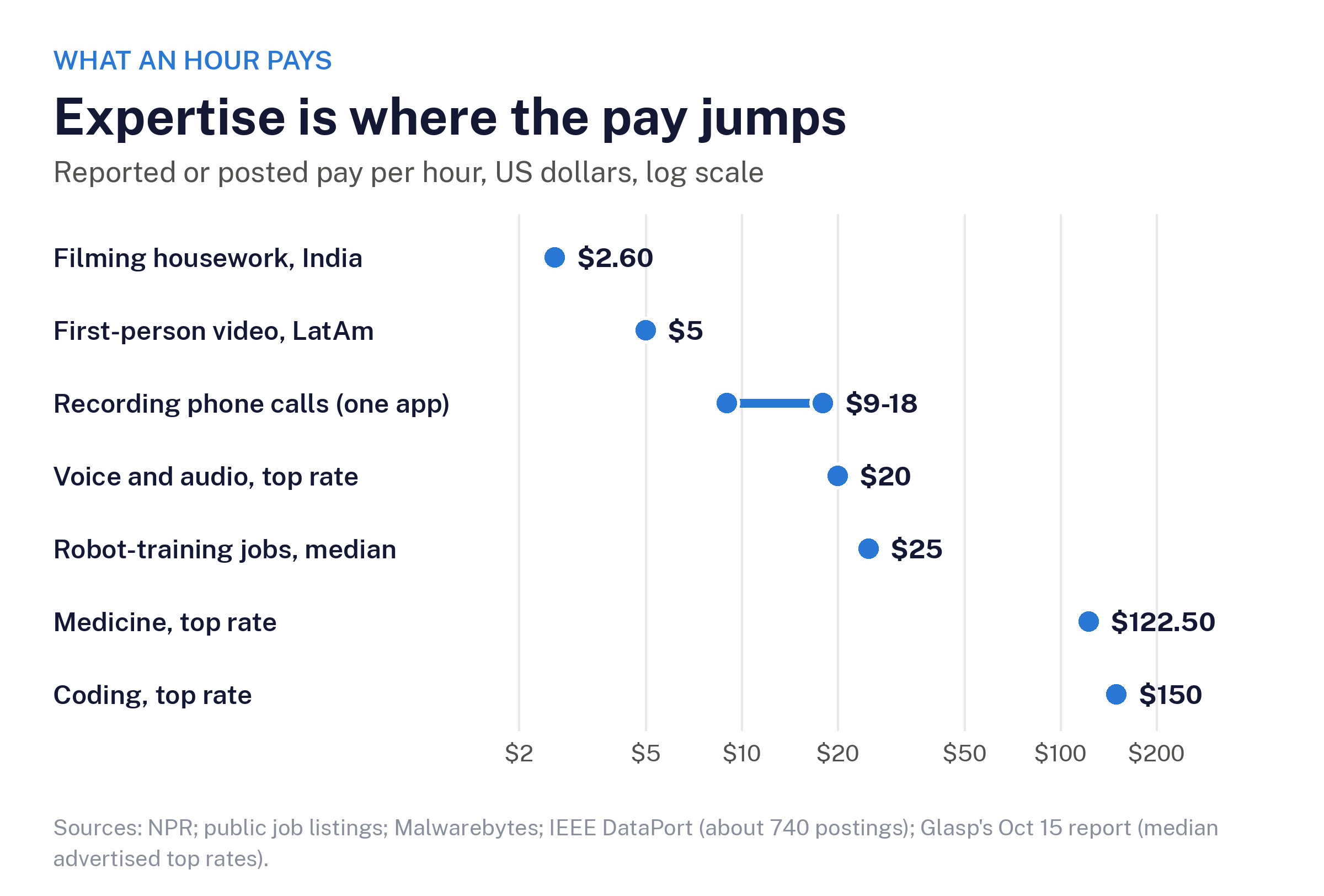
For some high-volume collection work, no. Public listings for first-person video ask for a recent phone and time, and NPR found a worker in India recording housework for about $2.60 an hour (NPR). Lower labor costs are one reason so much robot video is filmed in India and Latin America; NPR reported that most domestic-video clients of one Indian collector were in the US. Reporting also identifies a smaller skilled layer, with trades such as plumbers and electricians filmed on the job, and a tracker of about 740 robot-training job postings puts the median posted rate at about $25 an hour.
Voice asks for a different skill: performing. AppTek recruited speakers to role-play call-center conversations, and Miso Labs records voice actors working from scripts. Credentials pay most in labeling and evaluation. In our October 15 report, the median advertised top rate on AI work platforms was $150 an hour for coding and $122.50 for medicine, against $20 for voice and audio work.
Is this market growing?
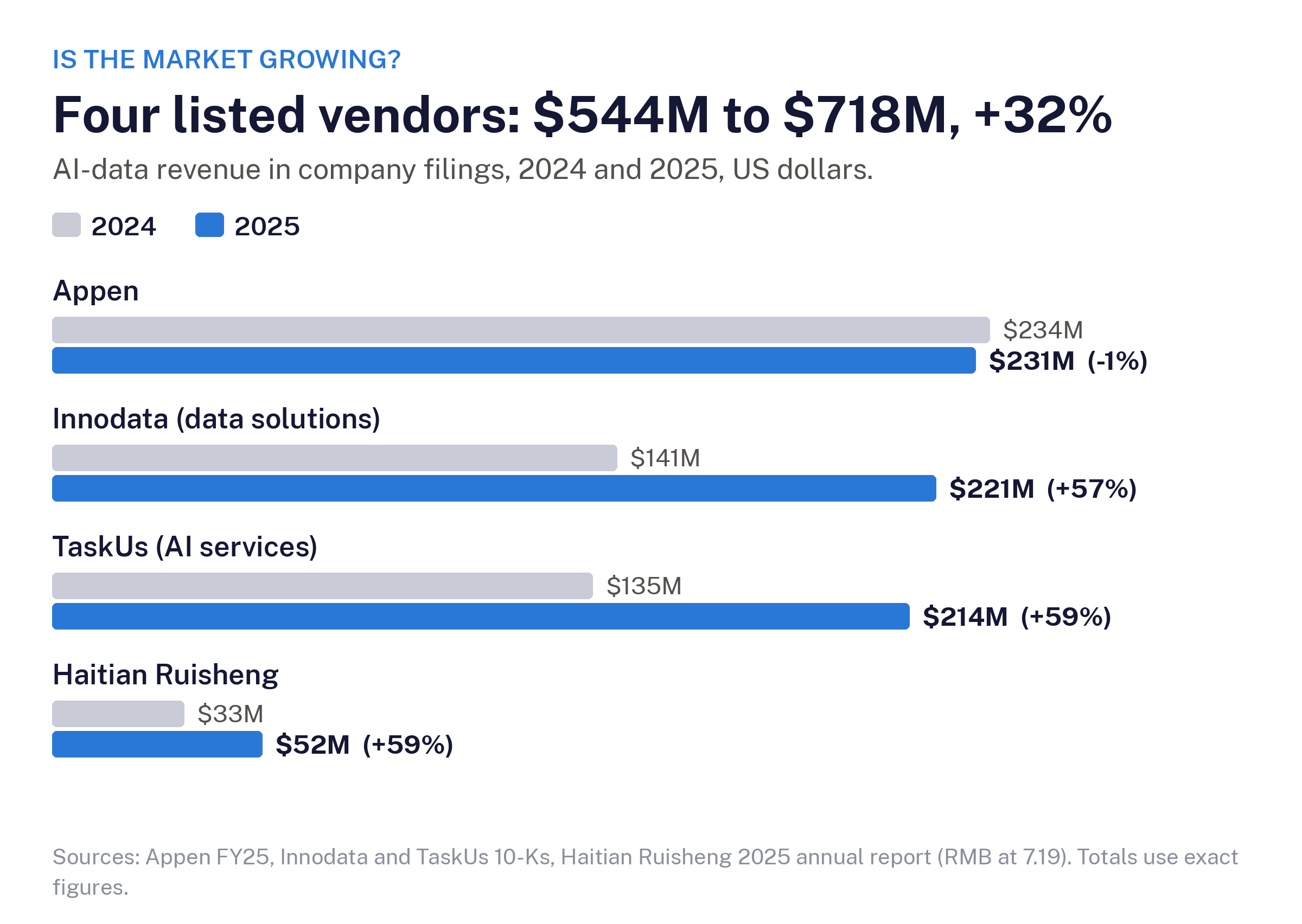
Yes, as far as anyone can measure it. Only a few listed companies report revenue from AI data work separately. In our October 15 report we added up the four we found: $544 million in 2024 and $718 million in 2025, up 32% (totals from the exact filing figures; the chart’s company bars are rounded). That is a floor, not the market.
The private companies are larger. Mercor reports a gross run rate above $2 billion (June 2026) and micro1 above $1 billion (October 2026), by their own or press figures that mix gross and net revenue. For robots alone, robotics companies are “spending more than $100 million each year to buy real-world data”, one data company estimates (MIT Technology Review, April 2026). And the mix is shifting: at one listed vendor, computer-vision revenue tripled in 2025 while speech fell 9%.
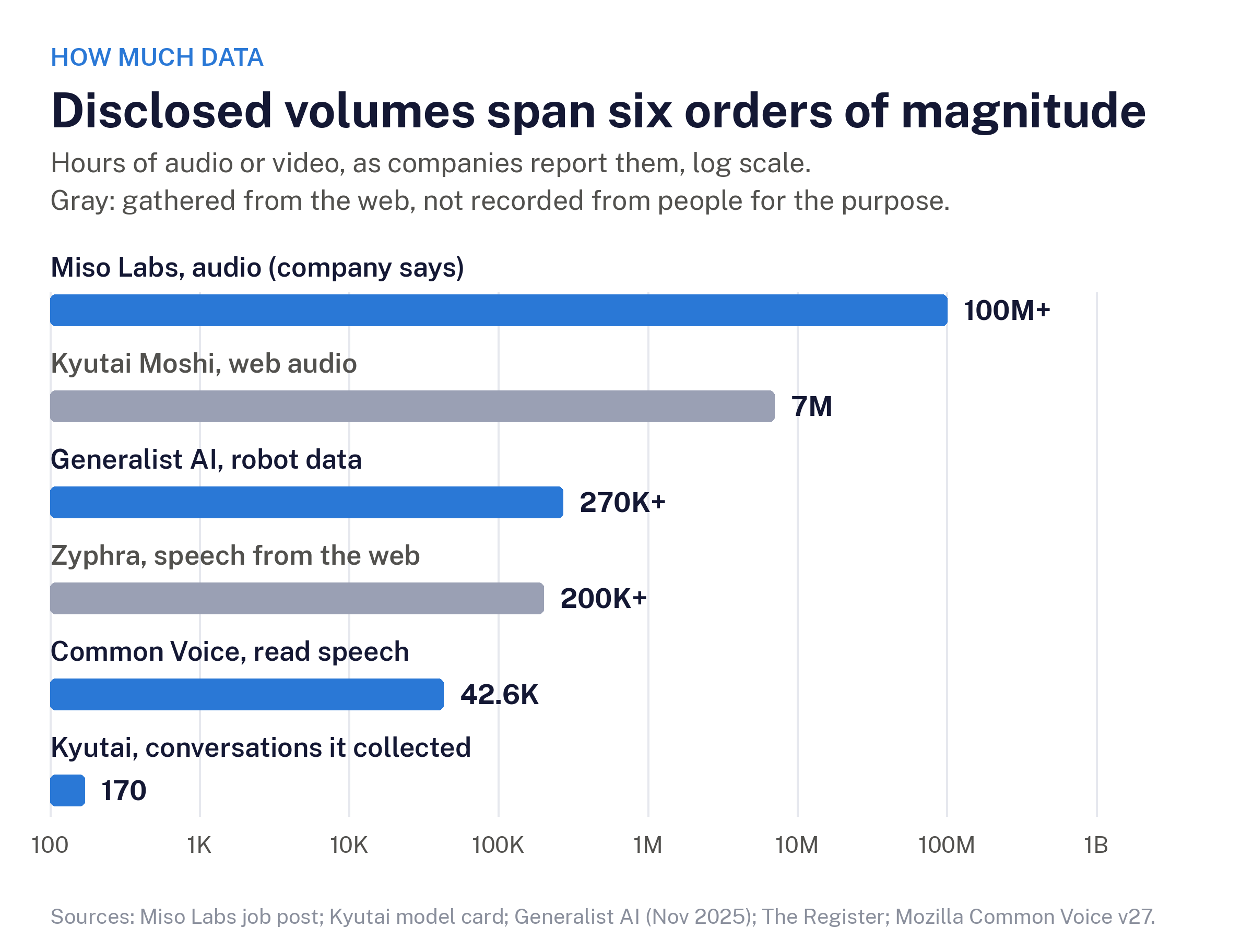
The volumes are growing too, and they span six orders of magnitude:
Where we think this is going
This part is our view, not a reported trend. It comes from reading the sources above and from our own research.
1. Hours get cheaper; the right hours do not. Volume is growing fast: one platform alone takes in more than 160,000 hours of first-person video a month, and collectors talk about targets of 10 million hours. Generic data, read speech and simple household footage, will keep getting cheaper because anyone can produce it. What stays expensive is what is hard to produce: a particular kind of conversation, a particular place, a particular task done well, with consent on record. We have no price history to prove the first half; it is our inference from growing supply and the contrast between generic and specialized collection.
2. Voice is going vertical. General conversation is getting easier to collect; field conversations are not. The next voice models are for medicine, customer support, sales and law, and the real conversations in those fields are private by default. So the data will increasingly be performed: role-played by people who know how a nurse, an agent or a salesperson actually talks. That favors people with real field experience over generic speakers. We think the next scarce kind may be people explaining and debating ideas: someone talking through a paper they read, or two people arguing about an article. That is closer to how people actually use AI assistants than casual chat, and almost none of it is recorded with consent.
3. Faces cost more than voices. Consented video of people talking, listening and reacting is scarce in public datasets, and it carries a person’s likeness, not only their voice. Expect it to stay at a premium, and expect the consent terms to get stricter.
4. Physical AI is splitting in two. A wide, cheap layer of first-person video from many countries buys variety. A narrow, better-paid layer (teleoperators, skilled trades, real workplaces) covers the tasks where how the work is done matters. The second layer is small today. We think it is where the value per hour will be.
5. Expertise moves to judging, not just doing. As models produce more of the content, the scarce human work is checking it: is this clinical note right, is this research plan sound, is this agent’s answer safe. That is already the best-paid work in this market, and we expect it to grow faster than collection.
6. Consent becomes the product. Lawsuits are already applying biometric privacy law to robot cameras in Illinois. Buyers will pay more for data whose consent, rights and provenance are documented, and less for data that may have to be deleted later. The companies that can show who agreed to what will win the better contracts.
7. Smaller buyers move first. The largest labs build their own pipelines. The many startups on this map cannot, so they buy, license or partner, and they need data that exists now.
8. Long tasks need long recordings. Most first-person video today comes in short pieces: AFP describes a worker recording around 90 clips a day of about four minutes each (AFP via Khaleej Times). Robots and agents that must finish long tasks, cooking a whole meal or completing a repair, need the whole task recorded without cuts, along with what the person was trying to do at each step. Narration helps here: a person saying “now I’m checking the seal” turns audio into a label for the video. Our hypothesis is that complete, narrated recordings of long tasks will be worth far more per hour than short clips.
9. Failure may be the most valuable data. Almost everything collected today is a success: the demonstration that worked. But a robot or an agent in the real world spends much of its time recovering from mistakes, and successful demonstrations rarely show how. Robotics research has long trained on moments where a human expert steps in to correct a robot (HG-DAgger, 2018). The same applies to voice: misheard words, interruptions and corrections are what a real conversation is full of. Our hypothesis: as successful demonstrations become plentiful and cheap, recordings of things going wrong and being put right will become scarce and expensive.
10. The hard part for a data company is the second sale. A fixed dataset may generate only a limited number of sales. Non-exclusive licensing permits resale, but some buyers want custom or exclusive material, and an exclusive deal ends resale. We therefore expect recurring revenue to depend more on continuing collection and services than on a static catalog, which makes these companies dependent on a few buyers. The filings show it: at one listed vendor the largest customer was 58% of revenue, and at another the top five were 74% (our October 15 report).
11. People do not stay. A sign-up is not hours. We expect most contributors to record a little and stop, while buyers need people who keep going for weeks; one platform asks for at least 10 hours a week (CNN). So providers keep paying to recruit, and finding people who stay is a large part of what the price pays for.
12. Can the valuations hold? If a fixed dataset sells only a few times, how do the fastest-growing data companies keep growing? Mercor raised $350 million at a $10 billion valuation in October 2025 and charges an hourly fee on the expert work it places (TechCrunch), and it has since been reported to be in talks at about twice that. Our answer, as a hypothesis: the winners do not sell datasets, they sell hours of skilled work, and the demand renews because data expires. Each new model generation needs harder examples, evaluation sets leak into training and have to be replaced, and a model that has learned one skill needs data for the next. That is closer to staffing than to licensing. The risks are just as visible: a few labs buy most of it, and the largest labs can build their own pipelines. Figure wrote in August 2026 that “vendors couldn’t hit the throughput, diversity, or quality bar” its model required, “so we built the pipeline ourselves”. Whether the growth lasts depends on whether “harder data” keeps being needed faster than the labs can make it themselves.
13. Collection may run on Android first. Listings already accept recent models of both iPhone and Android. Our hypothesis is that differences in device cost, operating-system restrictions on camera and background recording, and local market share may make Android the faster or cheaper collection platform in some countries, especially where it is the phone most people carry.
What nobody tells the people in the data
Across all 17 companies, not one public source we found says what the people in the recordings were paid. The licensing deals are between companies, and the largest data partners go unnamed. If you are ever asked to take part in a project like these, ask four things:
Consent you can read: who gets the recording, for what, and for how long.
Everyone recorded: get clear agreement from everyone whose voice or details may be captured. Rules vary by place.
Storage: who keeps it, and how.
Pay for the time: what happens to a recording that gets rejected.
Best,
Kei & Kazuki
Would you like to take Glasp on the go?
With the Glasp mobile app, you can highlight and organize your favorite content anytime, anywhere. Stay productive on the move and never miss an insightful quote.
Partner With Glasp
We currently offer newsletter sponsorships. If you have a product, event, or service you’d like to share with our community of learning enthusiasts, sponsor an edition of our newsletter to reach engaged readers.
Most of the data on this map comes from people talking, filming or performing for a model. Would you ever take part in a project like this, and what would you need to know first? Or if you already have, what was it like? I'd love to hear in the replies.
If a line in this issue stuck with you, highlight it here and it will be saved to your Glasp library:
https://glasp.co/save?u=https://read.glasp.co/p/ai-data-market-map-how-ai-companies-get-human-voices-and-video
The most interesting insight here is that the real value in AI data may not be volume, but context, expertise, and consent. As generic data becomes increasingly commoditized, authentic human interactions, domain-specific knowledge, and recordings of mistakes and corrections could become much more valuable.
I especially agree with the point that consent and provenance will become competitive advantages, not just compliance requirements. However, there’s a fundamental question the industry still needs to answer: if human voices, faces, skills, and experiences become valuable inputs for AI, how should the people contributing them share in the value created?
The next phase of the AI data market may be defined as much by fair compensation, data ownership, and trust as by model performance.