


Glasp’s note: At Glasp, we value the close personal relationships we’ve built with thinkers, creators, and doers who fuel curiosity and growth. This week, we spotlight Bobby Powers —a lifelong learner passionate about leadership development and continuous improvement. With more than a decade of experience leading teams and developing learning and development at startups, Bobby understands the transformative power of curiosity and mentorship. You might remember him from his Glasp Talk appearance, where he shared insights on leadership and personal growth, inspiring thousands. We’re honored to continue learning from Bobby and are thrilled to share his thoughtful reflections with our community.
If you want to reread or highlight this newsletter, save it to Glasp.
Hi, I’m Bobby Powers! I run the Leader & Learner publication, where I share two posts per week that will help you become a more curious leader and learner.
Unlike most people, I didn’t get addicted to reading because it’s fun (even though it is). I got hooked when I realized books could help me improve many aspects of my life.
Countless times, I’ve read about a topic one day, only to have that knowledge immediately help me solve a problem a day or two later. That immediate feedback loop is invigorating, and it’s kept me coming back for more.
That’s one of the biggest reasons why I read much more nonfiction than fiction. I love learning new principles I can apply to my life and work. But the only way to harness those kinds of meaningful insights is to read deeply, which is the purpose of this post.
Here are 10 tactics to get more out of what you read:
1. Read with a pen in your hand
“A great reader respects the book by NOT respecting the book.” -Ryan Holiday
I used to treat my books no differently than a library book. It felt wrong to deflower the pages with my scribbles, so each margin remained milky white. But then I heard that many of the top readers throughout history took copious margin notes, so I gave it a shot. My reading comprehension skyrocketed. Writing in the book helps you fully immerse yourself in the text and signals to your brain what’s important.
Do you think that writing in a book is disrespectful? I couldn’t disagree more. Any author would prefer to see a tattered, highlighted, well-worn copy of their book than an unblemished one. Respect the author by pulling out a pen or pencil and going nuts.
2. Use the book’s back cover to create a one-page cheat sheet
“Never read without taking extracts.” -Pliny the Elder
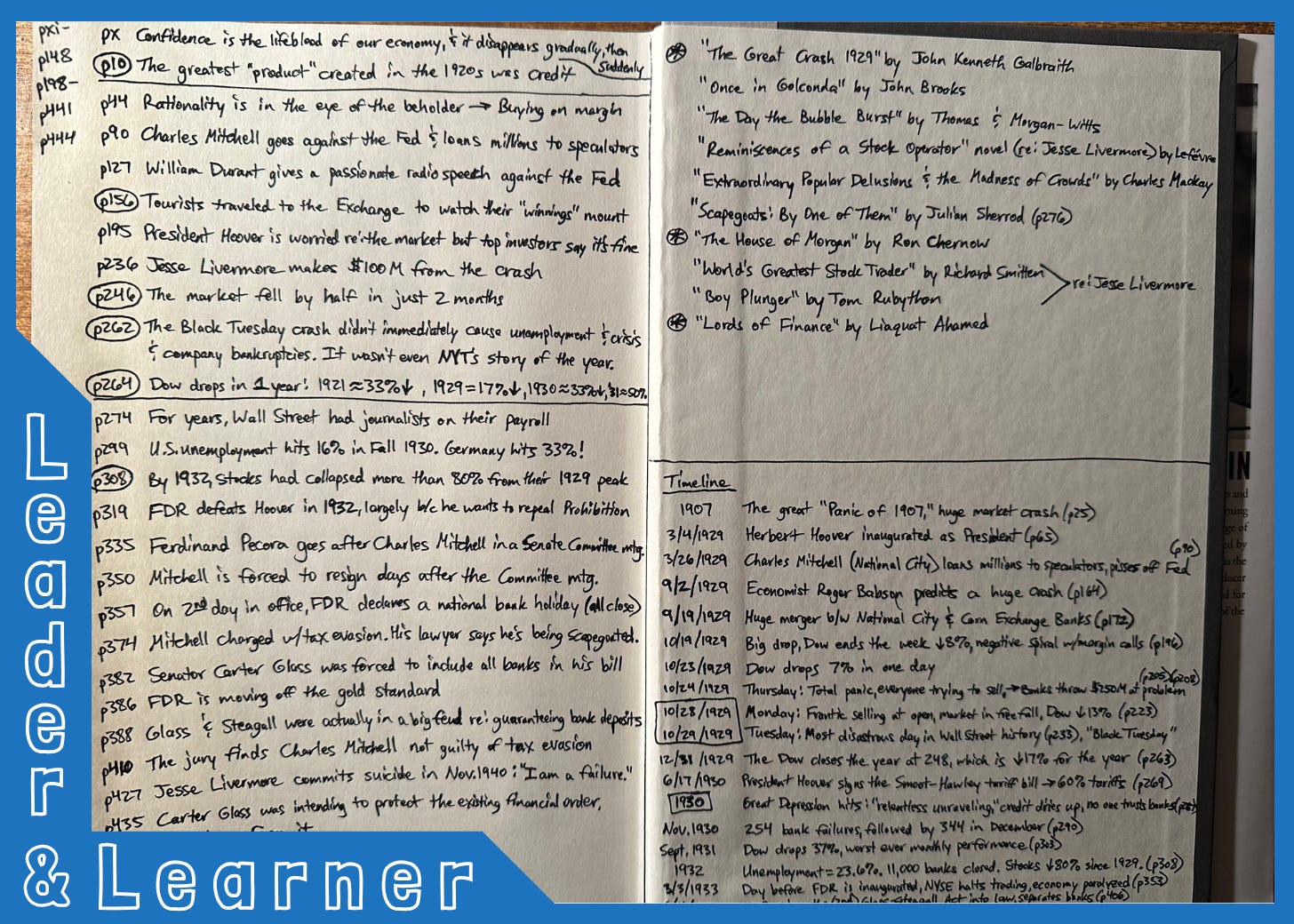
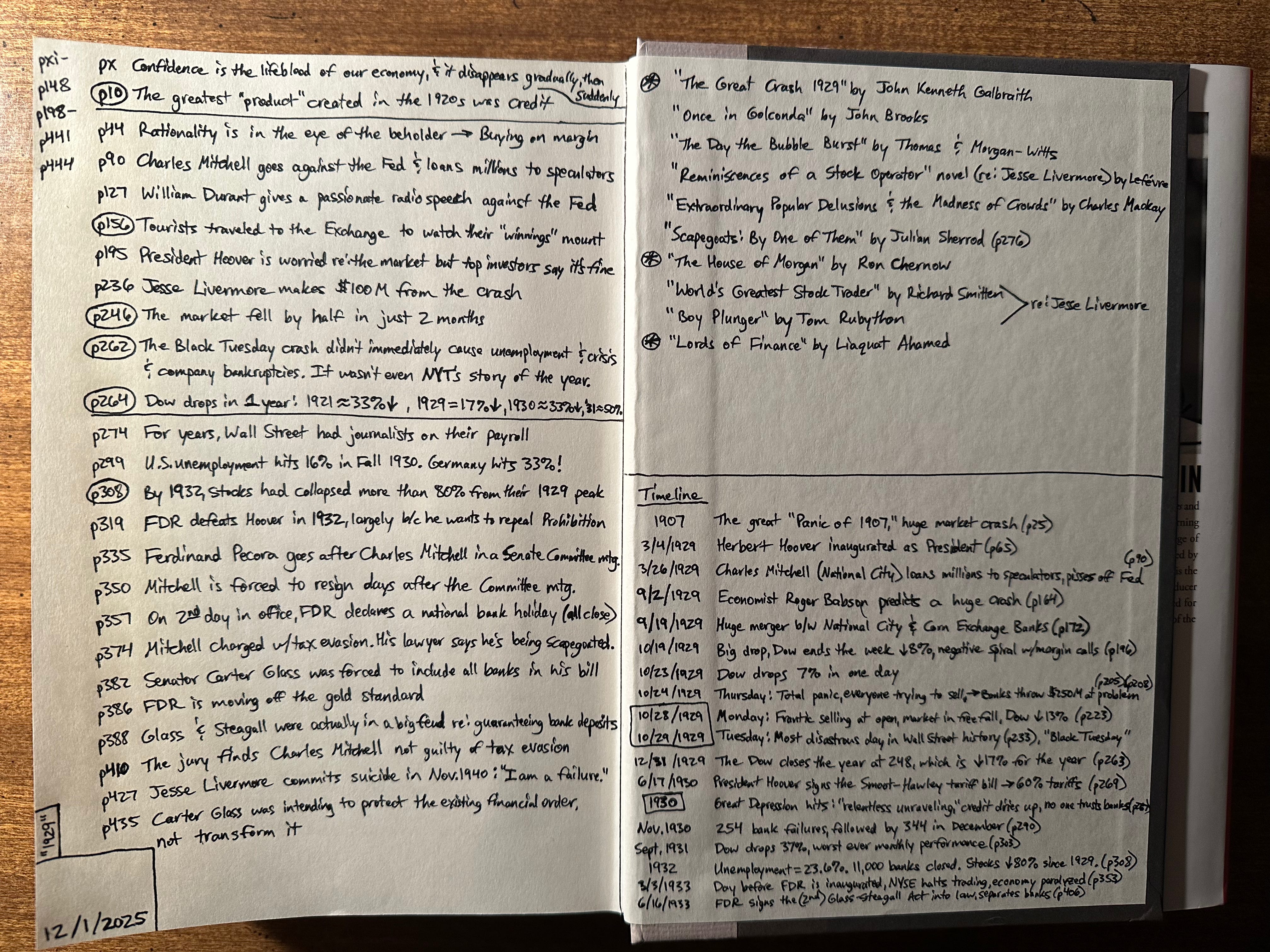
After I started underlining books and writing in the margins, I took it a step further. Now, for the past decade, I’ve also been writing notes in the back cover. I jot down my top takeaways, along with their respective page numbers (as depicted below). This creates a powerful one-page cheat sheet I can reference later whenever I want to refresh my memory about that book. Now, whenever I want a two-minute refresher on a book, I just pull it off the shelf and open the back cover. Voilà!
3. Write timelines to put events in context
“That men do not learn very much from the lessons of history is the most important of the lessons that history has to teach us.” -Aldous Huxley
In many nonfiction books like biographies and historical books, it’s helpful to write a short timeline in the back cover so you can keep track of what happened when. This can also help you memorize a few important dates, in case you want to reference those later. (For example, in the picture above, you can see that I boxed a few of the critical dates I want to remember in the timeline.)
4. Argue with the author
“Whatever you do in life, surround yourself with smart people who’ll argue with you.” -John Wooden
As an intellectually independent and curious person, it should be uncommon for you to agree with every single thing an author says. Approach everything with healthy skepticism and critical thinking. When you find yourself disagreeing with an author’s point, jot a note in the margins. Engage in literary discourse with the author through your marginalia.
5. Choose at least one idea to put into practice immediately
“Action without information is chaos, but information without action is a waste. The key to unlocking our full potential lies in finding the perfect balance between the two.” -Pat Flynn
Effective reading is like breathing: you must breathe in and breathe out. You inhale ideas and exhale action. Just like in real life, it doesn’t work to only inhale and never exhale. You must enact what you learn so it doesn’t leave you bloated with unapplied knowledge and facts. Pick at least one practical idea from each book that you can immediately apply in your life.
6. Don’t read while lying down
“…the feel and appearance of a book when combined with a literate person in a straight chair can create a spiritual condition of priceless depth and meaning. This form of meditation…may be the greatest treasure at the core of our civilization.” -Kurt Vonnegut
In college, I fell asleep every time I read my assigned books. My persistent napping convinced me that books must be boring. Like an idiot, it took me years to realize that I was only falling asleep because I was reading while laying on my bed. After I kicked that habit and began reading at my desk, I stopped napping. (Btw, sitting at a desk also helps enable better note-taking. Win-win.)
7. Physical books > e-Books
“Though many people find they can read faster on a device, the distractions, like social media scrolling, advertisements, and email notifications, often hinder memory retention. Physical books provide an immersive experience, resulting in readers who absorb and recall the content more effectively.” -Heather Rose Artushin MSW, LISW-CP
As a big Barnes & Noble fan, I remember excitedly buying the Nook Color e-reader as soon as it launched. I joyfully downloaded a few books and pounded through them, thankful to have avoided adding more tomes to my already-cramped bookshelves. But shortly afterward, a couple of friends asked me what I had been reading lately, and I realized that I couldn’t remember a lick of what I had read. Sure enough, a 2024 article in Psychology Today cites research that indicates reading comprehension is 6-8 times better when reading physical books compared to e-books. If you’re hoping to remember what you read, trust paper.
8. Summarize what you’re reading
“While we teach, we learn.” -Seneca
Almost every day, my wife and I discuss what we’re each reading. I’ve noticed that my first synopsis of whatever I’m reading is often clumsy and disorganized. It takes me a while to distill the book’s themes and takeaways in my own head, so the ideas come out jumbled. But then, a few days later, friends or colleagues will ask me what I’m reading, and each successive synopsis gets more crisp. This act of discussing and synthesizing book takeaways is helpful for the learning process. Look for more opportunities to discuss what you’re reading to crystallize your takeaways.
9. Save quotes and stories in a commonplace book
“Scholars, amateur scientists, aspiring men of letters — just about anyone with intellectual ambition in the seventeenth and eighteenth centuries was likely to keep a commonplace book. In its most customary form, ‘commonplacing,’ as it was called, involved transcribing interesting or inspirational passages from one’s reading, assembling a personalized encyclopedia of quotations.” -Steven Johnson
A commonplace book is a collection of ideas, quotations, or anything else you want to reference later. You can collect such information in a journal, second brain app, or even a box of notecards. Especially if you’re someone who frequently creates presentations, speeches, articles, books, sermons, lessons, or anything else that depends on saved knowledge, I highly recommend starting a commonplace book.
10. Experiment with new genres
“It is well to read everything of something, and something of everything.” -Joseph Brodsky
It’s healthy to peruse other genres beyond your favorite genre. Doing so helps you develop a well-rounded perspective on the world—and it also can help you make connections between disparate worlds. More times than I can count, I’ve accidentally stumbled across the same person or event in multiple books around the same time, and the experience gave me a fuller understanding of that topic.
Example: President Lyndon B. Johnson came up in a book I read about social justice (because he signed the 1964 Civil Rights Act), then he also popped up in a U.S. history book, then I read an entire biography about him, then he came up again in a historical novel. The result was a latticework of information about LBJ that helped me understand him from multiple angles.
It’s okay if you don’t remember a bunch of facts after finishing a book. After all, the purpose of reading isn’t memorization, it’s osmosis. The concepts later ooze out of you in unexpected ways—taking the form of ideas, philosophical perspectives, or even changes in character.
The ten practices above will improve this osmosis process while also aiding your overall reading comprehension. Give them a shot to see which tips help you most!
👉 Want to receive two posts per week with book recs & personal development tips? I’d be honored if you subscribe to Leader & Learner.
📣 Community Updates by Glasp
🟥 Glasp Talk with Bobby Powers:
Glasp Talk features intimate interviews with luminaries, revealing their emotions, experiences, and stories. The guest, Bobby Powers, is a dedicated learner passionate about leadership and personal development. With over a decade of experience managing teams, leading onboarding, and Learning and Development programs at various startups and SMBs, Bobby is also an avid reader, having read over a thousand books in the last 15 years.
✨ Want a concise summary before diving in? Install the YouTube Summary with ChatGPT extension by Glasp for instant video summaries!

🟦 70,000+ Unique Kindle Books’ Highlights Imported to Glasp:
Glasp users have now imported Kindle Highlights from over 70,000 unique books 🎉 This milestone shows how quickly our shared knowledge base is growing. If you’d like to import your Kindle Highlights, please see the tutorial here.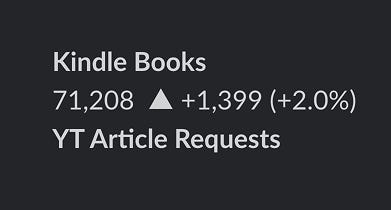

Would you like to take Glasp on the go?
With the Glasp mobile app, you can highlight and organize your favorite content anytime, anywhere. Stay productive on the move and never miss an insightful quote.
Partner With Glasp
We currently offer newsletter sponsorships. If you have a product, event, or service you’d like to share with our community of learning enthusiasts, sponsor an edition of our newsletter to reach engaged readers.